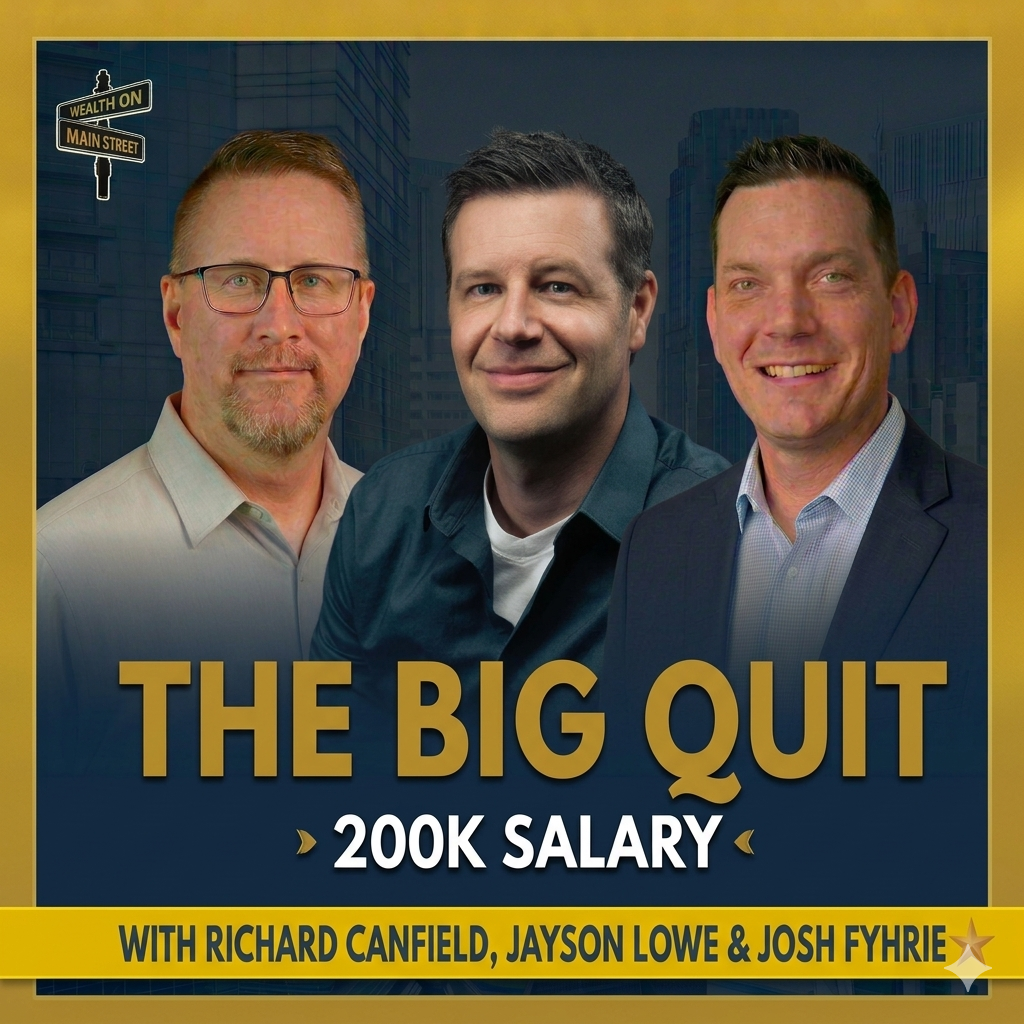
Episode Transcript
[00:00:00] Speaker A: Foreign.
[00:00:11] Speaker B: Welcome to wealth on Main street, where conversations about growing your wealth are fun and entertaining. Wealth isn't just about money. It's the skills and the knowledge that we develop to pass on to future generations.
Tune in each week to grow your mindset and your net worth at the same time.
[00:00:36] Speaker A: All right, I want you to imagine this for a second. So you spent 23 years building a career, and you're earning 200,000 plus a year, full benefits, unlimited vacation. You've got equity in the business.
Basically the thing that everybody says that they want. And then one day, you walk away from all of it. And it's not because you had to. It's because something just didn't feel right.
And I think. I mean, most people don't do that.
Not because they can't, but because they won't.
Walking away from something really good and, you know, in an attempt to find something even better that can mess with your head just a little bit, it's. It's kind of like leaving a perfectly good steak dinner because you think there might be sushi somewhere else.
It's a pretty risky move. But our teammate Josh, our guest today, he actually did it. And what's really fascinating, especially to me, is that it wasn't. It wasn't money that held him back. It was, as he's shared with. With myself and his teammates on a number of occasions, it was meaning he had success and stability, just didn't have the fulfillment. And so we're going to talk about that. We're going to talk about what it actually feels like to walk away from something safe. And I think what most people get wrong about success and how really applying a different way of thinking about money can actually change the decisions that you're willing to make throughout your life. And by the way, if you're watching or listening and you're someone who's been doing all the right things, but still, something feels like it's missing. I can promise you this episode is going to hit a little closer than you expect. And so before we dive in, hit the subscribe button. Follow the show wherever you're listening or watching, because conversations like this don't come around every day. So let's get into it. Josh, welcome to the show.
First question for you. Let's start with something I shared before we even hit the record button. So, 23 years, $200,000 in income. Why walk away?
[00:02:51] Speaker C: The word that comes to mind is unfulfilled, but I don't know if that's the best word for it.
But that's how I felt when I really took a step back and actually took a sabbatical. I took a month off just to see what it's like to not have to work and really just like, you know, kind of figure out what I wanted to do next.
[00:03:18] Speaker B: Yeah, trying to figure out what you wanted to be when you. When you grew up, sort of a situation.
[00:03:24] Speaker C: Well, I always thought I knew what I wanted to be, and then it changed, you know, like, yeah, I.
Nobody really knows what they want to be.
Sometimes something new organically just comes in and then all of a sudden you confused on where to go from. From here. And I think they call it a midlife crisis. And I'm about, you know, I'm a little past the midway point.
[00:03:46] Speaker A: And so from the outside, like, everything looked great, but what didn't people see?
[00:03:51] Speaker C: You know, when I. When I first got into the insurance business, I was a. I was an agency owner and I loved having. I loved running a business. I loved building something. So it wasn't so much like, you know, I loved insurance. And when I say insurance, it was property, casualty, auto, home, business, work, comp. That kind of stuff. I loved being a business owner and I loved building something.
When I sold that agency, I. I became an employee. So what I did is I actually partnered up, is what they call it when you kind of roll up into a larger agency. And I did it for a lot of reasons, but, you know, mainly it was for expansion.
But nonetheless, that changed my title, that changed my role, and I didn't realize that at the time, how it would change the feeling of doing the exact same thing I was doing, but taking out that ownership, that. That builder component of it.
[00:04:48] Speaker A: Very, very interesting and super interesting.
[00:04:50] Speaker B: Yeah.
[00:04:51] Speaker A: So what, I guess what did that.
What did that moment make you realize about your own work?
[00:04:58] Speaker C: The work itself was.
It was financially fulfilling. I mean, you know, the money was there.
And actually I could relate it to, like, a story I remember. So my wife is in a different line of work. She's always been in the helping people line of work. I mean, she went from teaching daycare to being an academic advisor at a community college, to being an advisor at a university to. And now she's a occupational therapist. So in her career trajectory has always been about helping people.
And I remember one time she came home and she was talking about how grateful her clients were and, like, how they're always so excited when she came over and she'd help them out and, like, she was changing their lives. And I realized, well, actually, what I Did is I made a joke. I said, oh, yeah, I had a couple of clients say the exact same thing to me today too. And, you know, we laughed about it and it kind of like it stung a little bit, but it resonated with me where I'm like, here she is making a difference and changing people's lives. And I'm over here making good money, but not really making an impact or really adding the value that I guess I could be, you know, or I guess that I wanted to be.
[00:06:16] Speaker B: Wow.
[00:06:16] Speaker A: And so where did infinite banking come into your life through all of this?
[00:06:20] Speaker C: It's a long story. Are you ready?
[00:06:23] Speaker B: Yeah.
[00:06:24] Speaker C: All right.
So in the insurance industry.
I've been in the industry for 24 years and about 12 years into it, you know, I kind of thought I knew everything. I was an agency owner, I knew everything.
I actually had an employee that was taking these classes to earn insurance designations. So the letters behind people's names and he was doing that, he was an employee. And so I thought, oh my gosh, I'm missing something here. I should check out what he's doing. And so I started taking classes and I signed up for one and it's actually kind of funny. So the first class that I took was called Agency Operations. And I thought, this is going to be easy. I'm an agency owner. Like I sat in the back of the class, I didn't really take good notes and I took the test and I failed it. And so it was a big eye opening experience for me where I realized like, I don't know everything. Just because I was doing something in a role doesn't mean I understood everything about, well, like, I guess just what people teach and other aspects of it. And so, yeah, big eye opening moment. Like you don't know everything.
And so I actually started taking this designation process very seriously. And I ended up getting like five or six designations over the course of like five years.
And I failed another class. And so in this group of designations it was called a Certified Insurance Counselor.
One of the modules that I failed was like Commercial Casualty 2.
And my intention was not to take the Life and Health class, but since I failed that one, there's one other one that I could take to kind of like keep on the trajectory. And so I ended up taking the Life and Health, which is something that I wasn't really doing that much in my career.
I would sell term insurance here and there whenever it was needed. So I understood that product, but I just kind of wanted to like skate past that class in that Class, there was a guy named Charlie who was a teacher, and he was so passionate about life insurance. Like, I remember in the class, he would be walking around and he was, you know, kind of overweight, and he'd have a towel around his neck to wipe the beads of sweat off of his forehead because he'd get so excited when he would talk about something and then, you know, kind of like drop the knowledge of truth, like, life insurance can solve this and life insurance can solve that.
And at the end of the class, he gave everybody in the class, there's probably 50 of us, a book, and it was called Tax Free Retirement.
And so I read that book, and all of a sudden I started looking at life insurance and the different products within that category of life insurance in a completely different light.
And that kind of started my deep dive high fact finder investigation on what is here that I don't know about that Charlie was so passionate about in that class.
[00:09:19] Speaker B: It's interesting the way you talk about the teacher and, and how memorable he was as a character, as a person, and the experience that it made an impact on you. And also kind of you thinking about your conversation with your wife and the impact she was having and the concern of, well, why am I not having that impact? And so not only did he start you on that journey, there's also maybe a connection point between how he showed up sort of larger than life and was so passionate about something.
And, you know, here you are now on this podcast today, entering a role that you're passionate about in a different phase of life. So there's kind of an interesting, like, circle that happens there.
[00:09:56] Speaker C: Yeah. And it's, it's really interesting when I look back on it.
I was trying to avoid taking that class, and that class ended up setting me on a trajectory. And that was probably 10 years ago, but that trajectory eventually landed here.
[00:10:12] Speaker A: That is so good.
So when you, when you learned about ibc, was it the process or was it the certainty that it gave you that made that difference?
[00:10:22] Speaker C: So to, to kind of go back to that story when I initially read that book, because as you guys might know, that book is not ibc. I mean, that book is using a tool for tax free retirement, or so they say.
You know, I did a deep dive. I, I spent months trying to understand, you know, what's the best tool, you know, is it a universal life? An index, universal life, A whole life.
I, I actually bought an IUL back then, thinking I would underfund it then and then catch up when I sold my business because one day I always knew there was going to be an exit. You know, like anytime you have a business, there's a couple options you have, like, you know, go public, which wasn't an option, hand it down to a family member, which I wasn't really counting on, or eventually sell it. And so I knew that that was what I was going to do. I just didn't know when.
And so, you know, I, I started researching different stuff. Well, after I had that policy, actually, I was listening to a podcast by Joe Rogan, so nothing in the insurance industry whatsoever. And I remember I was on my mountain bike climbing up a mountain and I was listening to Joe Rogan talk to somebody about like longevity, like human life expectancy. And so he was talking to a scientist and they were talking about how they have all this different technology that in a few years from then they're going to be able to expand, you know, the lifespan of most humans, like 10 or 15 years.
And the light bulb went off on my, in my head where I was like, oh no, this is not the right product for me because I understand how it's architect, you know, how it's built. And I know that every year that you live, the cost of insurance drains the cash value of that policy. And so that was actually the moment when I realized, like, this is not a good product. I should not have this. And so I kind of pivoted at that point and I started looking into these other products. I mean, I spent months trying to wrap my head around premium financing, like, you know, methods like what, you know, different agencies like Kaizen promotes and stuff like that. And there was just, there's a lot of noise out there and, and it really wasn't until I found someone that I, that I felt like I trusted by listening to podcasts. And I started looking at whole life and, and then it just all made sense. Like, you know, I came to the conclusion that there's no risk there and know all these other products are adding risk to the equation. And so at that point I kind of knew, like, okay, I found the product, but it took me a long time. Like I, I would be a terrible prospect because it took me all this time to like do my high level fact finding before I arrived at that conclusion on my own.
[00:13:11] Speaker B: It's important to recognize that you, you did have to land on that conclusion at your own. And, and everybody needs to go through whatever their process is and that I think it's important that you identified the process you went through. And there's probably someone Listening, who's got a similar experience.
Maybe they're a client and they kind of took a long, more involved journey. And then there's guys like Richard who are like, oh, my God, I read this book.
[00:13:35] Speaker C: It's great.
[00:13:35] Speaker B: Let's go. So you kind of get all these dynamics, and of course you're going to experience that as you're. As you're working and helping with people. But it's so cool to understand that you've isolated what your own journey was, and then you'll be able to see and recognize that in others as well. When you can kind of help, mentor and coach them through if they're in a similar position as you and make sure you're providing them the right resources and also giving them space, because sometimes they need a little bit of space to be able to come about that conclusion. We're always there to help them out. We're always there to provide them the resources available.
[00:14:05] Speaker A: Okay, Josh, I have to ask, the Taco Bell story.
What happened there?
[00:14:10] Speaker C: So this was another kind of eye opening moment. And to be honest, like, a lot of the stuff that we might talk about today, I didn't really know, like, I guess I didn't really know myself that well until I started working with you guys at Ascendant.
You know, I've gone through, like, a disc profile, and I did read the strength finder, but, you know, when I first came on board with this Colby index, you know, I know Richard is very passionate about Colby, and I feel like you even like you're like a Colby practitioner or I don't know what you call it.
[00:14:48] Speaker B: Certified Colby consultant.
[00:14:49] Speaker C: Yeah, but it's something that you guys, you know, that you do with everybody that's here at Ascendant. And I started, like, once I saw my results, then I started looking back on these situations in my life where, like, I was putting the pieces together. So that's the, you know, so the Taco Bell incident. So one of my first jobs growing up in Steamboat was fast food, you know, which I feel like a lot of people have experienced working in a fast food environment.
And, you know, they usually start you on the line. And so I would spend a lot of time making perfect tacos.
And so, you know, it's fast food. It's not supposed to be perfect. And so I remember the owner came over to me because, you know, it was kind of a smaller town. So the owner would be there and he's like, hey, look, it's three fingers of lettuce, two fingers of cheese. Like, let's go. Both hands, get the tacos down the line. And it just wasn't. I don't know, it wasn't satisfactory to me. I wanted to make it look good, even though you're going to wrap it up, throw it in a bag, and somebody's just going to eat the taco. And so what happened was it didn't align with who I was. And so immediately they moved me up to the register, which I feel like was a promotion, but it was probably where I was better fit based on my personality.
[00:16:05] Speaker A: And so has that sort of, you know, perfectionist tendency, has it helped you or is that. Has it driven people nuts over the years?
[00:16:12] Speaker C: Yeah, I. I wouldn't call myself a perfectionist. And so. And the reason being is because, you know, I've owned a lot of houses, I tend to kind of be a do it yourselfer. And looking back, I did a lot of the. My own. My own remodeling. And so I definitely spent time, like I've, you know, bought houses, fixed houses, flipped houses, and I did all my own work to know that, like, it's not going to be as good as I want it to be. And so at some point, you know, you just realize, like, unless you're doing it every day, it's not going to be perfect. And so, you know, those are skills that I'm not going to spend time trying to get better at. And so sometimes it's better just to hire somebody else to take that job over and, you know, produce a better outcome, a better product.
[00:16:56] Speaker B: Well, you know, Jason asked a little bit about how infinite Banking found its way to you, but we don't know. How did it transition from you choosing to start the process for yourself to eventually molding into a career change? So we know there was a big, long career in advance, but where was the pivot point where you said, you know what? I think I need to start doing this and helping other people with it? What was the shift that happened there for you?
[00:17:21] Speaker C: All right. I mean, it took a while, as most things have in my life.
So when I first kind of had that realization that this is what I wanted to focus on, like, well, let me. I guess I'll tell you another story. So in January, it was January 1st of 2020, I sold my insurance agency to a larger insurance agency. And when we were going through the due diligence process, we were working with a consultant. My business partner and I were working with a consultant because, you know, this is going to be the biggest windfall of our lives at that time.
So we wanted to make sure that we were doing it right.
And one of the things that that consultant had told to both of us was he said, guys, when you, when you complete this sale and you have this windfall of money, don't do anything with it for six months. Just sit on it for six months. Don't buy anything, don't invest in anything. Like just get acclimated, you know, because we are coming from, you know, we had good cash flow, but we also carried a lot of debt. So I mean, really we're coming from like seven figures of debt to seven plus figures of equity.
And, and so that was January 1st of 2020. And so, you know, I, I put money in an account and I didn't do anything with it. And then what happened In March of 2020, like three and a half months later, you know, Covid, so that's right. Stock market crashes, Nobody knows what's going on. There's fear, there's anxiety. And here I was thinking like, do now. You know, like I, I, I, I wanted to preserve and protect that wealth. I wasn't really looking at putting it at risk. And had I had a crystal ball, I would have just put it all in the S&P 500 and rode the wave up to where it is today with all time highs. And I would have been sitting pretty for now, you know, I mean, who knows after that?
So instead what I started doing was, yeah, like researching these, this concept of infin and whole life insurance, you know, in order to, you know, at the time, I was looking for a better solution than what was out there, you know, because again, I have money sitting in a bank account. I knew I didn't want to keep it there.
So started I.
It's kind of funny when I think of it. So, because I was already a licensed life insurance agent, what I did was I talked to a guy at the time that I was learning from listening to some different podcasts. You guys know him? Nate Scott. Great guy.
[00:20:05] Speaker A: Yeah.
[00:20:05] Speaker C: And I asked Nate if he would be so kind to show me how to build the illustration with one of the carriers that I was already appointed with. It was a mutual carrier so that I could write my own policy without having to give Nate the commission.
So I thought that was a good idea at the time. And Nate was graceful enough to help me go through the illustration. And so I started a policy on myself.
And then I kept learning, kept listening, and I ended up starting another policy. I started one of my wife and I kept learning, kept listening, and then I started a policy on my son, and what happened was I had the tools, but I didn't have an advisor or a coach or an agent that was teaching me the process.
So every year, when my premiums would come due for about three years, I would waiver, and I would have to go back to, you know, Nelson's book or a podcast or do something to get my head straight, because nobody else was doing this.
And a lot of the people in my network are. You know, they're. They're buying rentals, they're investing money. You know, crypto was blowing up and all that kind of stuff. And I thought, I'm a lone ranger over here. What am I doing? Is this right? But I would go back to the book, I'd go back to podcasts, and every time I'd be like, yes, this is good. Stay the course. But I didn't have anybody to consult me or bounce ideas off of because I was my own agent, and I had no knowledge of the process. I just had the tool.
[00:21:41] Speaker A: Yeah, well, if somebody watching or listening feels this, then what's the first step that they should take?
[00:21:49] Speaker C: Should talk to somebody who understands it, who lives it, who can help support them and guide them and educate them, because there is so much education around this.
And, you know, today I talk to people, and it's interesting. You know, sometimes you talk to people who, you know, they've heard about it, maybe their friends are doing it, they feel compelled that it's. It's a good idea.
And. And they'll tell me, like, I already get it. I already understand that. And, you know, it's like, well, that's good for you. Like, I'm still learning, and I'm six years into the journey, but, you know, I feel like people just kind of have that.
Either it's ego or they're successful in other aspects, or they understand numbers, or they have some success with investments, and they just think, like, this is another investment, like, I'm good.
[00:22:38] Speaker A: That is so true.
That is so true. Because it's.
It reminds me of what Nelson would often say. Richard and Josh, you're aware of this. Nelson would say that everything begins with the way that you think. And he said most people in North America don't think past this weekend because most people would rather die than think.
And so when you process that and then you see what's happening out there, mainstream people are doing all the things that mainstream tells them to do.
Take whatever's left over, put it away.
Here's where you may want to consider Putting it away.
Wall street wants your money. Bay street wants your money. The banks want your money.
And you, you run into these people every day that set up these plans and most often couldn't even tell you what they're invested in. They may recall or be able to share some clever name of the fund or an area of the economy that the fund is invested in. But if you ask somebody to walk you through what each one of those businesses do that that fund is invested in, you're not going to get a compelling answer to that question because it's easier just to. We're in a time where set it and forget it just resonates because we have so much going on in our lives.
[00:24:12] Speaker C: I was just going to say, and I feel like there's this perceived status when you can say, I have a wealth advisor, you know, I work with a financial planner. It's almost like you've reached this level in your life where you qualify to have an expert in, you know, supporting you. And I get that. I don't dismiss it, you know, some. It works for a lot of people. But one of the words that Richard says a lot of times, which I love this word, and I didn't use this word until I heard Richard say it, is abdicating the responsibility to someone else.
And so a lot of people will just do that, not really knowing, like you said, what someone else is doing with your net worth, with your retirement. I mean, with something that's so, like, important for, like, for our lives all day long.
[00:25:07] Speaker B: And it doesn't always work out. Hey, sometimes it works out great.
And the problem is when it doesn't work out, it's not always, and often, not even very often the, the person helping them's fault. And when it does work out, well, sometimes it's not because that person really did much of anything anyway. Like, it's very hit and miss. And there are people who are amazing, unbelievable wealth advisors, investment advisors that are out there, but, you know, not everyone is made the same. And the reality is that it's. No one's going to care about your money and your capital and your legacy and your value and your family more than you can. It's not possible.
There are great advisors who may they come really close, but they have their own families and their own things they got to look after. So you have to take that responsibility because you.
No one could possibly want it or own it more than you can, but you have to realize that that ownership must come with responsibility. Like, you have to take it on and I think that our focus as an organization is to help people really come to terms with that.
And I think we do an amazing job as educators. And, Josh, you're really doing an amazing job connecting with people and helping them start to see that, because you yourself have been through that experience in the various stages of your life, and now you're on the other side of. It's like, oh, well, I get why import why this is important. We can help show people how they can pull that control back into their world. And it doesn't mean that they don't still need or want to have another type of an investment advisor or someone else to help them, but they can own the decision process. And often the decision process is the thing that they're handing off to someone else.
[00:26:47] Speaker C: It's interesting. I do a lot of subliminal market research when I play pickleball, so that's been a sport that I've enjoyed playing. And, you know, everybody kind of jokes around about pickleball, where it's, like, for old people. And I don't think I'm that old yet. But, yeah, I do play with a lot of guys who are retired. And I ask them, you know, when we have the opportunities to talk, I say, you know, what do you do? And they're like, well, I'm retired. I'm like, how's that going?
And it. There's not a lot there. Like, it's going so awesome. A lot of times I'll ask him, like, if you could do it differently, would you? And every single one of them says, yes. And so, you know, I start to kind of cue into these insights where I'm like, okay, so that's not working for him.
And it's interesting. When I. When I sold my business, I was. I was 40 years old, and my neighbor across the street from me sold his business the same year. And he was, I want to say he was like, 66 or 67. And I remember him asking me one time, he's like, you know, because we're both talking about selling our businesses. He's like, you're a little young to be selling your business, aren't you?
And what I told him was I wanted to experience the sale earlier so that I could recover based on how the aftermath looks. Because, you know, if people haven't owned a business, they assume you sell a business. You know, you sail off into the sunset, you have enough money, you don't have to work anymore. And it's usually not the case. I mean, one of the first things I Realized was, you know, the, the IRS is going to take a quarter of that, those proceeds right off the bat, you know, in taxes. And that hurts. And I didn't want to, like, wait until I was 65 to experience that because then there's just not enough Runway to recover, you know, from that expense. And, you know, just things that you don't know are going to happen after you go through the process.
[00:28:37] Speaker A: And so I'm curious, like, what, so what changed? So given that you've been through all that and Richard referenced decision making, so when you think of how long you've been an owner of the tool, right, that's used to implement the process of Becoming Your Own Banker.
So what has shifted in your decision making, I guess, financially, like once you knew that you had ready access to capital on demand, on your terms, you're not reducing the value of the asset, you're not triggering any taxable event. Like, once you knew all that, what changed in your decision making financially?
[00:29:17] Speaker C: You know, sometimes I guess we forget that the game should be focused on passive income. I feel like a lot of people are focused on the gain or the perceived rate of return.
And one of the things that I told my son recently was I said, you know, it's, it's not about, you know, accumulating more and trying to add to the pile of money. When you understand that you can recapture more, you know, it almost changes like the strategy of the game, you know, it's not about working so that you can have more. And, and I'll tell you, I, I know a lot of, you know, financially successful, well off people and business owners and, and there's not a single one that I've asked this question to, you know, like, you know, when is it enough? And most people's response is it's never enough.
And so there's this mentality. I mean, these guys, these girls that have way more than I do, you know, their answer is it's not enough. And so that's just kind of like the mindset that's out there. It's like it's never enough. Like you're always trying to add to that pile. And I feel like now where I'm at, like it is enough. I just have to keep doing what I'm doing and everything's going to work out, you know, because it's a different strategy than what other people are doing when they're relying on the market and hoping that, you know, the taxes are, you know, aren't going to.
Well, I don't know. There's a lot of hope. What do you call it, Richard?
[00:30:43] Speaker A: Opium.
[00:30:44] Speaker B: Opium.
Used to say that Wall street and those guys up there in Ottawa, they're running on hopium.
[00:30:53] Speaker C: Yeah, it's true.
[00:30:55] Speaker A: And so, Josh, what would you say to the person listening right now who knows that they're not where they're supposed to be?
[00:31:03] Speaker C: I guess I would say, you know, listen to that feeling and be open to, you know, maybe what.
Just alternatives, you know, like.
So going back to Nate, you know, the title of his podcast was very fitting. It was. If you follow the herd, you will be slaughtered.
[00:31:23] Speaker A: Yeah.
[00:31:24] Speaker C: And, and, and there's a lot of places in life where, you know, if you do the opposite of what everybody else is doing, usually you'll see massive success.
It won't feel comfortable at the time, and you'll question it, but, you know, that's why it's, you know, make your. Make sure you're aligned with, you know, the right guide or people who are already experiencing what you're looking at so that they're.
Hindsight can be your foresight in going through that unchartered territory.
[00:31:56] Speaker A: That's fantastic, Rich.
[00:31:58] Speaker B: You know, you're thinking about, of course, your, Your time in the insurance industry that while it was a different space, but you've. As a business owner, you experienced obviously growing an organization, having employee staff, people working for you, training other people, advisors, sales advisors, all the things that you needed, and taking all that experience, that knowledge, you know, there was a, there was a point where you had that arrival syndrome, and then you move past it because of a few events that you shared with us, thinking about where you're at now and the time that you've spent as part of the ascendant organization, training, learning, growing, camaraderie, teamwork. What, what do you say is, in your experience, what's different, what's. What's interesting or unique about the experience you're having now compared to the previous 24 years you spent in your insurance career.
[00:32:48] Speaker C: Gosh, I don't know. I feel like one of the hardest things for me is, is going from being an expert in my industry to, To a noob, you know, just being new at this.
There's just so much to learn and, you know, at Ascendant. So I guess to contrast that, to maybe answer that question.
In the insurance industry, there's a lot of, you know, it's almost like there's a lot of tenure. You know, there's. There's people who have been doing it for 10, 15, 20, 30 years. You know, they're very successful.
And, you know, at Ascendant, there's a lot of guys that are, and girls that are new, you know, that have been doing it for a few years. And so you don't have these long term advisor roles. I mean, you know, there's a few of them, like you and Jason, you know, out there that have been doing it for a long time who are helping support us. But a lot of the guys in the industry are just, they're just kind of getting started and so there's a little bit of comfort there, you know, where it's just like, okay, I'm, I'm not the only new guy. There are also new people that are here and they're learning it. But yeah, I mean, they've come from different walks of life and they're seeing tremendous success in teaching people this concept. Like, you don't need a long term career in the insurance industry to be able to teach people infinite banking. You know, the, the product itself is, I mean, it's very powerful. It's, it's complex. It's, it's wonderful. But the process can really be learned and taught by anyone who, who has an open mind and really like, you know, a desire to learn and to kind of rethink traditional financial standards or, you know, ways, you know, like everything that we've been taught about money, you know, there, there was a quote and I don't know, I might, I might mess it up. But you know, what if everything you've been taught about money is designed to keep you stuck, Like, I love that, like, that, that sticks with me because it's like, it's a little bit conspiracy theory. Ish. But it's also, there's a lot of truth to that that I realize now, knowing what this concept.
[00:35:06] Speaker B: Very interesting on that note, Josh. Well, we've, we've covered a lot of ground here today. And your first time making an appearance on the podcast, we're excited about the journey that you're on, the people you're helping, and all the experience that you bring while in an insurance industry is now being reapplied to a different layer, a different way of helping people and the impact that you said that you wanted to have. Are you starting to feel like that impact is progressing? Are you, do you feel a difference between the, the guy doing insurance who wasn't making an impact when his wife was to the guy you are today, where you had to actually stand up and have those impactful conversations with clients?
[00:35:44] Speaker C: Yeah, 100%. You know, I mean, the celebrations, you know, in the PNC industry were landing an account and, you know, calculating how big your commission is. And it's different here. Like, the celebration for me now is, you know, the light bulb went off. Like, this person gets it. Like, it's clicking with them. Like they're, they're, they're understanding what this is about. You know, they're taking the time to dive into it themselves. And I'm, I'm teaching them something new. And so, you know, yeah, sure, there's some compensation involved in there, but it's not about the money anymore. It's the impact. It's the value that I'm bringing.
[00:36:18] Speaker B: Well, speaking of impact, we want to think about the impact that you want to leave on the people you care about. And so while you have a lot of books behind you, if anyone's watching on YouTube, not quite as many as Jason, but you're probably pretty darn close. Maybe there's another shelf in the, in the office that we can't see as a high fat finding. I know you're an avid reader, but if we were, if we were reading the story that you left behind, Josh, and it, it was all about Josh the hero, who would you want reading that book?
[00:36:50] Speaker C: Well, obviously my family, you know, my wife and my son. I want to be a hero to everybody that works with me. I mean, I want to use my strengths to help others.
I can remember a long time ago when I was probably in college, I was probably 20 years old.
My dad told me this. He said, the purpose of life is to serve others.
I remember it, and I really do feel like, and I don't want to diminish what I did for the last 23 years in insurance, because every now and then, I do have some clients that are like, you know, I really appreciate what you do. Thank you so much. Like, especially now as I'm going through and, and saying goodbye to these people, letting them know that I'm leaving this industry and, you know, leaving on a high note and making sure that they're, you know, taken care of and there's no friction in the transition there. You know, I do get a lot of gratitude, but that's what I want. I want more of that. You know, I don't want. Just want to help people save money on their insurance or help them when there's a windshield claim that needs to be filed. Like, it's just not significant enough anymore for me.
And, you know, I have a level of cash flow confidence. So, you know, continuing on that road is not What I have to do, like, I get this opportunity to pivot and focus on adding value versus chasing and accumulating more wealth. And so, you know, I want to use one of my strengths in the strength finder is. Is futuristic. And Colby says I'm a high fact finder. So we're all different. And, like, if we focus on our unique abilities to help others, and especially if it's something that we enjoy, I just feel like the world's going to be a better place. So I want to be a hero to all the individuals and the families that, you know, benefit from working with me.
[00:38:43] Speaker A: That's fantastic, Josh. Seriously. Thank you. Appreciate you coming on and. And sharing all that we discussed. I mean, there's a lot of people listening right now that need to hear it. And for people that are tuned in, if this conversation with Josh hit you, don't just move on to the next episode. We want you to do that, but don't just move on to the next episode like nothing happened.
Just sit with it. Because sometimes the thing that makes you uncomfortable is the thing that's actually pointing you in the right direction in your life. And we always say there's no such thing as having arrived in knowledge. There's always something new to learn. And so if you want to keep learning, keep expanding, how you think about what we discussed today, how you think about money and what's actually possible for your life, then just make sure that you're subscribed, that you follow the show and share this episode with someone that you think needs to hear it, because the conversations that we have here at wealth on Main street, they really do change the way that people think, and that's where everything begins. And so, guys, this was a lot of fun.
[00:39:52] Speaker B: Okay? You want to learn how to implement the process of Becoming Your Own Banker? It's easy. We put it together in seven steps, the exact educational path you need to be successful in this process.
Go ahead, go to 7 steps CA. That's 7 steps CA. And get your copy of the report right now.