Episode Transcript
[00:00:00] Speaker A: Foreign.
Welcome to wealth on Main street, where conversations about growing your wealth are fun and entertaining. Wealth isn't just about money. It's the skills and the knowledge that we develop to pass on to future generations.
Tune in each week to grow your mindset and your net worth at the same time.
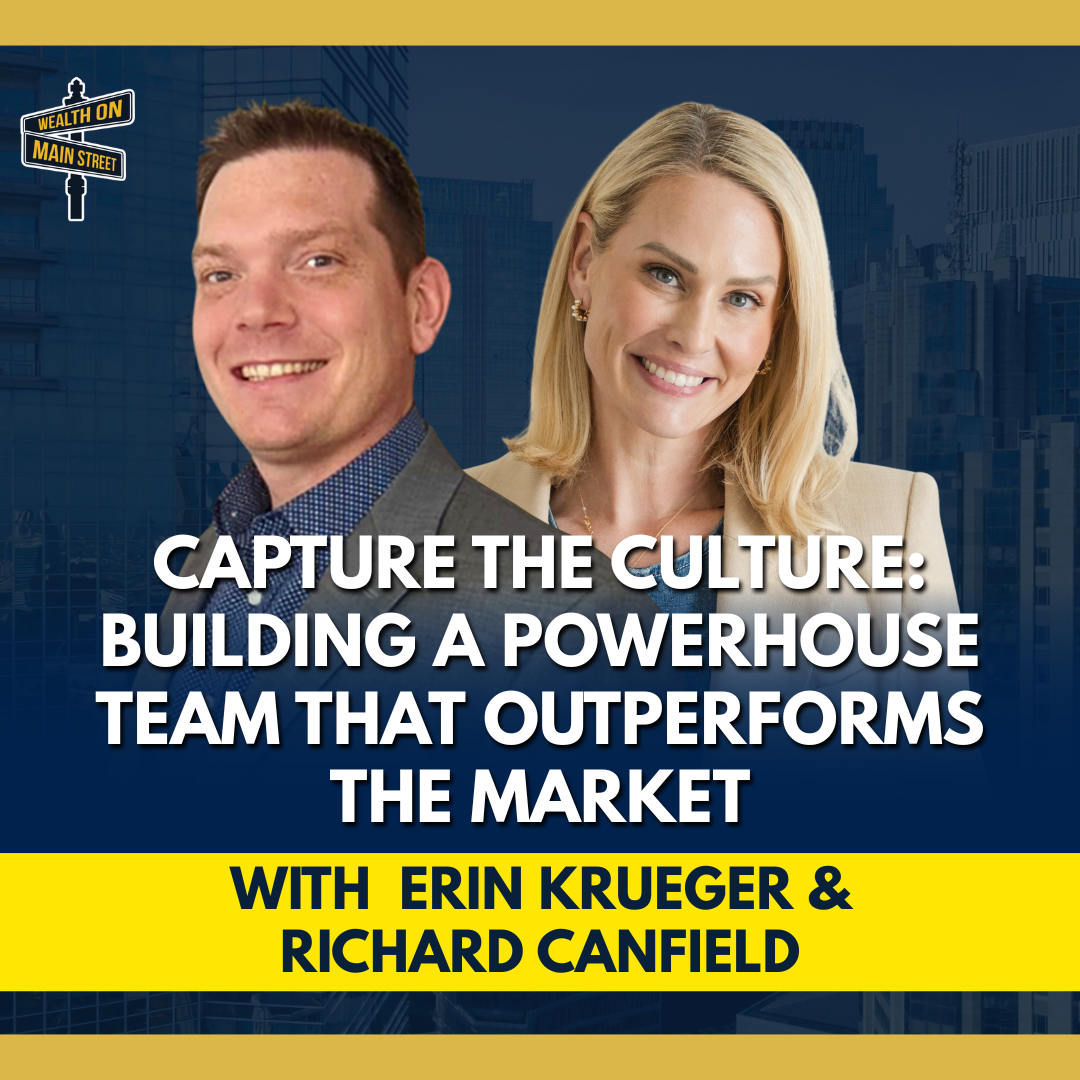
What exactly are the proven strategies to build a powerhouse team and take your business to the next level? Well, we're going to talk a little bit about that today because there's an incredible book that we're going to unpack. Capture the culture, the proven plan to rise above those challenges, build the powerhouse team that you want, and take your business to the next level. Now I ad libbed the subtitle a little bit there, but we're joined by the author of that book today. We've got Aaron Krueger with us. Aaron, excited to have you on the program. Now you lead an incredible team of female ran basically real estate brokerage in Nashville. You've been kicking butt in the real estate there for a number of years. So you got a lot of ton of success stories to share with us both about real estate investing and about the business of running your real estate empire, we'll call it. So welcome to the program today.
[00:01:25] Speaker B: Thank you for having me, Richard. I'm excited to be here.
[00:01:27] Speaker A: I want to dive in right away talking a little bit about the book. So you know how we were introduced was from a mutual friend, a client of mine, Feng Shua, amazing guy who I originally met through a real estate event actually.
And he's been on our podcast, he's written a number of books himself and he's also a great coach to people. So shout out to Fong. And what I'm really excited to hear is, you know, it's not easy to write a book, having done that a couple of times myself. But there's you were called to do this for a reason. So what really was the inspiration that prompted you to put this book together?
[00:01:57] Speaker B: Well, I never sought out to be an author or to write a book. I'm just, I love to sell real estate and I was in my zone. But I am occasionally asked to speak to real estate professionals, investors or entrepreneurs. And I ended up going on stage for an event that, you know, was a lot bigger than I, that I thought when I walked in and I said, whoa, this is a big deal when I got there and I just went up there and I kind of told my story and when I got off I had all these people lined up to talk to me, including a publisher. And he Was like, your story needs to be told. There's a unique thing that you bring to the table, and I think you should share it with the world.
So it kind of got me talking, like, thinking, do I have time to do this? And then I remember one thing that my mentor always told me. If you want to, you would.
So you'll make time for the things that matter most.
And I've always been one of those people that I just love to help other people grow their business. I just. I love it. It fills my. Fills my bucket. And so how can I do that by, you know, helping multiple people without coffees here or phone calls here or zooms here, I can put a book together.
And so I really kind of thought back to the beginning of where it all began. And I'm a farm girl, and, you know, I'm used to hard work.
And you don't. You give it 110%. And, you know, you do it until the job's done. When the animals. If you're sick, the animals still need to be fed, right? So it's like, it's a different kind of perspective that I came from.
But writing it, you know, I learned a lot reading it back about myself. I said, okay, now I understand where I got this from.
Explained a lot. But one of the things that is kind of at the foundation of everything that I do is kind of the culture that I bring to the table. Um, I was in corporate advertising and marketing out of college, and I had a lot of bad bosses.
[00:03:53] Speaker A: Did you notice how even when you said that, there was like, a little bit of, like, you were still trying to get the sleaze off of me a little bit when you said it out loud?
[00:04:00] Speaker B: Totally. Like, I had some bad bosses, right? And I think that good bosses and bad bosses, they're both great things to have because they prepare you for what to be or what not to be.
Right.
And so I use that to say, if I was ever a boss, this is how I would do things differently, or I would take and. And try to amplify this. Right? So there's just different things that I've learned along the way. And one thing that I learned is that if you have a really great foundation and culture is your number one asset, and you keep positivity at the top of the framework of the people that you're hiring. Not necessarily. I don't hire on skill. I can teach you real estate, but I can't teach you to have a positive attitude. I can't teach you how to show up on time. I can't teach you to care, right? So if I can find those people and I can't teach you to hustle, you got to be born with some hustle. I love it.
You know, if I can find those people, I can teach you everything you need to know about real estate, and your dreams can come true. I always tell my team members, if you make my life easier, I'll make your so good. I'll make your so good. You know, I'll give you so many opportunities because I'm looking to simplify my life, right? I don't need to have all of these listings and all of these buyers. I want to give this business to my team members so they can hit their goals and reach their goals. And so that's kind of where I am now. So this book really gives the team leader in real estate, the person who's building team. But honestly, it can help any organization. I've had a vice president of a pharmaceutical company message me. I didn't know them. He said, hey, I read your book. I'm buying it for my entire sales team. You know, it's. It's touching other people beyond real estate, which I never thought would ever happen.
Right. That's a beautiful thing about putting yourself out there. And if you want to, you would. And I did.
[00:05:49] Speaker A: Well, I love that because each business has its own language and lingo and, you know, terminology. The. The products, the services, the tools, the things that you use, the other. The other people you interact with, suppliers and that sort of thing. But the fundamentals of things that are common are always common in business environments. And that's the teamwork, the people, and how that does. And so what I love that you said is that you mentioned culture as an asset. And when people are looking at their assets and liabilities, especially when they're trying to get financing for that next real estate deal or real estate purchase or investment piece of real estate, and they're putting all that paperwork together to get. Get the mortgage broker to go fight and defend, to try to place that loan.
They don't put culture on the asset column because no one really looks at it that way. So your perspective is both fresh and intriguing, but it's also rational. It makes sense that you would need that.
[00:06:39] Speaker B: The.
[00:06:39] Speaker A: The thing that I think is difficult for a business owner to determine is how would you quantify that? You know, you can look at the tractor that you've got on the farm, and you can say, that's how much it's worth. And we can put it on the balance sheet. You can look at the piece of real estate and you can get a value on it from the real estate team and you can put that on the balance sheet. But it's hard to put the, the aspect of what that culture is worth in. But if you were to really unpack it and think about how your business is growing or you want it to grow and what has happened when you've been a part of maybe negative or a bad culture, you can quickly see that the degree to which that lever can go up and down almost to an exponential degree as you think about placing culture on your balance sheet.
[00:07:22] Speaker B: You're absolutely right. And I, and I always say that, like people, people can feel a positive environment. So even my clients, so if we come to them and, you know, Nashville, I'm in Nashville, Tennessee. We are a little bit of a softer market now, right, for real estate, great for investors, gobble it up. But, you know, we are a softer market. So to, you know, bring some positivity and say, listen, this is our strategy, this is how we're going to handle this. Be exact in our standards and, and, and bring that confidence and that passion to the table.
That's where the culture is like, they feel our team culture. You know, I always say, I don't want any negative Nellies on my team, you know, or negative Nathan's. It's, it's, it's positive. People, People look for us to be that expert and they're, they're really kind of putting their biggest asset out there for us to go and sell. And so we take it extremely personal and we want to knock it out of the park for them. But it starts with, like, meeting them and like, them trusting us because people are only going to work with people that they know like and trust right at the end of the day.
So for me, I really tell my team members, I mean, they have to be happy because if they're happy and they love what they're doing, they're going to 10x their performance.
We have a small but mighty team. We have 12 people.
We do production and output of a team of 35 or 40.
Now, I'm not one of those bosses that makes you work 24 7. That's not me. But what we are is we are exact in our standards. We are a true team. So we actually, if somebody is sick, I don't worry about it. I got you. I'll be there for your client. We collaborate together. We lift each other up. We talk about our wins, we talk about how we miss some things and how we're going to be better. And we are constantly changing those checklists and we're learning by example. I am somebody who sold two and a half billion dollars in real estate. I've sold over 3,500 transactions.
I do not know everything. I know a lot, but I don't know everything.
And so I always try to teach. Every day is an opportunity to learn more things and new things. And that's why I think I love real estate so much, is that for the entrepreneur, there's no day that's the same.
Right. Everything is changing and you have to learn how to pivot and you have to keep motivated, especially in soft markets when the rate shot up years ago and I mean people were like canceling contracts left and right, the market just went quiet. How do you keep motivation, you know, with your team members when the check is going to be zero at the end of the month? Right.
You've got to, you got to know where you are. And I'm giving a lot of tips and I have on my website that follows the book Capture the Capture hyphen the hyphen culture dot com. There are free quizzes on there that kind of have you take a little test about where you currently are on the culture spectrum. Right. Do you need some work? Maybe you think your culture is great. Maybe your team members don't think it's so hot. There's also anonymous surveys on there that you can send them and do a culture check, a little culture audit. It's really important to know where you are because just like a foundation of a house, if your culture isn't right, it can crumble and it can crumble during hard times.
And that's what the true mark of a team is, is that you rise above and you really knock it out of the park and you gain market share during these difficult times and, and time and time again. 2024 was a really bad year. Our best year ever. 2025, even harder year.
And it will be even better than 2024. Right. It's, it's not because we added a ton of people to our roster. That's not what we did. We buckled down, we were consistent in what we did. We kept a positive attitude even though all the noise outside was negative. And we ended up doing what we said we were going to do for our clients.
[00:11:11] Speaker A: Yeah, I love that. Especially love the analogy of, of course, that you can't build a proper house on the rocky foundation. And, and you know, having been in real estate myself, I Was a licensed realtor for about 10 years in Edmonton, Alberta. And I remember in a collaborative way, coming in to help a. Help a colleague who was out of town. I said I would help him out. It was a home inspection book for a real estate investor. Property had an up, down, you know, suited area. You know, top level and bottom level. And near the end of the inspection, we actually pulled back some insulation that was available and open. So we weren't, you know, didn't. Weren't ripping drywall off. We were able, because you just literally move it with your hand and boom, right in the corner, there was a. There was a pretty sizable crack in the foundation. And we're like, cool. Great inspection over. Everybody out of the house. You're not buying this property. You know, I just like pulled the grenade right there. Like, you're not. You're not capable and knowledgeable enough how to solve this problem while it can be solved.
That's not the circumstances of which you're buying this deal for. And so we were able to pack up and leave and kind of exit early. But that.
The key element that I think is there is that you have to do an inspection when you're buying a new property, when you're buying a new business, or when you're adding new things into your business, you might want to do an inspection to check in point. That's what those surveys are for. But similarly, even if you've owned the house for 30 or 40 years, you have to keep up with the maintenance. You know, how many deals have you gone into and sold where someone's buying it because that property is poorly maintained and they smell a deal is there? Well, that might be your business. If you're not maintaining the property yet. The property that's solid, it's been there a long time. It's got the new roof, it's got the new furnace, the new, you know, heat pump, all the things that you need. It's got the air conditioner. Everything's been looked after and is well maintained. It has a solid structure. When you walk into a home like that, you can literally feel it when you walk in. The difference of how it's taken care of. That's the perspective that your culture is bringing to the business environment.
[00:13:01] Speaker B: Absolutely. And I think that, like you said, you hit the nail on the head when you said, you know, you have to check in even after you think it's great. Because. Because even these ebbs and flows in the marketplace, they. It can also be a recheck. You got to check in with your people. I'm constantly checking in with my people, kind of seeing where they are with their bandwidth is right out. Like personal situations outside of work can also, you know, determine them. I mean think about this like you know, if you're flipping a house or if you're renovating a property and you've got these vendors that rely on, you've been working with for years and years and years and you can count on them. All sudden somebody shows up intoxicated, somebody's, you know, there could have been a death in the family, there could have been a divorce. That's going on probably. There's stuff that's going on in the background, right. That you're now seeing at work. And you have to course correct, you have to have that hard conversation. And as leaders and as business owners we constantly have to have these check ins whether they're 1099 contractors that you're working with or their employees and, and you have to be able to have hard conversations. That's what leadership is all about.
I believe that if you have direct communication and come from a good place. Right, you come from a good place and presentation of that conversation is very important.
You know, you can really see some major changes in the positive way. But if their attitude has changed, there's not a place for course correction. It's perfectly fine to say that you are a wonderful person, but we're not working together anymore.
Right. You've got to protect the culture, you got to protect the product of what you're doing. You can't have somebody showing up to a job site that's intoxicated and showing up late. Right. Or a team member that's got a bad attitude and their performance now suffers and they're being fired from listings or whatever. You know, it's just, it's the same situation. And so as leaders we have to be able to check in, know the pulse of our team so we can have good results. It's like command central.
[00:15:00] Speaker A: Yeah, I love that. And of course that's going to lead towards more referrals, more reviews and things. I know for us we've, we've really been focused on asking for and seeing if we can get them. Of course, you know, Google reviews, the result of that is we have well over 15005 star Google reviews across multiple locations for our, for our business and that's just growing and expanding now that we also help and assist people down in the United States. In fact we have a couple of our team members who are in the Tennessee area and you Know, it's, you know, talking about growing up on a farm and where you got some of that hustle, some of that kind of gumption, some of those, like, hard work skills that you can only really learn on the farm. We just recently launched one of our most recent books called Growing youg Own Capital. And that's all about trying to maintain and keep the family farm where it belongs, with the family, rather than seeing it gobbled up by some of these large players.
And part of that has to do with making sure that there's a financial element that makes it something that can be successful. Because a lot of the reasons that these farms fail, and you've probably been involved in some of these real estate transactions where, hey, we're taking these chunks of land and we're parceling it out because there's a higher and better use for the land now. But also the only reason that conversation comes up is because the next generation doesn't want it. There's no one to step in and take over and carry on that legacy. A lot of times, I think what's happening, and I'd love to check your thoughts on this, is that as farm and technology developers, people growing up on farms, they probably remember, sure, a lot of the fun elements, but they remember a lot of the work. But they also remember a lot of the stress. Hey, when the market price shifts, when all of a sudden, you know, there's a drought or there's a flood or there's a this, it wipes out your crop.
The market price, you know, for cattle shifts, like all these things change. And then you go from having a good year to a bad year, good year to a bad year. And it's just this ebb and slow, the swinging pendulum. And it puts a lot of financial pressure on the backs of those running the farm. They still got to do all the same amount of work, but there's this hugely unknown outcome that is not always at their control. And I feel like the younger generations that are. That are growing up on these farms are saying, you know what? I don't want to have that pressure in my life. I don't want to be around that, that environment of that pressure cooker. Maybe there's another path for me. And my gut tells me that's a reason why we're seeing some of these family operations start to kind of go the way the dodo bird. So I'd love to get your thoughts on that.
[00:17:19] Speaker B: You're completely right. I mean, I've seen it so often that the kids want nothing to do with the farm. They want to create their own path and in life.
And then at the end of the day, to the owner of the farm, the farm is worth way more money split up. And the dream that they work so hard on is now, you know, parceled out.
It happens so often. I do think that the biggest shift that we're seeing is that the children that do stay on, they embrace the technology element of farming and that is the ones that really bring it to the next level. Right. And so, I mean, I was, I was out in Kansas just because, you know, obviously I grew up in farm. We have friends all over the place and they were showing me how their tractors are all ran like nobody's manning them. It's all computerized. I mean, these are combines that are, you know, a million dollar, half a million dollar, whatever it is, you know, they're just not manned. Like it's all being taken over with AI and technology, which is bringing an element of working smarter, not harder.
And I think that when some people understand that and they can financially do it, and not everybody can, but that's where I'm seeing the younger generations, like stick in it because they're seeing, okay, wait, I can be useful here. I can bring something. We're not doing the same old thing and I'm bringing a different element to the farming business and elevating what our family has. That's the big change that I've seen where I've seen the younger generation stick around.
[00:18:52] Speaker A: Well, and it's interesting too because there's, there's another element of that where the reason and the need for that technology to, to come into, into play. Like there has to be a problem first for someone to solve the problem. There wasn't a problem then. No one would have solved it with that solution. And the problem is, it's how do you find a way to scale when you're a small operation, when you can't even afford to hire the right people. And, and there's a job market crunch where you can't find people to work for what you're able or willing to pay them on the, you know, there's, there's all these elements where it's like, cool, we need to find a way to solve this. Where it's not a people solve because the people aren't available. We can't find and attract the people to do that work anymore. I can't, you know, force my kid to work on the farm if they want to go get a career as a police officer or you know, firefighter or something like that. And that's their path. That's what they want. Well, then what does that leave me? I don't have that help internally anymore. I have to find some other external mechanism. Hence, there's a way to solve that problem. And, you know, we talk a little bit about some of these things and the impact and some stories about how farm families are impacted through all these changes that have happened, not just in technology, but really in the financial sector with our book grow your own capital. So you go to growyourowncapital.com to learn all about that. But the key thing is that if we can structure the financial element, much like what you're helping people do with culture in your business, and that you're now sharing those. Those learned skills with other people from different industries. But also just the way that you're help your existing clients and investors in your localized market, there's a way to start to bring that conversation about how to have more control and autonomy over your life, your business, your household finances at the farm level, so that you can keep the farm in the family. So I would encourage people to get a copy of that book and certainly get a copy of Aaron's, because another element that ties into that is what is the culture that you're creating within the family and the farm? Are you having conversations that actually matter? You know, I also grew up in a farming community, and there was never real conversations about these kinds of things. And certainly for my parents, there wasn't either. It was just, you get up, you go to work, you put on boots, you go move some bales, you feed, you feed some cattle, you feed some sheep, you like, you do all these things and. But you. But there wasn't a conversation about, hey, what is the big picture of us doing? Also, what is. What can this translate to? What does this mean for our legacy? And so we want to bring those types of conversations to the family level so that by having them, we take the idea of money conversations that cause stress, and we turn them into assets the same way that you're turning culture into assets. And it's the same idea of how do you get that culture conversation to turn into something positive versus something negative. So you can build something on a solid foundation, but you can do that at the nucleus of your family. And these types of tools allow you to do that in a powerful way. So I love the book, the concept of what you're doing, I love what you've built, but more importantly, like you mentioned, sold over $2 billion worth of real estate. You've been top one producer in the nation and certainly in Tennessee. That doesn't happen overnight. That happens because you've built some systems and you have the right people in place. Talk to me more about the power of systems that you've created with your business.
[00:22:03] Speaker B: I mean, it's everything, I think. You know, I always tell people when they're like, Aaron, how do you get them to follow the systems? Like, how do you get them to follow the checklists and the processes that you've built? Well, there's no choice. You come on the team. This is how we operate, right? And we're going 110 miles an hour. And I always tell them, I'm going to put a life jacket on you and then I'm going to push you off the boat and you got to start kicking, right? I'm not going to let you drown. That's what the checklists are for. That helps us kind of stay the course. But I think what's really important is that you're constantly checking the checklist, even if the client doesn't feel a mistake happens. But maybe you do. It could have been better. Tweak the checklist, continually change and update and, and be committed to being better tomorrow than you are today, I think is the bottom line. And I remember early on, a lot of people say to me, where do I begin? Right? Like, I'm a. I'm a solo agent or maybe I just have my first assistant or I'm a small business and I just have one person that works for me. Where do I start? Well, everything's in your head at that point because you're just doing everything right. And I always say, get your voice app on your phone and start like, talking through what you do step by step, right? Transcribe it, thank goodness, with chat, GBT and everything that's out there. Put upload it, get it into a checklist form and bam, there's your first checklist download and tweak it.
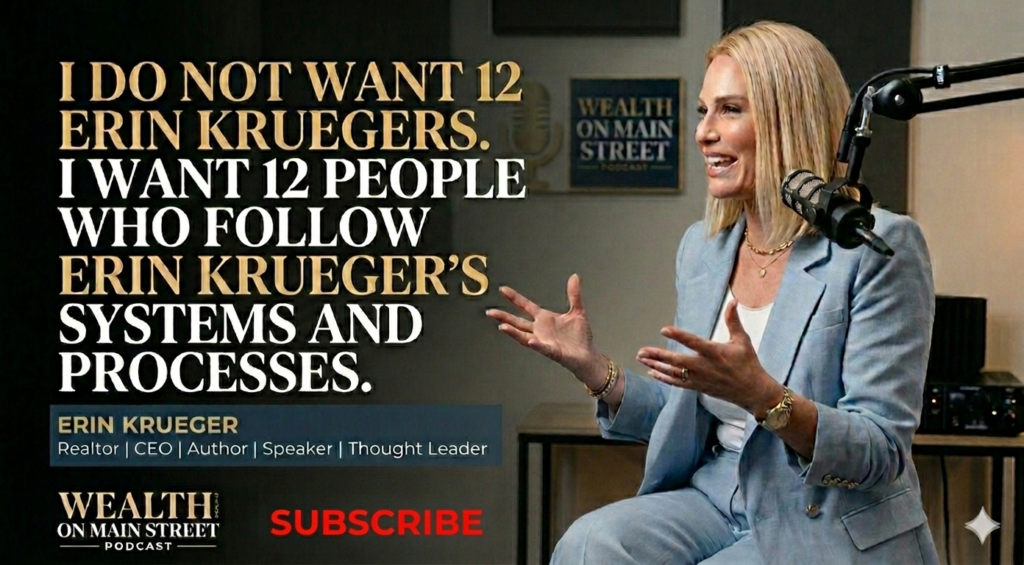
And that starts. And then as you start to do these transactions, as you start to do these jobs, these systems and processes get better and refined and tighter. And I always say to my team members, I do not want 12 Aaron Kruegers.
I want 12 people who do Aaron Krueger systems and processes. And you put your sist, you put your personality spin on it, right?
But it doesn't matter if that client has worked, had worked with me seven years previous or they're working with Georgia now, they're getting the same level of service because they're following the systems and processes and we're not letting something drop.
[00:23:59] Speaker A: I love that. And that makes, makes a ton of sense. I mean, that's the way that you create scale and you create a capacity. And it's interesting you talk about, you know, some of those initial SOPs, write down what you're doing. Voice Note is powerful, especially now that you can do that.
One of the things that I use that I love is a, a tool, a platform called Loom L L O O M dot com. And I mean there's many like it, but that one I particularly like. And you know, if you have the upgraded version, the AI version now, it'll transcribe your video and it'll literally give you the option to click a button that says turn this into an sop. And it's not perfect, but it's a pretty good version one. And version one is where you begin your checklist at. And then you iterate and you let people play with it and practice with it and they will find the iterations for you. So it's a really powerful way. And a lot of times we don't realize what are the things that we are doing naturally and by habit that we don't even know there's actually a step there. We've done a step and to someone else that's a step in an action we take. To us it's just like, oh yeah, that's just something you do. Like we don't. You bypass it because it's almost like the second nature. And so you don't realize there's a golden opportunity, a training opportunity, a leverage advantage that you can use by making sure you explain thoroughly how you got to that result.
[00:25:12] Speaker B: Yeah. And one thing, you know, we love Loom as well and we actually integrate that into our manuals. So for instance, every single position on the team, there is a manual that has to be updated every six months. Right? Because we're changing our processes, we're changing, we're getting better, we're getting stronger, we're adding something to our standard operating procedures, right?
And so they have to go in there and they literally have to update the training manual of their job.
Why is this important?
This is important because, you know, while I love every single team member, things happen.
Having an all female team, somebody could be on maternity leave, somebody has to step in. Now we have an updated training manual, right? This is, this is creating a culture of, of preparing yourself for every situation, right? That if somebody is out, somebody gets sick, somebody can Step in and do the job. There's a manual, there's a checklist. There's something that can help us get it done and done to the caliber it deserves and our clients deserve.
[00:26:16] Speaker A: Well, I think that's powerful and especially in the unique structure of the business that you have because you have basically, essentially a female driven organization that you've created, which is amazing by the way, and super fantastic. But that also comes with maybe an extra degree of complexity in that the risk of a maternity leave is maybe higher in your organization than the average.
[00:26:36] Speaker B: Right.
I have a person out right now and they're coming back in a few weeks, thank goodness. But, but it's funny because for her role, it was flawless. Who stepped into it because of the manuals and because of the systems and processes that we have in place. And that's what it's all about as a team. And I think that, you know, you, you have to start where you are. Like I said, pull out the voice app, get, you know, talk through it, make it better, get it into, you know, Google Docs and, and make it tighter. You know, we are all learning and we are all making this better. There's so many things about building a business that's so beautiful. But then it's like, okay, now I built the business, how do I strengthen it? How do I create new verticals? Right now you're looking ahead. Now you're forecasting like you're doing all of these different things.
You need to get in a position where maybe one day you can actually not be there. Right? That's the ultimate goal. We all want to have, you know, a life beyond the career that we love and we want them to be able to still carry on and this is the way that we create that one.
[00:27:42] Speaker A: That's the next thing I think it's important to identify. We, we often, we've had a number of people who are exit strategists. You know, on our, on our program people have written some great books about that. We have a lot of, we actually have a whole playlist on our YouTube about for that whole thing. In fact, I've got another gentleman, Pete Moore is going to be joining us on a, on a program probably we'll record next month. Similar element, you know, very high focused on exit strategy planning for businesses. And the reality is a business without standing, operate without that training manual, it, it's devalued substantially because you know, I, I think what you've brought up for me, Aaron, that I think would be a good question for someone to ask themselves if they're in business, is will this system or will this training manual or will this SOP survive, essentially, maternity leave, like that should be the barometer by which you're building it. Will this survive maternity leave? Because if a person in here is in that role and they. They go to, you know, spend time with their family and they're growing their own family, which, you know, in my opinion, we should absolutely support, then we need to have someone fill that role, either internally or we got to bring someone in externally. There's no other way. It must happen.
So if you are building your process, your procedure to do that in the same point in time that you're doing that so that you can have continuity in the today world, you're also creating an amplification on the exit strategy. So whether you're the one exiting and you're selling it to some third party, or you're building up someone to take over from within at some point in time, we're both, we can both agree that you and I aren't going to be in the present business that we're in. We're either going to exit because we want to or because we don't want to. And sometimes that happens because we're talking about each other in the past tense. And if that's the scenario, well, then we have an official exit. And will the business survive that or not? That's what those processes and procedures are going to be able to do. But by the impact of putting them together, you're also creating an amplifier for the period of time when you do want to exit. Because a business that has those processes in place is worth far more than one that isn't.
[00:29:40] Speaker B: Absolutely. And I. One of the things, obviously, as I told you earlier, you know, I love coaching people and all that. We're launching a coaching program for team leads, you know, about culture and how to, like, keep that up. But this summer, we're launching succession planning because I have found that real estate agents don't really value their business as they should, and it is worth something.
Some of them just vacate and go stick their toes in the sand and, you know, think, oh, well, I'll stop sending them stuff, I'll stop these touch points, but if they call me, I'll refer it out for 25%.
No, no, no, no, no, no, no, no, no. There are so many things that you can do, you know, to, to continue to have revenue when your toes are in the sand or God forbid, something happens to you and your heirs can still have Something right? And so I have taken, because of my background, one of the things in my book opens up about this is there was an accident. You know, I come from the farm family and my parents were involved in a car accident and died when I was 21. And so here I was left to run the farm, disperse the farm, deal with the IRS at 21 years old. Taught me a lot.
What it taught me you have to have a plan and it, you have to have a plan for everything. You have to have estate planning for you personally, but you also have to do extreme business planning and succession planning for your business because it's worth something.
And so with real estate agents in particular, a lot of them don't think about this and it's worth so much. There are people that will buy your business, there are people that you can join their business and do a step down approach where for a couple years you're with them and the branding is with a new team and then you slowly exit and there's a time period that you get paid on all of your business, right?
There is, there's so much that you can do, you know, if there's a family business and it's a step down approach of how much do they get? You know, maybe they don't want to be a real estate agent. They don't have the love that you have. What then? There's all of these twists and turns and we are building out a really amazing succession course for people to really figure out what's important to them when they decide to retire. But most importantly, God forbid, what happens if something happens to you.
[00:31:53] Speaker A: I love that. I think that's awesome. It's interesting that you share all that because similarly, in this last year we launched the Elite Advisor network, which is highly focused on people in our unique vertical who love and promote the sale and the placement of dividend paying whole life insurance contracts. And that's their focus and that's their baby. And how do they create a bigger legacy that goes beyond just their bank account, something that can not only pass on to their children, but also what's the degree to which they're impacting the families that they love to serve and how are they ramping that up in a way where they can create scale but you also have to factor in, you know, similarly, you know, you have people in the financial planning industry, you think they know about putting their own plans together for estate planning and things. And surprisingly, you know, it's like the cobbler that doesn't have any shoes. It's the same situation that happens and it's common in real estate, it's also common in the financial services industry. And so part of our platform for the Elite Advisor network is to take people who have that focus, bring them into a team and collaborative approach where they can grow and scale their business, create more time freedom, but also start to plan the legacy elements that they've been putting off. And in the first year of our program, we have a number of people who are already in our program that have done really updating wills, they've put in corporate wills in place, they're having family banking meetings that they've been putting off because they haven't been able to get their family together. And they're making these things a critical priority as they roll into the next year. And it's incredible to see the results that are already taking place.
[00:33:23] Speaker B: There's something about some peace that we can have as business owners when we know that we have a plan, right? And I think that's really, really important. I mean we can talk about building the company and the sweat equity and the checklist and hiring the right people, but then when you built it and it's, it's really going, you need to protect it.
And there's a lot of peace that comes with planning.
[00:33:48] Speaker A: Oh man, I absolutely love that.
So, Aaron, you know, I want to do another shout out, of course for the book. It's capture the culture, the proven plan to rise above the challenges, build a powerhouse team and take your business to the next level. You've given us a lot of insights into how to do that and how you're doing it and your, your background from the farm, having to deal with that horrible experience and, and close that chapter to be able to move on in life. You come from a real world experience background to share these things. The way that you're helping not only your existing team but now expanding that to other people I think is quite powerful. And so people can learn more about of course the coaching that you're launching. The book itself, make sure they can get it on Amazon. Of course they can go to your website. We'll put those down the show notes below now before we adjourn for the day because we've covered a lot of ground and of course anyone who's interested in the Lead Advisor network, make a comment on the video below and we can, we can get you in touch with our team about that as well. But one thing, we always like to check in with people and we really firmly believe now all the work, two point some Odd billion dollars in real estate sales and transactions. Over 3,000 transactions.
You've helped a lot of families discover home ownership, move on, change the structure of real estate from farmland to development land. All of these things you're helping investors.
When you, when you think about it, while you didn't show up to our podcast today wearing a cape, it would have been kind of cool if you did, but it's Christmas time, so it's not.
And but you, you are actually showing up to a hero to people. Not just the team that you have with you, but all the people that you now, they now aggregately support. So our question for you is, who would you most wish to be a hero to?
[00:35:26] Speaker B: You know, I think that I honestly would love to be a hero to the young farm kids. I mean, honestly, like, these kids are some of the hardest working kids out there, and sometimes they can be from really rural areas and not realize the foundation of what they're doing now is going to help them so much. You know, I have had people, you know, from Harvard and Ivy League schools and stuff like that, and then I've had people that have not gone to college or state institutions. And at the end of the day, I went to a state school because I lost a scholarship, you know, because of an accident. And, you know, I'm. If the definition of success comes from, you know, the bank account or how many people you've helped, I've done pretty well, right? And then I know people that have gone the Ivy League route that, you know, maybe are not right. And so it's not about that. It's about really finding what you love to do and really giving it your all and putting in 110%. You know, when my dad handled, handed me, you know, the tool to go cut the thistles in the fields, I, you know, I'm like, ugh. You know, my hands would be have calluses and then probably bleed, like, because he's like, don't leave one thistle behind, you know, And I'm like, oh, gotta get all these thistles out, you know, or bailing hay in 100 degree, you know, heat where you've got long sleeves on, because if you have short sleeves, you're going to get cut. You know, that it's all of these things that you learn that are going to help you be such a better boss, be a better entrepreneur, and actually be a better human. So I will say this, that not every day is a good day, but all of these difficult days do not define you. It's what you do with them that matters most.
[00:37:15] Speaker A: I love that. That's fantastic. And you know, circling back to the farmers, I'm glad that you identified that, you know, because a lot of people who are on farms, they grow up there, they don't necessarily learn or understand that the farm is a business.
Totally. And the business lessons that you I talked about with Realtors and you know, etc, the same business principles apply to the farm. But often the farm family isn't treating or looking at it like a business and they need to and you know, shameless plug. But if you want to learn more about that, actually a great book is growing your own capital. You can go to growyourowncapital.com get a free copy if you want today. But don't just get that book. Make sure you check the show notes and get a copy of of the incredible culture book that we talked about today with Aaron. Aaron, thanks for being on the program. We appreciate it so much. Those of you of course watching on YouTube, which we recommend, always watch on YouTube. You're going to see that magically another video just appeared. It says, oh my God, look at that. It's incredible content. So go ahead, click through it and check out that amazing next podcast episode. Thank you so much. Check out our upcoming events. Could be a live webinar or maybe a live event in your area. Register now by going to wealthonmainstreet. Com events. That's wealthonmainstreet. Com events.