Episode Transcript
[00:00:00] Speaker A: Foreign.
[00:00:11] Speaker B: Welcome to wealth on Main street, where conversations about growing your wealth are fun and entertaining. Wealth isn't just about money. It's the skills and the knowledge that we develop to pass on to future generations.
Tune in each week to grow your mindset and your net worth at the same time.
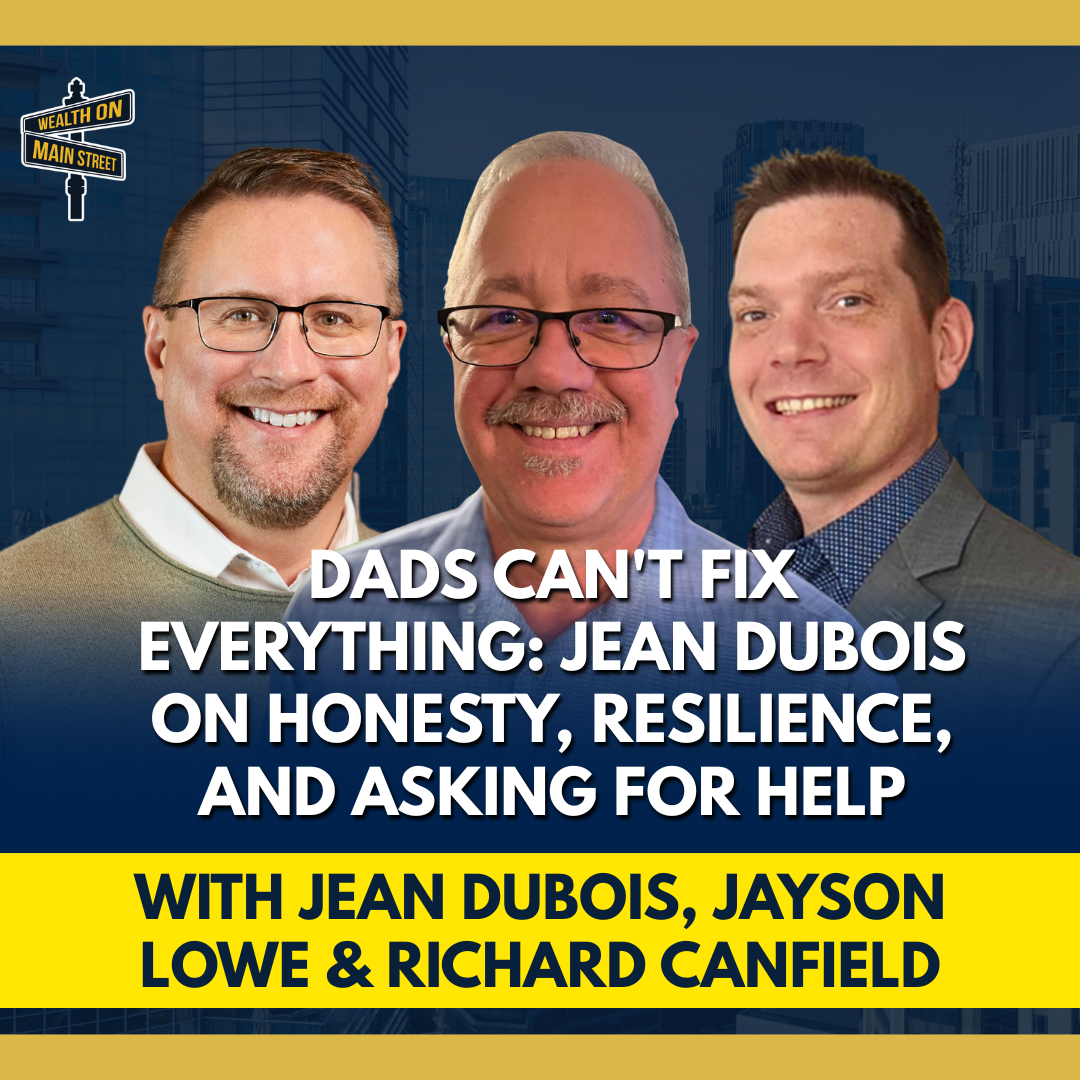
[00:00:36] Speaker A: Most dads grow up believing in one thing, that if something breaks, you fix it. If someone's hurting, you protect them. And if your family needs stability, you find a way. And what happens when life hands you something that cannot be fixed is something where today that conversation is going to go there. And our guest is Jean Dubois. He's a father, a husband, the author of Dads Can't Fix Everything.
Richard and I have known Jean for many years.
His life was forever changed with the loss of his oldest daughter to brain cancer. And instead of pretending that strength meant having all the answers, he chose something far more difficult. Honesty and presence and resilience. And for the past eight years, Jean has also been implementing the infinite banking concept as a framework for stability, for control, for peace of mind when life is anything but predictable, as we all know. And so this is not a conversation about fixing life. It's about showing up. It's about building certainty where you can and learning how to carry what you can't change. And so Jean, Rich, and I are incredibly grateful that you're here. Welcome to the show.
[00:01:51] Speaker C: Thank you. Thank you for having me. I much appreciate it. I'm grateful and honored. Thank you.
[00:01:55] Speaker A: And your book is titled Dads Can't Fix Everything. And the moment that you had shared on the Facebooks that you were launching this, I had reached out and said, john, we got to get you on the show. And given that that's the title of your book, what moment or realization made you understand that this wasn't just a title for a book, but a truth that. That other dads needed to hear.
[00:02:22] Speaker C: Yeah. So what. What drove me to this was a few years ago, about three years ago, I saw an article or read a story about a guy who was having a really tough time as a dad. He felt inadequate, and he felt like he wasn't providing the way he could, not just financially, but physically being able to be there for his family.
And I thought to myself at the time, you know, I've been there, you know, and I'm sure a lot of others have.
And I. I just had this thought that, you know, maybe I should write about this because it, you know, it might be helpful to somebody else.
So I wrote about two or three chapters, and it kind of sat for a bit because I thought to myself, well, who's going to read this? You know, like, who cares? I'm just a regular guy. I'm one of how many millions of other dads out there and maybe in a similar position.
But then I read a book by Jen Gottlieb called Be Seen. And her mantra that she describes in the book is hope. H O P E. It stands for help one person every day.
Which kind of got me to think about it more. And further reading in her book, she described how important it is to tell your story.
Doesn't matter if it's for.
You're not trying to reach millions necessarily, even if you help one person. That's the, that's the main. That's the important part.
So once I read that, that kind of pushed me to not necessarily push me, but it was that little, I guess. So I guess it was a bit of a push, right, to get me going on this. So I, I wanted to be more focused. So I actually took some time to, to write instead of trying to write after work. And if you're tired, it's not the same, right? You not as creative.
So I, I spent, I took a week off, locked myself up in a hotel room in Pigeon Lake and just wrote.
So I was more inspired then able to write. More thoughts come to me and the more I wrote, the more ideas came to mind. And that's how it, that's how the book came to be.
And the title itself, it wasn't, it didn't initially come right away, but I tried to think of something that people are, are dads are stuck in a certain thing and they can't fix something. I said, well, that's right. Dads can't fix everything.
So that title stuck with me and I decided to use that as the title of the book.
[00:04:46] Speaker A: That's so great.
[00:04:47] Speaker B: I also think it's interesting because even from my wife, of course, I often have to make sure I check in. Is this a fix situation or a listening situation?
And I'm sure anyone listen, anyone listening has had a similar experience to that. Right, Jason?
[00:05:01] Speaker A: Oh, yeah.
Oh, yeah, absolutely. And. And when you, when you think, you know, John, I mean, just in terms.
[00:05:12] Speaker C: Of.
[00:05:14] Speaker A: If you could, if you could speak to a dad, you know, directly who's, who's listening or watching right now, who feels that pressure, right? That pressure to, to fix everything.
What's the difference between trying to fix life and preparing for it? I'm curious what your perspective is on that.
[00:05:39] Speaker C: Well, I think the, the hardest Part for a dad, I think, and even just a man in general doesn't have to be a dad, but the instinctive thing to do is to be a protector and a fixer of all things regardless.
And I think the biggest part is you don't have to be the guy all the time.
There is somebody out there that can help you no matter what.
Even if it's small, if it's minor. I mentioned in the book, like, it could be just, you know, maybe you're, you're not strong on the trade side of things. Like you're maybe not mechanically inclined. That's fine. Don't make it. Don't put that pressure on yourself because you're only going to make yourself. You're going to go crazy trying to be that guy all the time. There's somebody out there. So I wish that would have happened to me a bit more maybe when I was a young dad.
You know, you just think you're, you're, you're the guy who's got to fix everything, but you can't, right? So if you're a dad out there that's struggling, my advice to you is don't be scared to ask for help no matter what.
[00:06:46] Speaker A: What.
[00:06:46] Speaker C: It doesn't matter what it is. Especially on the mental health side of things. Yes, that was kind of what you. It's kind of in the, in the back shadows for many, many years, you know, for guys. Right.
But it's no more in the forefront. It's on the mainstream.
So don't be shy about it, don't be ashamed of it. You know, just, just go ahead and ask for that help you may need.
[00:07:12] Speaker B: Love that.
[00:07:13] Speaker A: And your bio, when I read indicated that your story is about the courage to keep showing up. And so what does showing up look like on the days when strength feels entirely unavailable.
[00:07:31] Speaker B: To me?
[00:07:31] Speaker C: That's where you're.
You can still tackle the problem, but it's not on your own. So you kind of sit down and say, okay, can I fix this myself? And you say, well, maybe I can. So you make that attempt and you have to be.
My thought is you have to come to the realization that, okay, at this point, what I can do is you're there, but you're also looking for a solution. The solution may not be even be you. The solution could be somebody external, right?
External to your life or even if it's a family friend, hey, can so and so help me if it comes to any other type of thing, just.
You just want to.
You're still there. You're still guiding the process. You're involved in the process, but you're not necessarily the actual fixer of the problem. Right. That's the important thing you have to remember.
[00:08:25] Speaker B: I'm curious, you know, since, you know, the book was very recently, you know, published, but I'm sure you had a number of people even before you, you went to that launch stage, which on its own is its own kind of a lot of things to do and stuff in there, learning the whole process of publishing. So it's not just writing a book is one step and actually getting that book into the hands of other people is like a whole nother project on its own. But what's been an interesting, you know, a couple of comments or things that you've heard from some people that have actually had a chance to, to really dig into the material. And what are some, what are some of the interesting stories that you've heard from people who've had a chance to go through what you've put on, you know, pen to paper on.
[00:09:04] Speaker C: Most people have said when after they've read my book is they have learned a lot about me, but they've also learned a lot about themselves that things that they wish they would have thought of themselves at a certain time in their lives, whether it's like, why didn't I even think to go see a hypnotherapist or why didn't I think to just ask for help for something like this? Because maybe they thought they, for, wow, they're going to think I'm not manly enough or not good enough or whatever. It's kind of inspired them to be a bit more open and more willing to ask for that help. Right. And like I mentioned before, it's, it doesn't matter what it is. It could be something super, super simple. And then you, you, when you worry about asking for help is you think, well, is that going to make me feel silly or stupid or whatever? Right. But that's not the case a lot of time people worry about that all the time and they're worrying for nothing.
And that was one of the hardest things for me is, oh, I'm not worried about what they're going to think.
Forget about that.
I think is the older I get, the less I care about what other people think.
I'm not sure.
[00:10:15] Speaker A: So true.
[00:10:16] Speaker C: Right.
[00:10:17] Speaker B: And I think I'm seeing a Venn diagram of some nature that shows that.
[00:10:20] Speaker C: Yeah, yeah, exactly. So some of the feedback was, you know, I, I wish, I wish you would have wrote that a little sooner. I mean, There's a lot of other similar material out there, but when it comes from somebody you know personally. So a lot of the people who have purchased my book know me personally, and they were. They were.
They were actually, like, pretty proud of me for coming out and saying what I said and sharing my story.
So, you know, that's first. So for me, even that is. Is great because I may have already helped someone. I don't know yet. I can't say if I have or not. But, you know, my thought is I have, just based on the feedback I've gotten.
[00:11:01] Speaker A: So that's great.
[00:11:02] Speaker C: I'm happy about that.
[00:11:03] Speaker A: And when you were writing the book and you were, you know, in that hotel room and you said, okay, I'm staying here until it's done, who did you picture reading it? Was it a version of you or was it someone else entirely?
[00:11:19] Speaker C: Partly. It was somewhat something I wish I would have read. So I put it out there thinking, I wish I would have had this.
Right. But at the same time, I was thinking about how many people, how many dads out there were in the same boat at some point.
And it kind of made me think. And part of my. I. I didn't do like.
Like days and days and days of research because it's my story, just more from memory. Right.
But what I did did do some digging. It was kind of scary.
And it was to find out how many dads who have committed suicide because they did not seek the help they needed.
One of those guys even include my brother. Right.
And my thought was, I want to reach out to as many people as possible simply because if they just read a couple of these chapters, it might be enough. Right.
And the stats kind of scared me because it was.
When I did. That was about a year and a half ago now when I did that research, and it was this one dad in North America every three minutes that scared the crap out of me.
[00:12:35] Speaker B: Wow.
[00:12:36] Speaker C: Yeah. So I. That's who my.
I'm not saying I'm trying to reach millions if I do. Fantastic.
But that's. That's kind of who I was writing to. These guys that needed to hear a story similar to theirs, and that might have maybe, you know, shaken them out of whatever they were in just long enough to seek the help they needed. Right.
[00:13:03] Speaker B: One thing I really appreciate about the impact that. That that has, John, is just, you know, there's so.
So much happening surrounding us at all times. We're bombarded by quite literally everything we're being marketed to all the time. We're Being attacked by, you know, the social medias, the, the, the screens that are in our palms, all of these things. It's, it's constantly trying to get our attention, and there's certain elements where we have to provide attention there because of our business or our life or our work.
And. But we, we have to recognize that our families need our attention. Our spouses, our children, our grandchildren, and, you know, our extended members of our family, the people that are close to us who are like family.
So we're always dealing with some kind of a attention budget.
And how are you appropriately focusing that attention budget towards the things that actually matter most to you? And have you even asked yourself about what matters most to you and who are the people around you that matter most to you? So you can apply some of that attention and budget very intentionally towards them. And I think having a book like yours, while that might not be its focal point, it can give people the presence of mind to be able to start asking those really intentional questions.
[00:14:20] Speaker C: Yeah, like for me, my, my immediate focus has always been family, no matter what, from day one.
And sometimes I see it in.
You see it, I don't know, online even. Like people have regretted neglecting their family for so many years and they've been. Become distant or estranged even.
Like I do whatever it takes to keep my family happy and healthy, everything I can. I mean, even our, our surviving daughter Alita, anything goes on with her and that she needs a hand, we're there no matter what. There's never any excuse, you know, if, if we have to cancel a trip, we'll cancel trip, whatever, because a trip can. If you're going somewheres, that place was never going anywhere.
Right. So it, to me, it's just, it's just natural for me. But I'm pretty sure for most dads, it's the same thing for family would come first, no matter what.
And that's, that's my ideal focus.
And then, of course, you have friends like you. We've dropped everything just to go help out friends. If they're in need, help them out.
It's, I mean, it, it does it, sure, it might take some of your time, but so what?
You know, we're all in this together at some point. Like, I've needed help myself and I've had friends come and help me.
So we're all in this together. We all help each other out. And that's, that's, that's the way I, I think about life.
[00:15:51] Speaker B: I love that, as Nelson Nash would say, the time was going to go by anyway.
[00:15:55] Speaker C: Exactly.
[00:15:56] Speaker A: Yeah. And so true.
Joe Polish, who founded the Genius Network, said that life gives to the giver and takes from the taker. And you're definitely in the giving category.
And John, if. If there's.
If a dad is listening to this alone, it's late at night and he's feeling like he failed because he couldn't fix something, what would you say directly to him?
[00:16:23] Speaker C: I'd say even though you feel like you're stuck right now, part of that is mindset. You have to understand that you don't have to do it alone.
There's always somebody that can help.
You can look at something and try to tackle it. Maybe you're not successful.
That doesn't mean you're a failure. It just means now you got to find a tool or a person that would help you to fix this problem, Whatever it is there is. There's always hope out there somewheres, whether it's if you need to fix something around the house, there's somebody that can help you. If maybe you're.
You're not feeling well mentally, there's somebody that can help you. There's no shame in asking for help, and you can try to do it on your own, that's fine. But when you get stuck, that's where you don't, don't just stay stuck and don't say it can't be fixed, because it can.
That's my message to these dads. Wow.
[00:17:24] Speaker A: That's really powerful. Really powerful.
[00:17:26] Speaker B: Well, one of the core components, of course, of your message, John, is just about the.
[00:17:32] Speaker A: The.
[00:17:32] Speaker B: The critical importance of how you prioritize family in your own life and a recognition that you know how most people are doing that you know to some degree their own version of that. Another area that you've really gone above and beyond, I think, in prioritizing that also is with your implementation of the Infinite Banking concept. And that's an aspect of securing not only your future, but elements of your family's future. There's a protection element that's attached there to it as well.
And as you are going through the process of writing the book and thinking about the journey that you've been on with the concept as well, there's some overlap here in timing with some of this happening throughout your life. And I'm just curious, how did. How did knowing that you've been implementing this concept help play a role in either maybe some of what you infused in the book or your thought process and how your own mindset has shifted and changed it over the Last number of years.
[00:18:27] Speaker C: Well, in like in our case, I almost, I think back to before IBC and when our daughter was sick. That was very, very draining for us, not just mentally, but financially completely basically cleaned us right out.
And when we learned about ibc, my first, like Shelly and I, our first thought was, wow, this would have been something fantastic to have having that resource there available to you at any given time.
And you don't have to ask for permission to, let's say take out a policy loan to help pay off this debt or to make a mortgage payment because you know, you're not working that kind of thing.
People think about, they don't realize that when somebody, when a life situation happens, all of a sudden your income is gone.
The, the payments still have to be paid, the bills still keep coming.
And this is where IBC would have been a huge savior for us back then.
So with that said, now with, since we've been with using ibc, we've come across some situations where, holy crap. How are we going to do this? Oh, wait a second. I know.
So a good example, let's say.
[00:19:48] Speaker B: A.
[00:19:48] Speaker C: Major repair on a car, you know, that happens to many, many people and let's say it's off warranty, all of a sudden it's six thousand dollar bill.
Well, where is that going to come from? I know.
And let's say if you're a person who's in a position that says, well I can't afford to pay it all back right away, that doesn't matter because you can, you will, but you can put pause on it if you have to right down the road.
That's the beauty of it. And that's where I always encourage as many people as I can. Not everybody are takers sometimes. It's hard for some people to understand, but it works for us. I tell them like this, this really works. And you're not at the mercy of a bank anymore.
You're, it's, it's all under your control.
And that's what I love about it. You can, whether it's to finance a trip if you want. You're, we're just basically channeling all our income through the IBC system so it stays in our control.
You don't have to worry about the bank or nothing like that.
So that's the beauty of it. That's what we love.
[00:20:53] Speaker A: Well, how does that make you feel?
[00:20:56] Speaker C: It's very relieving.
[00:20:58] Speaker A: Okay.
[00:20:59] Speaker C: And it's also puts us in a position where we are not necessarily stressed all the time about finances.
Here's a good example. We purchased a house in September and we were able to use funds through IBC to help facilitate that.
[00:21:18] Speaker B: Wow.
[00:21:18] Speaker C: You know, so I mean it's, it's there and we use it and we don't steal the peas.
You know, you work on paying it back in, you know, a planned way and it's always there for you. It's always there for you.
[00:21:37] Speaker A: Yeah, I love that. And so I'm curious, so what, what advice, what advice would today's Jean give to past Jean that past Jean probably wouldn't have been ready to hear?
[00:21:52] Speaker C: I think that you're going to learn in the future that life isn't always rosy. You're going to meet some very significant challenges, even though you may not expect. You know, that's kind of like you think of when you're 20 years old, you're invincible.
You don't think about the future that much.
You just think about now, which is okay.
But as you start to get a little older, you then you start to think about the future.
So I wish it was more instilled in me how important it is to like plan for the future because the future is going to come a lot faster than you think that the truth. Yeah. And there's.
You may get some setbacks in life, whether it's job changes, maybe your life will change. Obviously throughout the many years I, it's in my book.
I've even quit a job. There was a six figure job back 20 years ago because my mental health was much more important to me and my family than it was to just keep working that six figure job. That's when Shelly and I sold our house and Peace river, quit our jobs and moved to Vancouver island for a lot, a lot more, you know, relaxed lifestyle.
And that made a huge difference.
I can almost honestly say it'd be.
I, I can't say it was a very tough time before I quit that job.
I can't say I'll still be here maybe, but it was a very tough time. It was time for us to make that move. And I think that saved our marriage at least could have even saved my life. I'm not sure. But, but you know where I was then. I was not the dad. I like when my, when your daughters start saying what's wrong with dad?
That, that one really stung.
Right. So that was more. That's pretty much the catalyst.
So as you know. So the, the younger Jean would have really liked to have learned a wealth of information ahead of time. If somebody had given me that kind of information ahead of time that would have, might have prepared me a bit more for the. My future self. Right. Things would maybe a bit, a bit different, maybe not, but I would have been maybe more prepared and I would be able to handle things a bit differently, maybe.
[00:24:20] Speaker B: Very powerful question. Yeah. And, and I think that the other key element of this that is important to take away is that there's transitions that we all experience in life.
You don't necessarily know what it is, but you, you want to keep your, you want to be open to what the transition is and be ready to make that, that shift and that change.
And it sounds to me like, John, a lot of that is about really being clear and having set on your priorities. Sometimes we don't necessarily. Maybe from a day to day basis, with the influx of all the activity, you might lose sight of one of those priorities. But life is going to throw a two by four at your face and it's going to realign your priorities very quickly because it stings when a 2x4 hits you in the face. And so I think that's really what you're identifying and, and you're also helping through your book, provide your own story, but reference points for people who might have experienced those similar elements to really know how to navigate and move beyond in those times of struggle when, when, when this, when you're still peeling the slivers out of your cheeks from that two by four. Fundamentally.
[00:25:24] Speaker C: Yeah, yeah, exactly, exactly.
[00:25:27] Speaker A: Now that's an image.
[00:25:30] Speaker C: And sometimes it's not a 2x4, sometimes it's a semi.
Yeah, yeah.
[00:25:36] Speaker A: Jean, is there, is there a question that you wish people asked you, but rarely do?
[00:25:41] Speaker C: Maybe what comes to mind is like, why do I care so much about helping people? Like, I, I'm a doter.
And they say, well, why, why do you do it? Like, what do you get? What's the benefit to you for doing it so well? I don't do it for my benefit.
I said if, if there's any benefit at all, as a side benefit, it just makes me feel good, that's all. And there's nothing wrong with feeling good. I've had people say, like, like, why are you wasting your time doing this? Like, you know, I can't, you know, let them take care of themselves. Well, I don't want to do that.
I mean, I, I just, I just, I don't know, I just care, I guess. It's not a. I don't want to sound braggy or nothing, but it's just that that's just my that's how I'm wired.
And then I know, I get that, honestly, because my parents were huge, you know, community volunteers.
They kind of instill that in us.
My parents, as long as I can remember, my dad's 90. My mom is going to be 78 or 79 this year.
And as long as I can remember, they were volunteering in the community.
That's just the way we grew up. That's the way they grew up, too. It's that maybe generational thing, and I just like to kind of carry that forward, you know, to keep that going. We don't want it to stop at this generation. Why would we. We want to keep it going all the time.
And it's just. Yeah, I just. It's just the way I, I like to do things, and I don't care what anybody thinks, I'm going to keep on doing it.
I love that.
[00:27:22] Speaker B: I, I appreciate that. And I think, speaking of volunteering, you've done something great by volunteering your time to be with us today, John, and going over your story, talking about this incredible book. And also you've. You. You volunteered to pay a hotel some money so that you could have some focused time to be able to put those words, those thoughts down on, on paper and, and create this, this amazing treasure trove of your story that can inspire others. And so thank you for being with us today to help inspire so many dads, so many people out there who recognize that you can ask for help and you can leverage what John says in his story about that. So make sure, look in the description, Go ahead to Amazon, get a copy of the book. And before we go today, of course, Jean, we always like to ask, you know, for our guests, is who would you most want to be a hero to?
[00:28:12] Speaker C: Number one is always going to be family, as I mentioned before.
But with regards to my book, it's to any one dad out there that just needs to read it if it helps save his family, his marriage, his life.
You know, I would like to be a hero to that guy. Whether it's one dad or a million dads, I just. It doesn't matter. It's just as long as it's one guy, I hope that I. I'm that hero for that guy.
Wow.
[00:28:41] Speaker A: John, I would say, you know, to any dads that are watching or listening, if this, if this conversation that the three of us shared today resonates with you even just a little bit, do yourself a favor, get a copy of Jean's book, read it slowly and sit with it, and maybe for the first time in a long time, just allow yourself to feel understood. And as Richard mentioned, you can find Dads Can't Fix Anything through Amazon, through Jean's link tree. It's available on Kobo Apple Books, as far as I understand. And be sure to connect with John on social media as well. And Jean, thank you. Thank you for not just sharing your story, but for your vulnerability and your honesty and your being a giver to help other dads realize that they don't have to carry everything alone. And so, to everyone listening and watching, keep showing up, control what you can. And remember that sometimes the strongest thing that a dad can do is admit that fixing everything was never his job.
And so we'll see you next time.
[00:29:50] Speaker C: Jean, thank you so much for having me. Much appreciate it.
[00:29:54] Speaker B: Thank you.
[00:29:54] Speaker C: Take care.
[00:29:55] Speaker B: Want to connect with more people just like you, people that love this podcast, love the show, love the concept of infinite banking. Well, you can do that by joining our private community. Go to wealthonmainstreet.com community. That's wealthonmainstreet.com community.