Episode Transcript
[00:00:00] Speaker A: Foreign.
[00:00:11] Speaker B: Welcome to wealth on Main street, where conversations about growing your wealth are fun and entertaining. Wealth isn't just about money. It's the skills and the knowledge that we develop to pass on to future generations.
Tune in each week to grow your mindset and your net worth at the same time.
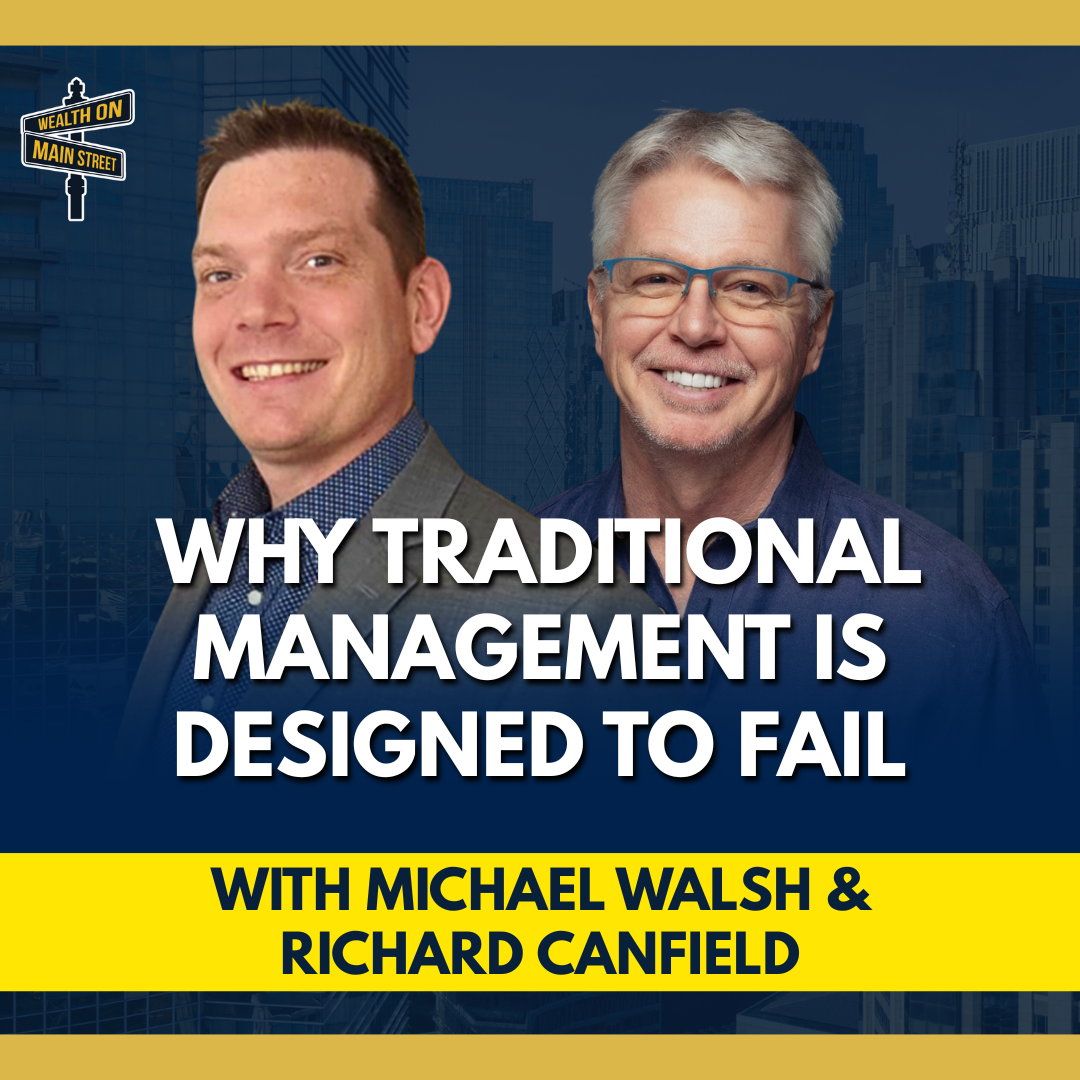
Okay, entrepreneurs, how can you grow your business and reclaim your freedom from it at the same time? Create a business where you actually enjoy the journey of running the business? We're going to discuss that with my guest today. I'm joined by Michael Walsh. He's a business coach who's created this incredible framework which he talks about in his new book, We're Going to Get into that. It's developed by over 30 years of helping businesses grow to 10 million, 50 million, and beyond without sacrificing their sanity and their personal life. You can read about all us in his new book, Freedom by Design.
Michael, I'm excited to have you with us today.
Yeah, you know, I want to get into some things. Right before we hit the record button, we were talking a little bit about behavior and human behavior. In a business, when you're running it and you're growing, you hit little periods of time where they call it the ceiling of complexity, and you can't break through that ceiling. And there's something that's shifted or changed in the business. It's a manpower, it's a technology thing. It's all these, like, a confluence of events, and sometimes it's really hard to break through that to get to the other side.
How does human behavior that you've discovered over 30 years of doing this really impact that aspect?
[00:01:45] Speaker A: Well, let me take a step back and. Because I want to speak to what you just mentioned about these different times when people get stuck and there is a ceiling and complexity. But here's what I find is that there are different stages of growth where people, like, once somebody's past their first million, they want to go to 2, and when they get to 2, they want to go to 5, and then when they get to 5, they want to go to 10, and when they get to 10, they want to go to 20. And then on it goes, right?
And what I find is that there's, you know, as a business grows, the problems multiply.
I mean, you got more people. There's lots more, you know, there's lots more to do as far as that's concerned. But what I find is entrepreneurs are really pretty savvy people. Okay.
If we can see a problem.
Okay. So, Richard, if you could see a problem, you can figure out how to deal with it, either directly, yourself or with others. If you can't see the problem but you know that it exists, you can still figure it out and deal with it. The ones that I find tend to get people stuck is if you can't see the problem and you have no idea that it exists, and even if it's got you in its grips, those are the ones we have a problem with.
And so I've spent the last few years, you know, even as we've been running into these issues, what, you know, what I did in the year 2000 or 2020 when Covid hit, I thought, okay, I'm gonna have a little bit more time on my hands because I do travel a fair bit, except nobody was traveling. So it's like, okay. So what I decided was it's time to actually deal with what's going on in what I call these danger zones, these times when every single milestone, it seems like there's underlying issues that people can't see.
And here's the problem I ran into.
People can't see them. So we're solving these problems, but I can't see the common thread. What is a $2 million company and a company approaching 10, and a company in this chasm between 12 and 20, what do they have in common? And so I literally took three years from 2000 to about 20, just mid 2023, and was trying to figure out what are the underlying issues. And yes, to your point, human behavior is one of them. Okay.
What I find is that with each stage of growth, people outstrip their structures. I mean, everybody knows that a $5 million company is not going to be run the same as a $1 million company. The structures that I use for 1 million, the systems and processes and all that stuff, they're not going to work at 5 million.
I mean, first of all, I can't afford 5 million dollar structures at 1 million. And second of all, it'd be overkill for such a small business. Right. But what you find is that with each stage, and as you're approaching two, is the first time you hit that thing you're calling the ceiling of complexity. And I agree that that's there.
What you find is that people have outstripped their structures, but at the same time, they've added more people.
So I've got increasing masses of people combined with lack of structures. And it just gets harder, okay? So here's what people try to do. They go, well, I've outstripped my structures. I know I gotta put More structures in. But they don't realize it's that in human behavior working together to form impediments on us. And as a result, people then put in new structures and they try to get people to do what we want them to do. If I can only put, you know, if I make the timesheets mandatory, maybe they'll fill them out then. Or whatever it happens to be right or, you know, I mean, you have to report to me earlier when you're. When you're running behind on a project, even though people say, well, I don't know I'm behind on a project till I'm far enough along to see that I'm behind on a project. You know, all that kind of stuff. It's like, yeah, whatever, okay, so what happens is people try to put that in. And the dynamics of human behavior play a huge impact on, first of all, how structures go in when you're replacing them, but also noticing when they actually do need to be replaced.
So back to your question about human behavior.
If you can understand a few different aspects of human behavior, it actually gets a lot easier. There's behaviors and there's structures in business.
And a lot of people, you know, I know businesses that do quite well for themselves. They don't really have many structures, but they got really strong behaviors on their people. They got really experienced people. They understand what the customer needs. They know how to protect the company's profit. They know how to give the customer what they need. They work well together. Those companies seem to do pretty well.
And I also know other companies that are incredibly highly structured. I mean, I've got a colleague who's got three stores of a coffee franchise, okay? They got structures for their structures. They got structures for everything. They have jury duty. Who has jury duty when you got little coffee shops? I mean, nobody has that. Nobody thinks of it in a small business except a franchise. You know, they tend to think of these things, but they've got weak behaviors. Apathyism or apathy, you know, lateness, you know, just not really caring about different things.
You know, really not paying attention. They're somewhat disengaged. Those companies don't do so well.
So what I find is it's less about behavior or. Sorry, it's more. Less about structures and it's more about behaviors that are involved in this stuff. Except here's the piece. They don't tell you there's structure to behavior.
So, for example, we have four different aspects of human behavior that if business owners just got these, their lives would get A lot simpler.
So first of all, every single human being has the biological need to survive.
We will do what it takes to survive. People talk about the ego and you talk about emotions and stuff like that. I got to tell you, those are features of being human.
They're not flaws.
They keep you alive.
Okay.
[00:07:50] Speaker B: People act like saber tooth tiger is coming. You need to have this feeling to run away from the saber toothed tiger. Right?
[00:07:56] Speaker A: Yeah. Now, and in modern parlance, since I don't see too many saber toothed tigers, a bus does come though. And sometimes they don't see when somebody steps out on the road.
[00:08:05] Speaker B: And tigers are kind of yellow and buses are usually kind of yellow, so it's in the same location, especially if.
[00:08:10] Speaker A: It'S a school bus. So you're all set, Right. And they're too busy with the kids yelling in the back that they may miss it.
So if you take a look, if we were logic first, we'd be go, oh, there's a bus coming. But now what are the pros and cons of getting out of the way? There is no getting out of the way if I'm sitting there with logic. The reason we're not logical is because it's too slow. Do we have logic? Sure. But the one that drives us the most is emotion. If you went, bus, eek. And you run and you get out of the way, next thing you know, you live to actually witness another school bus going by, you know, so the biological need to survive is right there and it's tied directly to our emotions because emotions are very fast. The second thing that's right alongside that is we have the innate desire to thrive.
And it's interesting because if you look at entrepreneurs, it's that innate desire to thrive plus a confidence that they can handle their survival. Stuff that actually has things go so well. Okay, now. So survive and thrive are right there with each other, but if there's a threat, survive comes first. If there's not a perceived threat, then thrive has the ability to participate in all that we do. And you don't need to have all your survival needs met before you can actually get to thriving. Otherwise why would a 5 year old ever share a toy?
Right? So both are there, but survival's there when it's needed, but not when it's not. You know, so there's those two, there's two more.
The ability and the need to connect.
Okay, we know that together we're stronger, so we're safer when we're doing, but it's also where we collaborate where we create really cool things.
And the fourth one is the ability to adapt to a changing environment, even if we don't like the environment.
I mean, people told me during COVID that they had no, they were crystal clear, they had no, no doubt that there's no way they could send everybody home and still survive their business.
And then Covid happened and two weeks later everybody's at home and a lot of businesses survived. Now it's really difficult to run a restaurant if you don't have anybody that's allowed to come visit you. But for many of the businesses, they, in fact, they did find ways to cope and adapt and survive. You see that when many actually found.
[00:10:30] Speaker B: That they could thrive even beyond what they thought was possible.
[00:10:36] Speaker A: A lot of times, but even in, even when there's like an earthquake or something like that, you notice that people come together and then they adapt to whatever's going on.
You know, so, so we, we have these things and if I know that I've got that the people that work with me have these core elements baked into what it is to be human, then I can look through those lenses and go, okay, so what's going on? I notice somebody's really frustrated about what's happening. Well, what does that do? Does it threaten their economic viability?
Well, guess what? Survival's kicking in. So all of a sudden they're there. Are they thwarted in their commitment to thrive and contribute? That can also show up. That's, you know, sometimes people are there, you know, do they have a chance to connect?
You know, if not, you could see different things happening.
You know, it's interesting, this morning I was on a call with a group of managers in Michigan and we've been doing this management training stuff and you know, we worked through culture change and things like that. There was a number of different aspects of what we, we worked through. But you know, almost everything that we talked about they'd already done during the program. Because one of the first things we did, these are guys in the insulation business and you know, blue collar worker skilled work, because there's a lot to learn about the different aspects of insulation. But they're the guys that they roll up their sleeves and they're out there and they're, you know, it's in the construction industry sort of thing. And one of the things that we had them do at the start of the year, because we've been running this since the start of the year with them, it's a year long program, we're just about through, I said, you know, when you've got your two person teams, one of the things we had the senior person do, so let's say you were the senior and I was the jun.
There is your helper. You're the guy with the knowledge I'm learning from you and stuff.
The only request we made to the seniors is identify one or two things a day that the person's doing really well.
And so we had this one guy, we're going to call him Joe, not your average Joe, he's a really smart guy and he was just taking notes in his phone because that's the mechanism they were using. That's fine. So he said, it's an experiment, just identify one or two things each day. And so he's putting notes in his phone. And so every two weeks we've been meeting and I said, so you've been putting things in your phone? Yep.
Did you tell the guy what you've been noticing? He said, well, no.
Okay, so the next part of the, of the thing is to actually once a week just, you know, like, does he drive the rigs that you do? Oh yeah, we both have our A license. These are big rigs that they've got because they've got all the equipment in them and all this stuff. And so I said get him to drive for one of the days, whether it's Wednesday or Friday, whatever, but once a week just I want you to be able to pull your phone out and just say, you know, I noticed a few things about what you're doing and I just wanted to share them with you.
And so he said, okay, I'll do that next time, you know. And so he spent a couple of weeks doing that and then he came back and reported to the group. And he said it was fascinating. I said, what was so fascinating about it? He says he was afraid I was about to give him like real trouble.
He thought he was, you know, well, I got things to talk to you about. It's like the only things he usually hears is if he did something wrong, if he did something right, we all assume it. He did his job. Well, that's good, good for him. You know, I can sit there, pat him on the head every day. But. But he. So he says, no, no, no. He says, listen, if there's a problem, don't I tell you about it? He says, well, yeah, immediately it's like, yeah, because something needs to be fixed. But if you got the problem sorted, then there's nothing else to talk about. Let's move on. These are things that I noticed that I really think you're doing well with.
And so he's like, oh, okay.
So. So he reads them off and he's like, okay, so what else? And he's like, no, that's all, that's it, that's all I noticed.
And he's going, okay.
And then he did it again the next week and he did it again the next week. And by the time he'd done it the third time, it was interesting because the young gentleman that he's working with started asking him questions.
He hadn't asked him questions before about anything.
And it was interesting because the senior guy, our guy Joe, okay, I said, so why do you suppose that is? And he wasn't quite sure, but one of the other guys that jumped in the thing, he says, I know why. And he's like, well, why?
He said he trusts you, he knows that he can ask you a question. You're not going to be all over him that he's doing something wrong or he's thinking something wrong, right? And he's like, huh.
So one of the things they started noticing is if they're sharing the good stuff with people, they start asking questions because the trust is going up. Well, normally it takes, it has taken between three and four years, okay, for anybody to go from a junior to enough of a senior that they could have their own helpers. And Andrew right now has been with the company a year and a half and for the last five, six months he's actually been a senior supporting juniors.
And the guys themselves are blown away by how fast these guys are learning because the guys actually can relax around their boss and they know that their boss is out to protect them as opposed to something else. Now guess what? Joe's life is like now.
[00:16:08] Speaker B: I would imagine he's having a lot more fun and it's more interesting for his day to day work.
[00:16:14] Speaker A: Yes, he's a lot more fun, more interesting and he finds that the youngster, okay, I'm going to call the youngster Billy, he's way more interested, okay? And he's now grown and then he's tapping some of the other seniors as well. And he's got his own juniors and stuff like that. And this morning I heard about one of their jobs. He's running six guys. They're usually two person teams but they now trust Billy to run six guys on his own. So he's actually really growing as far as that side of it is concerned. And they were laughing because they're like, Billy's always calling us now, like, well, I got this. What about this? What about that? And so what they've spent the last month on is actually helping Billy build his trust in himself so that he can relax. So it's like, okay, well, what did you decide to do about it? Well, I'm not quite sure. I think I should do this. Well, actually, that's exactly what I do. Excellent. So he still calls, but he tells what his. He's already got his answer sorted before, you know, anything else. And he just sort of uses them as a sounding board. It's to the point now where it was really just. Just, you know, continuing to build the relationships with. With the different guys. And one of the things we noticed, for example, is that traditional management is actually designed to fail.
Okay, think about it. How do you be promoted to becoming a manager?
Which guy are they going to pick to become? Guy or girl? Which, you know, they've got. They actually have both men and women in the in on their teams. But how do you think they decide who should be a manager?
[00:17:49] Speaker B: You know, one of the common things is like, I think still a lot of the world operates on sonority. How long you've been with the company for or, you know, something, or a vacancy shows up, somebody fills that vacancy that's already been on the team for a long time.
[00:18:02] Speaker A: Sure. And sometimes it. Sometimes it is that based on seniority, but more often what they find is it's the person who can generate the results as an individual contributor, the best.
Okay. And when you combine that, because if I've got two and one's a youngster and one's been around a little longer, they will go to the person who's been around a little bit longer. But they find that it's, you know, that Max. I really, you know, I really appreciate what Max is doing. I know I can trust him. He always gets the job done. I can count on his word. You know what? He's going to be my manager.
[00:18:34] Speaker B: But they don't give him any management training and they don't give him any concept as to what it looks like or means to be a manager.
[00:18:40] Speaker A: Yeah, but he's good with people, so, you know, he was good with people when he was doing his stuff, so he must be good as a manager. Except guess what? You know what the number one skill of a manager is? An effective manager.
It's the ability to provoke thought in your people.
See, the reason Max would have gotten good as an individual contributor is because somebody actually challenged him and provoked him. And Max had to figure it out. And he found ways to figure it out. Except then he becomes a manager and he figures, well, I know more than these people, so if they don't know, I'll just tell them.
Now, the minute, you know, if I was answering to Max, the minute Max tells me something, I go, oh, well, Max knows what he's doing. I guess I should just follow him.
What happens to my ability or my thinking?
[00:19:27] Speaker B: It's been taken care of for you.
[00:19:29] Speaker A: Yeah. So what happens is I just wait and he tells me what to do and I'm not, I don't have to think at all.
So guess how much I grow. I become a doer, but I don't, I don't. The things that actually make a difference, especially in an expertise based business.
And with this, it's a skilled trade, the ability to think goes out the window.
So people think that they have to tell people what to do or I'm accountable for the result. No, you're not. You're accountable to support the people who generate the result. Because if you are accountable for the result as an individual contributor, then whoever's now in the individual contributor category, they're the ones accountable for the result. That's not your job. Your job is to support their thinking so they grow as individual contributors and learn how to work with each other so they can generate the result.
And to the extent that you're also there as an individual contributor, that's the only part that's there. So it's fascinating because we have this notion of management and it came to us when people went to assembly lines back in the early 1900s.
Right.
You're in a situation before that it was all apprenticeship, learn from the master. But as soon as you had to go to assembly lines, basically people became cogs in a system.
And so what happens instead of having one apprentice learn six things, let's say I was your apprentice. Now you're teaching me six different aspects, aspects of your profession or trade or whatever. Whether you're an architect, engineer, a doctor, a blacksmith, a carpenter, they were all done by apprenticeship. Right.
So we're in a situation where if I put those different people, I've got the Wylie veterans and I've got the apprentices on the assembly line. Everybody teaching their apprentices in their own way of doing things. I get a lumpy assembly line.
So what they did when that happened, when people started working assembly lines, they took anything associated with thinking away from the employees. And instead of having one employee try to do six things, they hired six people to each do one thing. And they just do their piece. And that's why people became cogs in a system.
Okay. And the managers were the ones that held all the information. Because if we give it all to the employees, they'll just try to go around the system or do something else and be creative. And assembly lines don't work very well with creativity.
Right.
[00:21:42] Speaker B: Well, what I really love about this, Michael, is it, it perfectly resonates with Nelson Nash, who wrote this book, becoming your own banker. And he would literally start every session, training session that he did by starting with saying, it's all about how you think. You see, it's all about how you think.
It's all about how you think.
[00:22:03] Speaker A: I love it.
[00:22:03] Speaker B: And he would begin every session just like that.
[00:22:06] Speaker A: Yeah.
Now, here's a question I have for you. So when you look at financial matters, okay, to what extent do survive, thrive, connect and adapt, play in your world?
[00:22:20] Speaker B: Well, when you're connecting with individuals that we serve and who we love to serve, I mean, it's critical because survival is directly connected to the amount of money running through your life and your hands on any given month, week, year, and how much is left over or if there is any leftover. And so really the financial picture of a person's life, whether it's their business or their personal household economy, is directly relevant to the survival instinct.
And so fundamentally, because of that, because when you talk about survival, well, things that go hand in hand at that are shelter, like primary needs, shelter, food, those are the two main things that we need. If you're, if you're in Canada and you need shelter, you need heat to go with that shelter, but still falls under that bucket. Well, in order to operate in those things, you need to have cash flow. And so it all circles back to that primary need of survival, fundamentally. And so people are driven to go generate revenue and income for survival needs and then they want thrive, which is the things that we want to enjoy our life after that.
And so it's the same elements that you identify just, just that the dollars and cents that we use, this thing we call currency, regardless of what format the currency takes, is a requirement in order to produce that survival mechanism and to give people peace of mind so they can have a sleep filled night, not a sleepless night, to be able to figure out how they can then thrive.
[00:23:46] Speaker A: Yeah, the. And you know, it's interesting because you talk about shelter, you know, not very many people pay for a home in cash before they'll take their family out to a movie or a concert or something like that. It's like you're doing both at the same time, you know, because you're paying off a home over a period of time, which, you know, you don't necessarily need all the money up front for that. You do need to know that you, like you said, with cash flow, that you'll be able to cover it when the time is right. But in the meantime, you can really enjoy things. If you've got that set up and you're comfortable with it, you can enjoy the different aspects or throw thriving whether it's in your business or whether it is in. In your social world or in with your family or what have you. So I have a feeling that these, these same premises are, are totally applicable to the stuff that you're doing, just like they're applicable to the stuff that I'm doing.
[00:24:37] Speaker B: Yeah, I mean, in our work, we spend the bulk of our time working on human behavior. You know, we use a financial vehicle, a tool. You need a tool to get the job done. But the tool is fundamentally, it's not irrelevant, but it's barely relevant in comparison to your thinking. So we put all of our energy and effort on training and working on thinking and developing a new format of habits so that we're creating actually a lifestyle. So it becomes a financial lifestyle rather than a financial thing that you do. It's actually engaged in now kind of the fiber of your being is kind of the focus and then it integrates in the family mechanism or in the business structure, depending on how that looks like. So. So there's a lot of overlap there now when it comes to your book Freedom by Design, which I love the title, by the way, and it is a phenomenal book. And by the way, thank you for a copy. So for those of you who are listening, don't know. I received my copy because Michael and I are in the same strategic coach group and he gave a copy to everyone in the group, which was hugely beneficial. And it is a really phenomenal book and it's very action oriented. There's very tactile things that you can implement from what you take out of the book. What I'm curious to know is what prompted you to write the book?
[00:25:47] Speaker A: Well, the first book I wrote was for somebody that wants to get their first million. And I wrote that book in 2009, published in 2010. And then I was working with a client who had at the time, she contacted us in 2011 and she was 52 years old. She'd had a business that was bouncing around between 250 and 400,000 pounds it was in the UK and she wanted to get, get herself to a million, but she was also looking at some financing options and things like that. And she thought that she really was looking for some help on getting her financed because she thought she needed a whole bunch of money. But it's a service based business so it just needed to be designed a little bit differently.
So one thing led to another. I went over there and we ended up starting to work together and in four years she was at 2 million. And actually my second book was written based on that half of her journey. In the next four years she got it to 7.3 million pounds, which is about 10 million US, about 12 million Canadian at the time.
And then she sold it and on she went. But the thing that I found interesting was it's like there are as many ways to grow a business, but the problems are very similar.
So we've each got different strengths and skills and we each partner in different ways with different people, whether it's with an actual equity partner or whether we partner with the people on our leadership team. And you've got this complementary stable of skills that are at the table.
Except everybody saw the same problem. So the second book I wrote was about that was what are the bumps and hiccups and problems that the misconceptions or the myths that people believe that stop them in their tracks? And then what I found is we're as we continue to grow and evolve and you know, we've done a lot of more work with people that are anywhere from 2 million to anywhere from 20 to 50 million to start, who really want to achieve growth. And this is more for impact. So whether somebody wants to go from 2 to 5 or 2 to 10 or 5 to 20 or whatever it happens to be quite often these days, it's not about the cash for them. It's. And you know, I mean, financial independence and freedom quite often takes a lot of money. So that's why people want the money. It's not the money itself, it's the freedom that they're, that they're looking for. But the other side of it is, and a lot of times it's the freedom to contribute in a meaningful way. So what I found was with this group there was these underlying issues and I wanted to get to the root of them and literally that's why I did that. Plus with COVID I had extra time on my hands, so I thought it was time to do something there. So that's literally why I wrote it. And the Freedoms that we talk about in the book are three freedoms. The freedom in your business to really bring your best to the table in your business and do the things you love that make a difference. Freedom from the business so you actually get time off, you actually can have a life, and you're fresher when you get back to the business. And the third one is freedom because of your business business. So that's whether it's legacy planning or actually adding to the security and wealth of your. Of your family or whether it's to make an impact in some small corner of the world or, you know, what kind of an impact you want to make with clients and stuff like the clients and customers, those three freedoms were the things that I actually focused on and I looked at what was the relationship between what gets people stuck and then what happens is if you can free them up. Just like our situation with Joe and his underling Billy, Joe is finding he's enjoying his job way more.
He's actually getting more promotions.
He's getting way higher pay than he ever believed that his family, that he could generate for his family. So is Billy in this particular scenario. And they're just thrilled and they really like coming to work and they're around other people who feel the same way.
Now you've run businesses, you know what it's like when people don't want to be there.
How easy or hard is that for you?
[00:29:42] Speaker B: Well, it's, it's makes it difficult to try to continually and constantly inspire people to have a, you know, enjoy their work. And we all end up doing things that we don't particularly like to do. Along the road of life, there's. There are tasks that you don't like to do, but at the core, those tasks lead to things that you do want to do, right? And so there is getting that inspiration towards doing those other elements and, and additionally, like, you know, my past life as an electrician, I'm very familiar with the experience of working in a construction environment.
And, you know, I started my, my trade in 1999 and working with an older journeyman. And he was a quiet guy that barely said anything. I literally had to figure out and interpret everything.
And I was trying to read the. The room and preemptively bring him the things that he needed almost by like mind reading to some degree. So he was a great guy. I did end up actually learning a ton, but I didn't learn a ton because he gave me a ton to learn. I learned it because I wanted to know enough so that I could be successful in the environment. And so there was a, it was a curiosity element that created the learning, not so much a training environment. So I understand the impact of what you're sharing and I think it's really beneficial because again, people need to know when they make mistakes, but they also need to know a. How to correct them.
Mistakes are going to happen no matter what. If we don't have permission to make them, then people will be scared to even speak up when it happens. And if you create an environment where you're. You're showcasing what is going well, treat people for what's going well, not only are they going to be clear that that that worked, they're going to want to do more of that.
And they can also mention it to other people who might be doing similar work on the team.
[00:31:23] Speaker A: Exactly. And the thing we found with this is that instead of needing to manage with authority or telling people what to do and being directive, what they're basically doing is what they're focused on is the connections with their people and the relationships.
Now, in a relationship, I mean, there's you and there's me, and then there's this thing between us, the relationship. Now, you don't control the relationship, I don't control the relationship, but we both have influence on this thing called the relationship.
The only way I could control the relationship if I somehow tried to control you. And I don't know about you, Richard, but, you know, not many people like to be controlled, and I'm one that does not like to be controlled. I know you well enough to know that you do not like to be controlled either, do you?
[00:32:12] Speaker B: No, I don't think that would go very well for me. My quick start energy doesn't last very well in a room where I'm being told what to do.
[00:32:19] Speaker A: Yeah, exactly. But at the same time, if you're actually feeling like you're part of a team and that you're. Your thoughts count and that somebody's willing to help you and there are no dumb questions and things like that, don't you just bring more to the table?
[00:32:36] Speaker B: The rising tide lifts all boats.
[00:32:38] Speaker A: Yeah, but it's like if you're one of five guys working with me and everybody's bringing more to the table, guess what just happened to my job?
It got way easier. Right.
So some people go, oh, you know, this is all nice and fine mom and apple pie crap, you know, and it's like, no, this is as hard nose as you can get. You want to increase your profits, here's what we found with these people that I'm dealing with in Michigan, their workload, they were able to take on 50% more work, same size crews. Now they've also added crews, but just for the same size crews, they've taken on 50% more work. And they used to have to put in a bunch of overtime to get their stuff done. Now they're putting in more work, and they're not having to put in overtime. And the boss still wants to make sure they're compensated. So what the boss is doing is he's giving bonuses so they get more work done. They're more happy in the work because the skill levels are actually going up at an accelerated pace. They're actually getting more money, and they've got more time with their families. And that's in real life. Like, this is what they're dealing with right now, you know? And I said, well, you know, when things get a little quieter, I know you're in your busy season. When things get a little quieter and they're like, michael, you've not been around here, have you? I said, well, what do you mean? I mean, I go every four months. I visit them, right? But we're talking constantly on a web call, and they're like, there is no such thing as a slow season anymore. Like, our slowest season last year outstripped our fast season from the year before. And now our fast season is outstripping anything we've ever done, and it just continues to grow. But the good news is, because we've been able to upskill our people at a whole different rate of acceleration. And not by taking any shortcuts, just by slowing and listening and supporting them. They're in a situation where things are just going at a whole different clip. And everybody's really happy because it's not like anybody's sort of being pushed or dragged through it. It's like if you found guys are really good at what they did. From an electrician's perspective, there's a guy that might take 30 minutes to wire a certain part of the house. And then there's a guy that can do it in 12, but not because he's skipping. It's just. He just knows the shortcuts. He knows, you know what? I go through this wall, this is what's going to give us everything. I stop going around with that. I'll run one wire to make sure the TV's cover covered over here. But over here, you know what? We're good. And I. You know all those things, right? Well, guess what? When people are new. They take the 30 minutes, not the 12.
Eventually you want them to get them down, but when your journeyman would expect to do it in 18 or 20 and they get down to 10 or 12, that's when it gets really interesting. But the. And then the house is wired just as thoroughly, if not more thoroughly than when they were each working independently and nobody's connecting with each other. You know what I mean?
[00:35:24] Speaker B: Well, and if there's, you know, a bonus model, those kind of things attached to it, people, not only are they working faster, but they're going to convey the. How those tips and tricks are going to convey that. Because everyone else wants to rise to the occasion.
[00:35:37] Speaker A: Yeah. And they're not conveying it like a directive. You have to do it this way. They're like, well, you know, you're building your skill. When if you want any tips, you let me know. Well, I'm really struggling over here. Okay, would you want to know how I did it when I was doing that? And they're like, sure. And then they'll listen because the credibility is there because they've focused on the person and the person has the level of trust of their boss.
So it's not like they don't, you know, share anything in terms of best practices. But they're not sitting there driving the stuff.
They're collaborating with people and they're really. And the people are really open to it, you know.
Now that said, there is one thing, other, other thing that they have done.
They realize that half the game is who you hire.
Okay. They recently hired six people.
They went through 101 different people in interviews to get the six.
And they're like, okay, unless the person is open to learning, really wants to contribute, you know, they have some basic skill, but they don't need to know the specific to do's of our industry. But they, but they've got a sort of an aptitude with their hands. But they've got to be willing to contribute, they've got to be interested in others, they've got to allow for the contribution of others. These are the types of things that people are actually focused on. They're not focused on, you know, all the brass tacks that people usually expect, you know, and they said we can work with that because our guys work with each other, you know, but it's kind of. They're having a ball.
[00:37:14] Speaker B: That sounds like it. And it makes sense why they're doing it. I mean, it makes sense why everything shifted and being able to take on more work with the same Manpower. But having everyone happy is not a normal thing that you would hear in most business environments. But what I'm hearing you indicate, Michael, is that if you focus on these behavior elements, that is an outcome that is very probable or possible inside of a business structure. So that's a big takeaway for anyone watching today. Yeah.
[00:37:39] Speaker A: And there is one other piece. Remember I said that they're outstripping their structures plus human behavior. What happens is as people outstrip their structures, instead of putting in new structures that try to get people to do what you want them to do, you put in new structures that support people to be at their best.
So I hire good people. We actually work with them in a collaborative environment. But when we're, when we're replacing the structures with more robust ones, it's based in what would really allow Joe and Billy and Max and Maxine and Maureen and Ronald to actually bring their best. Because if they're bringing their best, I'm tackling the X factor of human behavior. And that's the thing that really gooses the results for any business owner. And we've all experienced that and we love it.
[00:38:28] Speaker B: Well, speaking of bringing our best, Michael, you've done that with us today. I really appreciate all the amazing stuff you shared. Real world, real tangible, current, relevant things that are happening inside of a business structure based on great coaching and based on a lot of human behavior, which we spend a lot of time talking about. So for our listeners, human behavior does matter. It is all about how you think. And we encourage everyone to get a copy of your new book, Freedom by Design. It's an incredible book. There's amazing tactile things in there. So if you're a business owner, you're going to want to pick up a copy of that. Make sure you swing by Amazon or your bookstore and get one in your hands as soon as possible. Michael, something that we like to do here, of course, when you showed up, you've got a great whiteboard behind you, but you're not showing up with a cape. But when it comes to this business, this insulating company you talked about, you know, while you're flying over there in an airplane to Michigan, you might as well put the cape on because you've done superhero level activity as far as a business coach in their structure. So what we love to end our show with is finding out from you who do you most want to be a hero to.
[00:39:32] Speaker A: People that run companies that are based in the expertise of their people, who want to grow their organizations with the view of making an impact. When people want to generate the impact we can cover their financial wealth. We can cover a whole bunch of things when people are just about the money they actually get in their own way. It's harder to get people the money when they just want the money. If they want to actually get the impact they we can get the money there faster. But the other thing is that everybody has more satisfaction over the impact that they can make, the contribution that they can make in whatever small pocket of the world that they're interested in. So if they want to grow and they want to make an impact, we're all ears.
[00:40:10] Speaker B: Amazing. Love it. Thanks for being this day Michael. Appreciate it. And again, final shout out. Make sure you get a copy of that book. Interested in attending a live event? Hey, you should. They're fantastic. We've got events, webinars, in person sessions all over the place. Register now by visiting wealthonmainstreet. Com events.