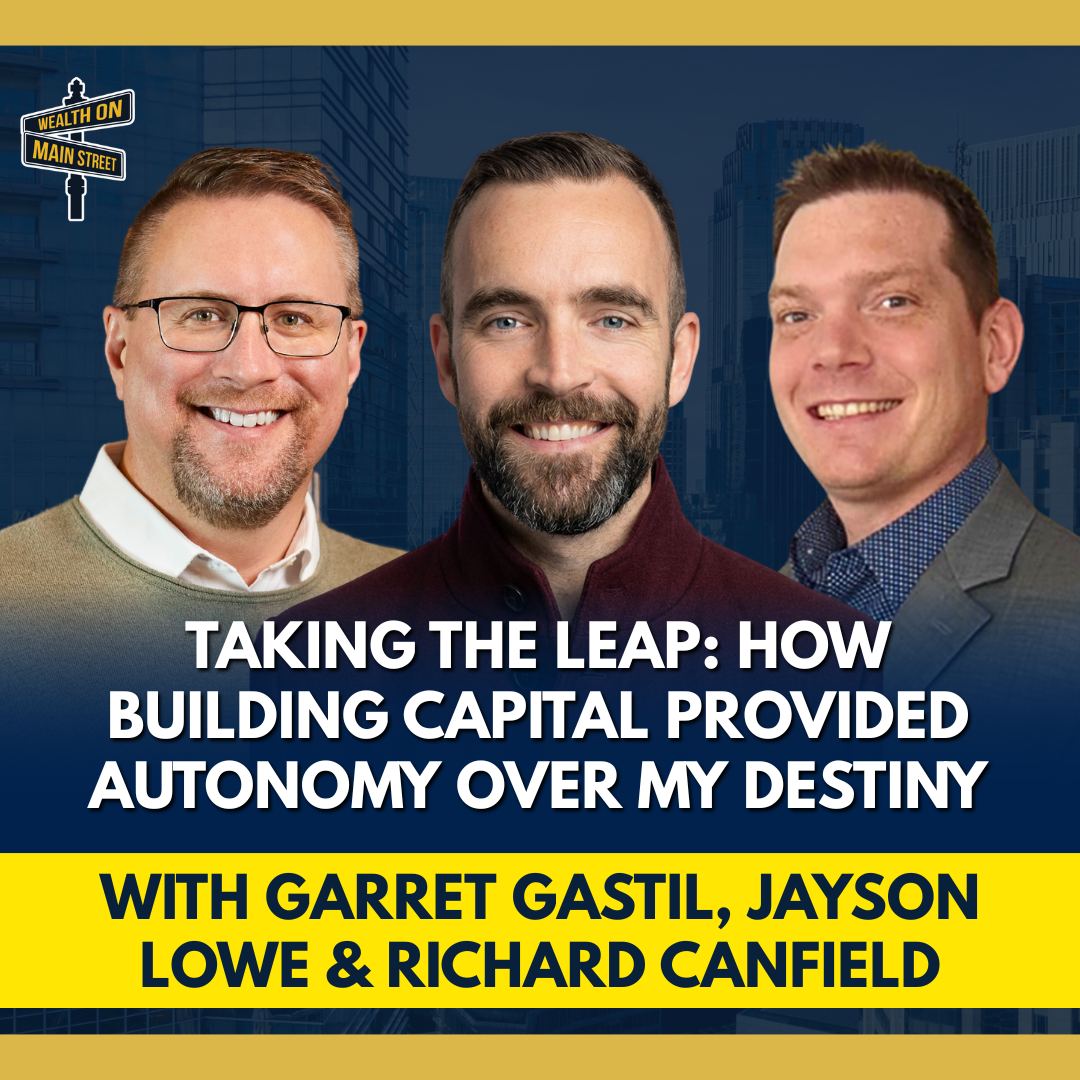
Episode Transcript
[00:00:00] Speaker A: Foreign.
[00:00:11] Speaker B: Welcome to wealth on Main street, where conversations about growing your wealth are fun and entertaining. Wealth isn't just about money. It's the skills and the knowledge that we develop to pass on to future generations.
Tune in each week to grow your mindset and your net worth at the same time.
[00:00:36] Speaker C: Welcome back to wealth on Main street. And today, you're about to meet somebody very special. Garrett Gastile. And every so often, someone walks into this profession with just a level of humility, desire, like a deep hunger to.
To be successful. Someone who's coachable and someone with conviction that reminds Richard and I why this. This mission of ours matters so much. And Garrett is first and foremost. He. He's a father, a husband.
He's.
He's just a guy with his priorities in the right order. And he's one of our newest teammates in the United States on the ascendant financial team. And I will say, I mean, he may be early in his journey in being a practitioner, but he's definitely not early in impact and what he's already accomplishing and how coachable he. He is and the work that he is doing for families and as he starts to kind of build a book of business with clients is already extraordinary. And so you're going to enjoy his mindset as much as Richard and I do. And he's decided that his life and the lives around him are going to be different. And so this is going to be a conversation that I think is going to remind everybody who watches and who listens that when the right person meets the right process, the future tends to bend in their direction. So buckle in. You're about to hear a great story of transformation and what happens when a family man steps into a mission that aligns perfectly with his values. Garrett, welcome to the show.
[00:02:24] Speaker A: Thanks, Jason. Happy to be here.
[00:02:26] Speaker C: It's great to have you. And I think a great place to begin would be.
Take us back. You know, who. Who were you before the infinite banking concept came into your life and what was happening in your world?
[00:02:38] Speaker A: Yeah, I. I got my exposure to this about seven years ago, before my first child was born.
It's wild to think that she's almost 7, but I was working a consulting job and working.
Gosh, like, I would. I would get up and go to work and I wouldn't. I would get home maybe after she went to bed or, you know, as she was going to sleep. And I just was chasing partner. Right. Like, I wanted to be the youngest partner at the firm and was a newlywed. And I remember my brother Got me into bigger pockets and. And told me to read Rich Dad, Poor Dad.
And I. I read it. You know, like, anyone who reads it, I was like, oh, my gosh, I gotta do real estate. And then I remember I was doing, like, a. An analysis and a spreadsheet of buying, like, a rental property.
And we were both working at the Times, we were making great income, but we were also maxing out our 401ks and putting our money everywhere else but our own system.
And you felt that, right? I was looking at what I had to work with and it would take me. I did this analysis of, like, okay, if I buy one property and maybe it cash flows a hundred dollars a month, I can retire at 65. I can get to financial freedom, like, when I would, you know, at that age or whatever. And I remember just being kind of, like, turned off by that. And then my uncle introduced me to this concept, and I read the book. I think I read. I've talked to Rich about this on the podcast before, but I think I. I don't even think I finished it. And I was like, I'm doing this. So I called up Living Wealth. Nate Scott, he was my. My. My coach. And I got started with a $500 a month policy.
And I didn't really. I. You know, I. We always talk about this. You kind of have to get in the water to really experience this concept. Like, you can read, you can watch videos, but once you're actually doing it, it feels really different. So I think a month later, we. We got, like, five more policies that year or something. We just, like, went all in. Like, I quit the consulting job and started, like, pursuing some other things.
But that. That was six years ago, right? So that. But since implementing the concept, my wife would tell you, and she.
I'm. I'm very much like the. Put the gas. Put the. Put the pedal to the metal. Let's just go do something. And my wife's an attorney, and, like, very exacting.
And so at first she was kind of like, what is this thing we're doing? Like, this is.
Like, this is.
[00:05:17] Speaker B: What have you gotten us into, Garrett?
[00:05:19] Speaker A: Yeah, exactly. But. But what's happened actually is we've had a lot more abundance and a lot more freedom than we would have had otherwise. And we've been able to do things that we would have never been able to do before.
And actually, I think she does a better job of explaining it than I do, because she just feels the outcome of what we're doing.
And so, you know, we bought an airbnb that we would have never been able to do if all of our money was locked up in a 41k, which we ended up selling. But.
But we wouldn't have never. Would have never been able to do that otherwise we bought our car with it.
And it's just. It's been knowing that, like, you have control of the loan, but also that you're. As you pay that back, you're replenishing your own system is just. It's. It feels really good.
And then on top of it, being a family man. And I always tell this to people, like, knowing that if something were to happen to me, my wife would be set is really comforting. And to her, too, she's like, I would not get remarried. I would go. I would, like, travel with the kids. And, you know, But. But. But it's just. It's just really comforting knowing that they're taken care of if something were to happen to me, on top of getting to use it in our lives now. And so. And that brings us to now, right? So two years ago, I was. I was at a big consulting firm.
And I remember.
I don't know if people are familiar with these things, but that they're big.
They're like, Deloitte Consulting is the name of it, and it's like, bigger than the town I. The city. I live in Boise. It's like 400, 000 people and just the one consulting firm, and they have four firms. And I remember I was on paternity leave.
My son had just been born, and. Which is a great perk of a big firm like that. And they were laying off a bunch of people because the market was bad. And I remember getting in touch with Nate Scott and just being like, what's going on? And so then he was like, why don't you come work for me?
And then he ended up leaving and going into ministry full time.
And then I got connected through that to you, Jason, and Ascendant, and then the rest is history. And as we know, it comes full circle back to living wealth now.
So it's just been such a cool journey, and I never would have been able to make that leap out of consulting if it weren't for having, you know, these policies built up to be able to kind of invest in my bigger future. Right?
[00:07:50] Speaker B: Yeah.
[00:07:51] Speaker A: And on the family man note. Yes, Honey, she's napping.
[00:07:55] Speaker B: There we go.
[00:07:56] Speaker A: There she is.
You want to say hi?
[00:08:00] Speaker B: Hi.
[00:08:01] Speaker A: Can you come in and wave?
[00:08:03] Speaker B: Oh.
[00:08:04] Speaker A: Oh, okay. Gotta move in a little bit. Come here. There we go. Say Hi.
This is my oldest.
[00:08:10] Speaker C: There's the wave.
[00:08:11] Speaker A: Okay, you can go turn something on. Okay.
Go for it. Okay.
[00:08:16] Speaker C: Speaking of family, man.
[00:08:18] Speaker A: There you go. Yeah. And my wife's out of town, so you're Mr. Mr. Mom for the couple days. It's great. But it's been a big shift in our lives, and I talked to a lot of people who are not, like, they're. They're at a certain spot in their career or their lives, and they're just.
[00:08:36] Speaker B: Are.
[00:08:36] Speaker A: They don't want to. They're afraid to take that leap. Right. And I feel like if you're doing this process, it makes doing that. That taking the leap, doing the thing that you've always wanted to do so much easier. Right. Because you have.
You have the flexibility, you have the capital, and also you build a community of people like you guys around yourself that just.
Who are thinking bigger and more strategically about their futures than your manager at a W2 job.
[00:09:10] Speaker C: I'm genuinely curious, given where you are now in your growth curve as a practitioner, where you're guiding other families now and you're coaching and helping people to get to clarity on this concept. What's.
What has surprised you the most about the learning curve and some of the early wins that you're experiencing? What surprised you the most?
[00:09:37] Speaker A: That nobody cares what you know about.
They care about how they feel.
And I can teach all day about something, and. And nobody cares, frankly. They care about their outcomes. Right. And what they're trying to get to.
And so the people that I've been able to connect with and build a relationship with, that's been.
It's also been fun. More fun for me, Right. When I get to have a conversation with someone and really help them. And something I'm finding, too, with people is I'm a man of faith as well. And it's really cool when that gets to come into my relationships with.
With prospects and clients and stuff, and getting to pray for people that I never would have had the chance to do that for. You know, just the spirit put something on my heart, and it just, hey, can I pray for you? And no one said no yet, but. But that. That's just really cool to get to. To do that with people. Something I never got to do in any other career before this. So I'm getting to bring that in just. Is really a really powerful thing.
[00:10:42] Speaker C: Incredible.
[00:10:43] Speaker B: Well, it's interesting you talk. You mentioned about community and giving people a different kind of hope. Not just financial hope, but a hope of, like, hey, if you feel like you're maybe stuck in a rut, you're looking for change, you're ready for a shift, making sure that you have. For a lot of people, the, the ability to do that shift comes with having not just the clarity and the focus, but also having the war chest of capital available. And if it's all stuck and locked away in a 401k or in Canada and RRSP prison really limits your ability to do that. And by having some time to build and strategize, to get something built up around you to put you in that position, to give you more control, give you more, more autonomy over your destiny and your options, the way that you see it in your future. And I think that's a really key item. It's not something we talk about a lot here. And we don't want to encourage everyone to just walk away from their W2 job or something like that tomorrow. That's not the purpose here. But it's about recognizing the power of what options and flexibility gives you. And sometimes we can have so many options, so many choices in front of. Think about going to a restaurant and you've got a menu and the menu has like 400 items on it. It's like, well, what are you going to choose? You want a little bit of everything. Whereas if you go to the menu and it's got, okay, there's 25 items, it's a lot easier to narrow your focus.
And so there is a degree where too many options and too much flexibility could actually almost be paralyzing to some individuals. So because you have this ability, responsibility of being your own banker and you get to choose the path, you have to also have some people around you community to help you understand where that path might lie. Like, what are some of the things that might go into that decision making process. I think that's kind of what you're identifying.
[00:12:27] Speaker A: Yeah.
[00:12:27] Speaker B: By being around that support system.
[00:12:29] Speaker A: Absolutely. And it's people who are thinking differently as well. Right. I think that if you, if you've. Have y' all ever watched the Chosen yet? It's okay if you're not. The opening scene is like a bunch of fish swimming this way. And like every now and then a fish turns blue and swims the opposite direction. And I feel like that's what you need in this concept too. You need people who are swimming the opposite direction. Because if you're with, you know, people at a W2 job, for example, like, you know, they're telling you you're doing the right thing by maxing out your 401k. I do.
And until I got out of doing that, I never would have even considered coming to do something like this. Right. Or, and, and my brother who was on this podcast, shout out to him. He never would have started his own GC if he wasn't doing this either. Right. Like opens up your mind to what's possible if you are building something that you can use in that bigger future. Right. If you're maxing out your 401k and head down at your job like you're, you're sprinting towards, towards retirement. And so it, it and I, and I, I, it's might be fulfilling to some people. Right. But it wasn't for me and I, I hadn't discovered this concept, I wouldn't have realized that.
[00:13:44] Speaker B: It's super interesting. You said that. I watched a video this morning before I kind of started my day, came across my YouTube and it was a gentleman who had, you know, quote unquote retired. And it was about an 18 minute video talking about all the things. It was a 12 or 13 things he realized post retirement that he wished he would have known before that he didn't know and didn't understand.
And it had a lot to do with his time, like how much the drive home, you know, really bothered him. He might have left the day feeling good and ready to go after having a successful day. But then the drive home just killed his drive, killed his energy. 20 miles a day to and from. And like how much time did that take out of his life?
How much, you know, was he spending on fuel and maintenance? He says, well you know, once I have all this time and focus, what's the value of that time I get to have with my family and my friends and just being around to have a conversation that I think he put it as not having to be, not having to be like family man on, on speed, you know, like every, like it's a speed meeting for everything I'm doing with my family members because it's only how much time I have left. And it was really interesting. He also talked about how much he saves on like vehicle costs and maintenance because he doesn't have to drive around anymore the same way. And all these unexpected things and benefits he didn't realize he would get because no one talked about it or trained him for that because he was so focused on that head down, you know, 30 year career model.
[00:15:01] Speaker A: Yeah.
[00:15:02] Speaker C: You know, when I think of exactly what you guys are describing and talking about any client and it's typically been business owner clients that have sold their businesses and they every day begins to feel like a Saturday pretty quickly and they're really hungry to do something different. And the reason I'm sharing this is that if you think of retirement and you know what Nelson used to share with us, that it's being literally, it means being taken out of service.
And I don't personally want to ever be taken out of service. And the scary thing for people is that, and this comes from Dan Sullivan. Credit to Dan Sullivan of Strategic Coach.
He said, you know, when people enter into that phase of their lives, they have to be really careful that they don't become low hanging fruit for gravity.
Because if you stop moving mentally and physically, what does gravity want to do? It wants to pull you down, right? And in that case, it wants to pull you into the ground. And so staying active mentally and physically is so important. But a question that I wanted to make sure that I asked Garrett was, you know, you've joined, you've joined a team of world class practitioners at Ascendant. And so what is being part of that unique ability team mean to you?
[00:16:40] Speaker A: Well, I think it means having, I mean, first and foremost, it feels like a family.
And just, I think it's a.
One of the things I've encountered is really being challenged to grow in ways I've never really needed to before.
And I know Jason, we've had a lot of discussions about this and it's interesting when you put a bunch of high performing people together who are 1099 or, you know, contracted, who aren't W2'd and so I think for me it's meant like. And I think the first couple months figuring all that out was challenging for me, but I think now that I'm starting to see it, it's becoming really fun, I would say. And just leaning into learning from everyone on the team. And I think on the U.S. we've, we've been connecting a lot with the folks up in Canada with you guys because you all have been, you know, doing this for a while now. And just the, the wealth of, of wisdom on the, on your Canadian team is, is invaluable.
And so I think we all on the US Team look up to y' all as, as we aspire to be like you guys. Right?
And so it's just, it's an honor to be part of a group that's serving people.
And I, I think one of the things that's so cool about it is you don't hear anyone talking about like, oh, I closed this huge case. It's like all about the people we're serving.
And that's really, that, that's, that's really powerful as well, that, that this is a group that wants to take care of the people, no matter what that looks like.
And so just being a part of that has really been an honor. And it's been really challenging for me, too, in a lot of great ways. And I can, I feel like I've already grown, which means I got a long way to go. Right. We never land, as you always say, Jason. Yeah, but just excited to be around such a great group of people.
That's challenging, but also encouraging and supportive as well.
[00:18:49] Speaker C: I can definitely speak on behalf of the entire team. I mean, we definitely appreciate you as a teammate. And yeah, there's no destination or landing spot for your capabilities and you're already making massive headway. And, but there's a lot more to learn and a lot more to do and, and it's going to be great.
And so what, I'm curious, what, what would be one piece of advice that you would give to somebody who's exploring the infinite banking concept for the first time? Given what you know now in guiding and, and coaching and helping people, what would be that one piece of advice that you'd give to someone?
[00:19:25] Speaker A: I'd say trust the process, like you always say, Jason, because we're not selling a product. It's about understanding the, the process of becoming your own banker.
And you can read, you can watch, you can.
I hear a lot of people say, like, I've been watching a ton of content on XYZ from ABC Person and they're distracted.
Right.
And, and as we always talk about, Nelson said, it's about the message. Right?
[00:20:02] Speaker C: That's right.
[00:20:02] Speaker A: And so, and I think what, what Ascendant does a really good job of is keeping it simple and singularly focused on coaching people to becoming your own banker.
You know, because you talk to people who are trying to do a trust and they're trying to do this and then, and it's like that you can do all that. The most powerful thing you can do is the simple thing which is controlling the banking function.
And so trust in the process. And that, and that, that means getting a hold of your coach, doing what your coach says, doing the homework, carving out a couple hours of your time. It's really not that much time.
And just letting them guide you through that. And part of the process, I think, is you have to be intellectually curious enough to do your own research on this, which, which we're going to help you through that. Right. But we're not going to drag you in. Right. So trusting the process, being intellectually curious, being open, and then just having faith and doing it, because you're going to learn more from just doing it than anything else.
[00:21:09] Speaker B: I'm curious on that, Garrett, because, you know, you came in from practicing this in your own life at the personal level, then being called to recognize that there was a shift, there was an opportunity for you to change the way that you could help other people.
What surprised you about going from the doing this for myself and my family side of the world to being able to support and help other families? What's something that surprised you by making that change? And maybe something that, since you got started, even with Ascendant, that what you thought you were going to be getting for coaching mentorship has also surprised you relative to where you're at today?
[00:21:46] Speaker A: That's a good question. Because I think. I think what has surprised me is because I came into this directly through, like, Nate Scott Living wealth.
And I didn't. I didn't watch a lot of other stuff. I just kind of read the book and then only listened to Dollars nonsense, Nate's podcast.
And I think what's surprising is how much noise is out there for people about this. You know, you people come and they have all these ideas or, like, not ideas, and they've heard about Iuls and they're told these are better. This is a better way to do this thing. And here's a better way to do infinite banking. And. And just how, like, how. There's a lot of great content out there, but there's a lot of voices in this space that are not.
They're. They're doing their best. Right. But they're sensationalizing what this is. And I think that that causes a lot of distraction from people. Like, they don't know what to. They don't know who to trust and what to do.
And so that. That has surprised me because I think just like the path I took and that my brother took, it was just like, directly into the infinite banking fold, you know, Nelson's way.
No, Iuls, none of that. And so, no, no, grow your money in multiple places.
Magic bullet, whatever. Like, it was just, like, very simple.
And it's surprising how. How much is out there about this and how sensationalized it is. I would say now that I'm coaching people through it.
[00:23:23] Speaker C: Very true. What do you wish every American family understood about controlling how you finance the things that you need throughout your lifetime?
Uninterrupted compounding being in that driver's seat. Like, what, what do you wish every American family understood about that?
[00:23:43] Speaker A: Something I was talking to a teammate about this morning, actually, Jason, that is, it's a lifestyle, right? It's.
This isn't like a financial plan. We're not financial planners. We're not trying to give us all your money so that you can.
We're going to control your money. It's about you taking back control.
And I, I think that once you start doing that and seeing that and you understand how this is going to work for your family and how it's going to protect your family and care for your family long term, it. That feels really powerful and gives you a lot of peace.
Something my wife always says is people, people want this and they don't even know that they want this. Like, everyone wants a death benefit, but they want it for really cheap. And then once you really need it, it's, it's done. It expired 10 years ago. Right.
And so knowing that we have that permanent death benefit in place for our children someday is just, it's, it's a, it is a stress free way of life.
And knowing that we're going to be able to finance things that we wish we had been able to finance through our family when we were going through life is just, it's, it's really exciting.
And something my brother and I are trying to figure out is like, how do we do this?
Like our families together? Because for so long we've kind of always. I'm, I've been doing it and he's been doing this and now that I'm hanging out with you guys, it's like, oh, wait, they do this with their whole family. Like, we need to, we need to start thinking that way because it's going to benefit all of us more down the road, right? It's just more protection, more, more money flowing back into our families. Right? So, so, so I think, I think I would say that just back, back. To answer your question, Jason, it's a stress free way of life.
Your circumstances are. You're gonna, banking is gonna happen to you or you're gonna be in control of it. And those are the two options. There's no way around it unless you use this process. And as long as banking is being done on you and not you in control of it, you're gonna be less financially well off than you would be otherwise.
It's pretty simple.
[00:26:07] Speaker B: Does having more control over your financial circumstances have any negative impact on your life? I would submit that it doesn't, I don't think anyone would say that it does. Something you brought up, I thought was interesting, Garrett is, you know, waking up one day and finding out something and talking about, you know, people with term insurance or whatever. And, and I, I, I, literally before we got on this recording, I recorded a video for a gentleman who reached out.
His son is a client of mine, so his father is approximately in his late 60s, early 70s, has a, has a term insurance policy with a professional organization, you know, an engineering organization. And it's at the point where it's not going to keep, you know, it's rising every year, it's not doing anything. And so he has no permanent coverage. And what he, what he would have been told throughout the bulk of his life is that when he gets to this stage he'll be self insured or he won't need it anymore.
[00:26:55] Speaker A: Right.
[00:26:55] Speaker B: Here he is in his late 60s, early 70s and he, he recognizes he does need it and he wants it. And now it's really hard to get and it's hard to have and it's, and, and there's a budget conscious aspect to it. And like so, so the, the, the, the theoretical wisdom that you're not going to want coverage that's tax free, that shows up when you need it the most, when you're older, because everything's going to be taken care of is complete bonkers. I don't know anyone that I've met. There's not a single person I've met. Jason, you can, you can tell me your thoughts on this. Who, as they age and they enter their 60s and beyond that, they think to themselves, man, I really wish I had less to leave behind to my loved ones.
[00:27:37] Speaker A: Yeah.
[00:27:38] Speaker B: Have you ever met anyone that's felt that way?
[00:27:40] Speaker A: No. And can I just speak to that for one second? Richard? So like we, we have some, some people that we know and they're going through this right now like aging parents and it's, it's hard to have, it's sad to watch the discussion be how do we care for these, care for our parents in the most cost efficient way because they don't have the means to take care of it. And it's like there's only so much money to use.
And if they had the system and had been implementing it, it would be no question, right. It would be either you get it in the death benefits, like we're gonna, we're gonna finance caring for them and we're gonna get the death benefit and it's gonna cover it. Or we're gonna borrow that.
And I just, I think that that's a, a lie that's been told to people of, you're not going to need this.
It's when you need it. Right.
And, and who. I don't think any parent wants to leave behind a mess for their kids or, or nothing to their kids or as little as possible to their kids. What I've loved about Ascendant as well is just the emphasis too, that because you hear, sometimes you'll hear people say, well, I'm already going to leave too much to my kids, so I don't want to leave them more.
And, and the, the hidden implication in there is that the kids weren't taught the wisdom of how to manage it. Right. And what part of what this concept is, is passing on the wisdom of stewarding this well. Right. It's not just passing on the death benefits, also bassing on the knowledge to keep, to be good stewards of what we've been given. Right. So I think it's just all those things really come together and are really important for people to understand that as you're aging, this is what you're, you're going to want something like this. Who's going to say, I want less money in those years? Right.
[00:29:36] Speaker C: I would add, if the people who need the coverage the least are the ones who are buying the most of it.
What, what does that tell you? Yeah, like, what does that tell you?
[00:29:55] Speaker B: That's a really good thinking question. And on Nelson on page 71 of Becoming your own banker, of course he has a little quote from Proverbs. A good man leaves an inheritance for his children's children.
And I think the interpretation that people hear, we hear the word inheritance, I think, in society, and our brain attaches dollars to it. It's, it's a monetary value that we've been trained to think of.
[00:30:21] Speaker A: Yep.
[00:30:21] Speaker B: That's not what we're referencing or what we're talking about here. You know, if you can choose to leave behind dollars or your experiences or your knowledge, I think very few people are going to choose the dollars. They're going to choose experiences or knowledge. You know, for me, I would choose the experiences because with the experiences, you're going to attain the knowledge, and with the knowledge, you'll be able to create the revenue or the money.
So. So the mindset around what we're leaving behind, the inheritance, isn't a dollar figure. Yeah. It might be attached to an insurance illustration or a policy. Sure. But it's. What's the impact of that dollar that's being created and, and why.
And then is there conversation taking place to some regularity about how that impact should show up, what the vision or what the goal of that impact is going to be?
That's really the case. So, so, you know, my age, I've got young kids. Garrett, you've got young kids. My son's gonna be having his, you know, at the time of this recording, we're stepping towards his 10th birthday. They don't understand anything really fundamentally what's going to happen if something were to take place to me, but, but a big boatload of money is going to show up, that my wife's going to be able to look after things. She's going to be able to talk about the legacy of what that money really stands for and how it's going to be set up and the things that allow them to do as a family that should I no longer be here. We're talking about Richard in the past tense.
But that is the impact. It's not the dollars that show up that's going to create time. It's going to buy time to make good decisions. It's going to buy time to take pressure off, to ease the stress. It's the emotional impact that it's showing up to do and then the longevity of what that can create over a long time frame. If there's a really good discussions about it. And I, I don't think people talk about it that way. We hear a word, our. The word comes into our brain, it gets transmuted into what we think that word means and it spits out the other side through our filtering process.
No one's just going to Google and looking up the Webster's Dictionary version of it all the time. But I'm pretty sure if we looked at Inheritance today, it wouldn't. It would probably give us examples of monetary value, not of the legacy of emotional impact and experiences that you're leaving behind. And I think what we're really trying to help people understand through our coaching, through our regular meetings are we have a Friday afternoon open Q and A session that people can jump in on. We've got quarterly group coaching for our clients. We're doing live events. We do a webinar every single month that people can jump on. A lot of people who attend, those are existing clients who want to just be around that community environment. They want to continually rethink their thinking.
That's. We love to see that we're not just doing these webinars because we, we want yeah, sure, we. We want more clients. We want to help more people, obviously, but, like, 50% of the people that show up are existing clients.
[00:33:11] Speaker C: Yeah, very true. And what comes up for me in what I wanted to. To ask Garrett is, so how are you already, you know, this. This early in your career?
Like, how are you integrating your values in terms of faith and family and service in the way that you are serving clients? Like, how are you integrating those values?
[00:33:39] Speaker A: So, like, the number one thing for me is definitely faith.
So I've been praying a lot.
But, you know, we always say prayer is about changing our hearts.
And so I. And I think I've seen a big change since I came on in April.
And.
And I think. I think for me, it's. It's showing up authentically with that, with people. So it's. It's.
[00:34:10] Speaker B: If.
[00:34:10] Speaker A: If I. If I feel the spirit leading me to pray for someone, I will.
It's praying for people I've talked to and, And. And recognizing, too, that even people like we, you know, we talked to a lot of people who aren't ready yet. Right.
And it's just continuing to pray for those people because we encounter a lot of folks who maybe who, like, don't know what this is and are looking for something that this can't solve for them today. Right.
But. But I would have never been able to speak into their lives had I not done this. So. So viewing those as opportunities to.
[00:34:50] Speaker B: You.
[00:34:50] Speaker A: Know, show up, be professional, but also be, like, kind and. And courteous and be a light to these people. And it's really cool because my wife will say, I'm upstairs. And they're all sometimes up here, like, going nuts. And sometimes I'm praying for people. My. My daughter will run downstairs and tell Mommy, like, daddy's praying on the phone. And like, that's just. I love being able to do that at work.
And.
And I also like. And getting my family. Getting my family to see that. Right. And hear that is really cool that, like, this isn't just something we talk about. This is something we live.
And.
And then in terms of, like, family, I think it's just. I gravitate towards people who care about family, and I think we all do. I think you can't. It's hard to do this. This process if you don't.
And so. So I think it's just a really good fit. And then I think it's just also putting my family first. And I think we've talked a lot about this, Jason, but just, you know, taking the time to be with my family, whatever that looks like, protecting that time, not being a.
A workaholic about it. And, And. And. And I think. I think most of my teammates can attest to this, that or. Or can relate to this, that when you're starting out, it's like you want to be on all the time. Like, you get a message and you're like, oh, my gosh, I need to respond to this. And.
And so just like, learning to protect my family time has been important.
And then. And then I think, too, just like, how I relate to others on my team and how I get coaching and help and being humble has been a big part of it. So just recognizing that I'm here to coach people and help people, but I'm always learning. Right. I can learn from the people I'm talking to, and I can learn from people on my.
And my. My peers, and that's just how I want to show up and how I'm showing up right now. So it's been a. It's been a really fulfilling journey so far.
Love it.
[00:36:53] Speaker B: Amazing. Garrett, this has been awesome. We. You know, you've. You've been on the program before. We didn't get a chance to really unpack what's been going on for you and your whole incredible transition into this. This industry and into this amazing transformative space that we have where we get. We get to do this.
Yeah, everyone has days. Whatever. Whatever the work or career you're in, we all have days that aren't, you know, I call them tinfoil days. You have, like, platinum, gold, silver, bronze, and then you have tinfoil days. We all have those. I've had a couple in the last few weeks due to some technology issues, but. But then, you know, we. We get to show up and we get the ability to have these conversations and. And really, truly make transformational change in people's lives.
And I don't know too many other industries or vocations that give people the ability to do what we do. And it's. I didn't know that when I came into this. This business. I came in because I wanted to teach Nelson's concept. Coming from being an electrician, being in real estate to doing this, and I didn't understand truly what the impact we would have is. I had a feeling that I would find out, but I didn't know what it was. And now, having done this for years, having also had to fulfill a duty of service and delivering a few death claims, it is. It is truly profound what we're able to do. For people. And so I. I'm excited for you to be able to impact so many. And your. Your story is just. You're just putting the pen to the paper now of the story we're writing of Garrett's incredible life journey on helping people discover how to become their own banker.
[00:38:26] Speaker A: Thanks, Richard.
[00:38:27] Speaker C: I would say that, you know, Garrett, your.
Your journey is a reminder, I think, of something that we talk about often on this show. You know, Rich and Rich and I, we always emphasize what Nelson said in that everything begins with the way that you think.
And when a person decides to think independently and as you have, and you've chosen stewardship and you've begun the process of stopping, outsourcing your financial destiny.
[00:39:00] Speaker A: You'Re.
[00:39:00] Speaker C: Proof that you're a family man who's decided that one day his kids would thank him not for buying stuff, but for building a system and choosing, you know, choosing to become the banker in his own life so that his family could experience confidence and not fear or uncertainty. Right. And you're designing now this bigger future by designing and building and implementing a process that is going to make that future achievable. And so, to everybody listening and watching, if you heard something in Garrett's story today that resonated, pay attention to that. There's something there that's possibility knocking.
And so, Garrett, this was a great conversation. We're going to pick it up and have you back on the show a little further down the road. And we'll take a look back on the Garrett today, and we'll talk about what specifically happened that made you remarkably happy with your progress.
Isn't that good?
[00:40:15] Speaker A: That's great. Yeah. I can't wait.
[00:40:17] Speaker C: A lot of fun.
This is wealth on Main Street.
[00:40:30] Speaker B: All right, I'm calling all the farmers and the ranchers. It's time that you control how you finance your operation, create the ultimate line of credit and keep the farm where it belongs, in the family. Visit growyourowncapital.com that's growyourowncapital.com get a free copy of our new book that shows you exactly how. Do that today.
All right, You're a farmer, you're a rancher. It's time that you had more control. Figure out how you can finance your operation, have way more control, and keep your farm where it belongs with you and your family. How are you going to do that? Well, visit growyourowncapital.com that's growyourowncapital.com and pick up a copy of this incredible book. It's going to teach you exactly how to do it.
Tired of having your farm under the control of someone else, like a bank? Well, the only way to stop that is to take control. Get this book right here. Growing your own capital. They're going to teach you exactly what you need to know so you can keep the farm where it belongs with you and your family. Go to growyourowncapital.com that's growyourowncapital.com.
Your journey to becoming your own banker starts with seven simple steps. Go to seven steps ca. That's seven steps ca. Follow a path that we've laid out. It's super easy, it's educational, and it's designed for North Americans. Go to 7 Steps CA.
Okay, you want to learn how to implement the process of becoming your own banker. It's easy. We put it together in seven steps. The exact educational path you need to be successful in this process.
Go ahead. Go to seven steps ca. That's seven steps ca. And get your copy of the report right now.
Hey, if you're enjoying this episode, hit subscribe on Apple and Spotify or wherever you listen to your podcasts. Never miss a show again.
Hey, if you're enjoying this episode, hit subscribe on Apple and on Spotify or wherever you listen to podcasts. Never miss a show in the future.
Hey, like what you hear? Help us out. Leave a review or a rating on Spotify or Apple. It helps more North American families discover the powerful infinite banking concept so that they can build financial confidence.