Episode Transcript
[00:00:00] Speaker A: Foreign.
[00:00:11] Speaker B: Welcome to wealth on Main street, where conversations about growing your wealth are fun and entertaining. Wealth isn't just about money. It's the skills and the knowledge that we develop to pass on to future generations.
Tune in each week to grow your mindset and your net worth at the same time.
Infinite Banking intersecting with Ontario residents. It happens. We know that we serve many of them. We're joined with one of those individuals, but he's not in Ontario right now. He's actually in Mexico. I'd like everyone to meet Martin Vox, who's a great friend of mine, an incredible individual, and an amazing infinite banker. Now, had the pleasure to get connected with Martin back in 2017, and he's here to tell a little bit about his story with the journey with Infinite bank and some of the things he's been able to do along that process. He certainly has become an advocate, and he is a lot of fun to talk with. So, Martin, I'm excited to have you on the program today. I always appreciate our conversations. I'm sure this one will be no different. Welcome to the show.
[00:01:15] Speaker C: Thanks, guys. Appreciate it.
[00:01:17] Speaker B: Now. Now, just before we hit record, you were sharing with us, regaling with us the tales of the old days when this. This thing called the podcast certainly started in its infancy, in that you. You were there participating, vicariously, listening in from the early days, and you've seen the show change and grow over time. And it's exciting that you've been around for that whole. A whole process. And so it's been a really interesting journey. And now we find you in Mexico with us today. You get to spend a lot of time down there. You were talking about getting some work done. I'm not sure if it was funded by a policy loan or not, but I'm sure you'll let us know.
Tell us a little bit about your introduction to the concept, Martin, and. And what intrigued you to it initially.
[00:02:00] Speaker C: Okay, so as the story goes, I wasn't very happy with the conventional banks and started doing some searching online, and I found myself on YouTube, you know, how to start your own bank, which was, you know, a dead end here, dead end there. But then I started seeing all these videos, and they were just teasers. They sounded really good, was intriguing, and they wouldn't give you the answers. And I wasn't clicking any links. I was like, okay, I'm not biting on this. And then eventually I found one, and it kind of played it out along these lines that we all know. And I thought, okay, this is in the US Let me Just change the search to put Canada at the end. And that's how we met.
The rest is history, local.
[00:02:52] Speaker A: And, you know, before we kind of dive deeper into, you know, more details around how this process has been, you know, serving you and, and where you are in life. And take us back, like, take us back to what was happening in your life or business, like when you even decided and you said, look, infinite banking, okay, I've, I've discovered it. I've got clarity or I've got enough information to say I'm ready to go. Take us back to that, to that moment.
[00:03:25] Speaker C: Yeah. Having my initial call with Rich and then, you know, getting the book, you know, the, the book, it's the game changer. You know, I couldn't even tell you how many times I've read it over and over, but it's, it's, it's interesting how you can always find something else that jumps out at you, something that you've read countless times and, and then it just has some meaning that it never had before or you read something and it makes sense to you in a different way.
The, the book, Nelson, just, you know, you read it and you think about them and how he got through and how he started this thing and navigating life, period.
And you know, for a guy that figured it out, you know, having the world the way it is, he figured it out. He figured out a way to make it work for him and just let everything else happen around him, you know, and took this and made it his life and it's his family's life. It's, it's a game changer.
[00:04:38] Speaker A: And he often said that the more you see infinite banking concepts, the more you'll see you didn't see. And that speaks to what you described and for all our viewers and listeners. So when you hear, when you hear Rich and I express the advantage of rereading the book titled Becoming youg Own Banker, if you don't have yet have that book, make sure that you add that as soon as possible to your wealth building library.
And the more Richard and I read it. So we're on our way to the annual Infinite Banking Think Tank Conference next week. And by ritual, on the airplane ride down to Birmingham, we reread the book and we always, Rich and I get together and like, I can't believe that we didn't see that before on page 32 or page 48 or, and we collaborate on what we learned and we've been doing this like I'm going into my 18th year.
[00:05:37] Speaker B: We're going to be getting some fun perspective on the book, too, because a lot of our. Our other teammates, they're. They're having. We're going to be doing kind of like some book reviews. And we got one of our teammates, Stan, who's going to be doing kind of like a faith corner. He's going to go through the biblical references in the book and share his own perspective and where his thinking was at when he read that, relative to maybe expanding on some of that. That text and those verses that are adjacent to it. And so that's going to be coming up as well, which is exciting, you know. And, Martin, like, when you and I first connected, you've been in business a long time, 30 years in business. You know, you're kind of a. You've got this, like, efficiency thing where you come in and you make buildings efficient. Where's this leak and where's that leaking? And you do these audits, and then you, you know, you have people calling you all the time. You're like, I don't really want to deal with these guys. And I'm like, martin, they're throwing money at you. He's like, yeah, but they're a pain to work with. You know, they want me to have a bond. They want this.
And I just love it because, you know, we're very similar, I think, in how we think about, let's call it overarching oppression of government bodies to some degree, saying, well, you need to have this or that. You're like, yeah, I used to have that stuff. If you want my service, here's what it is. I'm not getting the thing. You could pay me or not pay me, someone else will pay me. It's fine. And I just. I just love that.
And so. But you find people are calling you all the time. It's like, well, I don't know if I want to do it anymore. Well, the next time I talk to you, I'm going to Newfoundland. I'm going to do a job in Newfoundland.
And it's just so interesting. You have a really energetic. You're a busy guy. You're always doing stuff. You're an avid fisherman. You. You have fishing tours. You got all these cool things that you love to do. And there's a real.
There's a real take control of your life atmosphere about you in all the areas of life, you know, living out on an acreage you used to have, you had land, you had all these things. You really like to take control of stuff as it relates to your needs. And so I feel like maybe when this connected with you, the book and the process, it was just like a natural fit to the type of person you already was. Does that sound like we're on point there?
[00:07:33] Speaker C: Oh, of course.
Yeah. You know, it's another line from Nelson answering all these questions and filling out these stupid forms. It's, you know, it's, it's bygone. It's, it's over.
You fill out a few forms, but it's the questions and the, yeah, the too many things that they want.
[00:07:55] Speaker A: And after all, you know, all the years now that you've been, you know, implementing this process in your life, like, how do you now define success with infinite banking, given how far along you are?
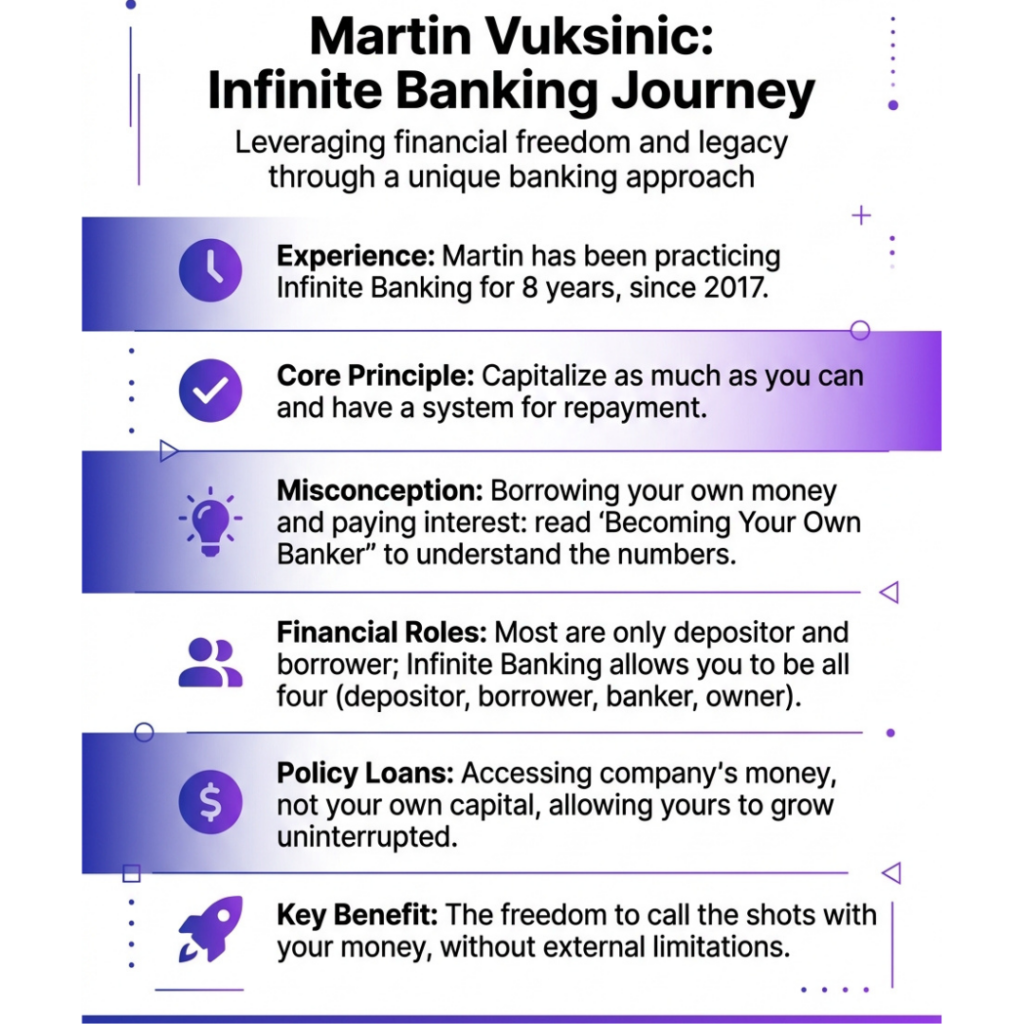
[00:08:07] Speaker C: Oh, it's, it's a day to day thing. It is, it's part of our life. You know, we operate on policy loans.
Every transaction that happens, some money's coming in, it's going somewhere else and it's being split up and capital's going here and interest is going there. Income, it's, it's assigning it know, payback schedule, you know, what you're paying in interest over the year for these loans. So you can use them as a tax deduction. Everything is assigned a purpose. And it's, it just, it just rolls. It's, it's just a, a thing that it happens. You know, it's, it's taking the money and, and putting it to work.
And, you know, we've also just started putting the money into paying our premiums right away. Instead of having it sit in the bank and accumulate, we'll, we'll put it there and it'll generate some income there as well as not giving it to somebody else to use.
Right. So it's those little things. It's, it's, we have a system and it works well.
So it's, it's just, it's a lifestyle.
[00:09:24] Speaker A: That's the key right there.
[00:09:26] Speaker B: He's living, he's not just in Mexico living the lifestyle. He's also living the infinite banking lifestyle, something that David Stern talks a great deal about. And I remember, you know, earlier on, geez, I must have been, maybe it was 2018 or 2019. You know, I remember having a conversation with you, Martin, about taking a policy loan to fund a mortgage on a rental property that you, you had and doing one of those first situation and, you know, oh, do I need documentation? Like. Well, no, you don't need documentations. It's your loan. You do whatever you want. You just need to know what Your repayment schedule is and set a proper schedule and then you know, I know this property you bought was kind of out in the middle of nowhere and you, I think you bought it mainly because it had a good access for your boat to the lake and the rental property was kind of a secondary element and you're like wow, I might do something with it one day. Somebody can pay it, they'll pay the bills, they'll pay the mortgage, it's fine.
But man, I can get my boat know onto the lake right here. Really?
[00:10:21] Speaker C: Well yeah, it was, yeah could have been a future, future destination for living but you know, things happen, things change but yeah, it's, it's still there. We still have it.
[00:10:35] Speaker B: That is awesome.
[00:10:36] Speaker A: And when you reflect back on actually accessing the policy loan, what was the experience like?
[00:10:45] Speaker C: Oh it's, it's, it's simple.
Equitable is great.
Sun life is pretty simplistic.
We, we have Manulife one Rich and I, we love those ones. Eh, that's, we kind of created a Frankenstein back in 2018.
It, it's good.
It's just the whole, the, the whole administrative side of most of that is, is challenging but I've, I've learned to deal with it. We've, we still do okay with that one.
It's in a holding pattern as it is right now but it, it's, it's a very well funded policy that is going to go to work for us probably within this calendar year.
[00:11:38] Speaker A: That's great.
[00:11:40] Speaker B: Makes it makes a lot of strategic sense for your unique circumstances.
It does not make a lot of sense from a transactional perspective.
I will say this, you may not know this Martin. Jason would certainly be familiar in a lot of the work that we've been doing with the Nelson Nash Institute over the last three years. I'm actually coming to the. Well, I don't know if it'll be conclusion but the end of the third year of a three year stint as a member on the practitioner council supporting the Nelson Nash Institute. I work very closely with you know, David Stearns and, and Lee, his daughter who now supports as well and it's, it's been a great journey and a lot of growth that we're trying to have for that. Well one of the things that came out of it is we launched something called a coaching academy about a year and a half ago for new advisors to come through and it's now a requirement anyone that comes through the NNI must attend this in the first year.
And one of the things that we were Inspired to create actually came from experiences that I had with yourself and a few other individuals with that particular policy contract, we'll call it. And it led to the creation of something called the Policy Design Considerations Guide.
So what is this laundry list of things that an advisor should be looking at in their considerations around designing a policy for a client? And a whole chunk of it is based on the life company, not just on are they a strong company, do they have good history, you know, long term dividend record, are they investing in a bunch of crap? Or do they have, you know, good history of that as well? Like that sort of thing. There's the elements of how do they interact with the people who are their consumers, how do they interact with the end client? Is it difficult? Is it a challenge? You know, do they mess up transactions? Some of those things you don't know until you have a policy or two and you get a chance to really do it. And you know, I was the first one to get one and I can tell you I've had as many. If anything, you're probably having better success with that contract than I have in my past. And Jason, you've got one as well. And how frequently does your wife initiate loans from that particular contract?
[00:13:41] Speaker A: I would suggest to you that following the first few instances, I can't recall when one's been accessed from it since. And it's.
Yeah, it's just. Yeah, just due to the experience. And that design guide that you referenced, Richard, I mean, it speaks to that perfectly because I would imagine like Martin, when you say, you know, equitable is great and you know, you reference a few companies, what we hear from our clients is never how they obsessed over the policy illustration.
What they're telling us is what their experience has been like in the implementation of the process and how they've been served in policy, loan request and fulfillment policy, loan repayments, premium allocation, when premiums are paid, and how smooth or how much friction there was in that process. And so it's just interesting to me that if you think about it, when people are looking at the implementation of this process to begin with, if they're comparing companies because of illustrations, I think there's a lot being missed.
Would you guys agree?
[00:14:58] Speaker B: I would certainly agree, but I think Martin has better perspective because he's one of those unique individuals who, like yourself, Jason has policies with multiple companies and he's incorporating the process. He's the banker, but he has to navigate still with the transactional element of moving money from one place to another. And you've Kind of experienced it from all angles, Mark.
[00:15:21] Speaker C: Yeah, yeah, it's, it's. Each one is different and. Yeah. Navigating the process with each one. You know that when this happens, you know they're going to do this and you know that you're going to have to do that within a couple of weeks because it always goes to the deposit option.
[00:15:41] Speaker A: Very true.
[00:15:43] Speaker B: Yeah. You know, if you're going to be accessing or sending money to one particular company of a certain color, that, that, that timing is not necessarily going to be your friend. And you need to prepare long time. It's one of the reasons why we say, we always suggest, hey, look, you should be planning 30 days in advance of your need of capital.
You might get it sooner. That's great. Many instances you will, depending on the company. In some instances it might be right in that target zone. It could even be a little bit longer. So having that reference point is important. That's where good coaching, I think, comes in, but also where you have to have your own level of knowledge and liquidity and you have to practice these things. There's an element of needing to go through the steps a couple of times to really begin to say, okay, here's how I need to prepare for that. Here's how I need to make sure I'm dealing with things on my end. And that's how you start to formulate your unique way of interacting with the concept.
[00:16:40] Speaker C: Yeah, you have to keep notes in my phone. Each one has notes on the steps and how they go and who I email for this and what's the email for repayment requests or notifying them before I send the money.
And it's just smooth with some, it works super.
[00:17:01] Speaker A: So I would ask you this sort of question just sort of surface for me like you've. Along the way, or even maybe before you implemented the process, you've probably heard the criticisms about the infinite banking concept. And so based on your own lived, real lived experience, can you think of things that maybe people might get wrong about the infinite banking concept? Their, their interpretation of it?
[00:17:31] Speaker C: Yeah.
Like it says in the book, it's the misconception of the word loan.
Why. Why would I borrow my own money and pay interest on it?
Well, should read a little deeper into the book then.
There's. The numbers are all there. I know Rich knows me. I'm a bit of a numbers freak show, but you know, just look at D and E in the book and they'll, they'll tell you the bottom line. You know, there's one line There I don't know if it's year 50 or 51 or something. It shows the difference in the numbers and it speaks for itself. And I think that having some experience with looking at numbers that jumped out at me, it kind of sold me on it, you know, and also it's, it's the personality of the person. It's. You have to, you have to be ready to kind of play this game. I know he, he called it a play like Shakespearean, but I consider everything a game you're playing to win.
So you should know what you're doing.
Right.
[00:18:46] Speaker A: That's so true. And what Martin is alluding to. So in Nelson's book titled Becoming youg Own Banker. And again, we get a lot of viewers and listeners. This might be the first episode that you're watching. Make sure that you add that book to your wealth building library. This is the, the premise, the foundation of what we're describing. And Nelson. So Martin referenced a few really good points. So there's. Nelson talks about. There are four characters in the financial play. You have the depositor, the borrower, the banker, the bank owner, and the overwhelming majority. If we were to address probably 99% of North Americans, you're only two characters of the four in the financial play. You're the depositor and you're the borrower. And when you can become all four characters, it opens your eyes up to a whole new financial world that you simply didn't know existed before.
And the second thing where people, again Nelson said, words have meaning.
And so when we're describing accessing a policy loan and using the proceeds of that loan to control how you finance the things that you need throughout the course of your lifetime, you're not borrowing your own money, you're borrowing the life insurance company's money.
Your capital never leaves your system. It, it continues growing daily, uninterrupted, while you're using the life insurance company's money to control how you finance the things that you need. And it's ridiculously simple. And so Martin, myself, Richard, we're always going back to the book.
And it's just so, it's so incredibly powerful. Like once you read it, you can't unsee or delete from your head bone what you've read was a domino that tipped over for me too. Martin.
[00:20:37] Speaker C: Yeah, it's, it's. Try to be as simplistic as possible when we're, we're talking about it to other people.
You know, when you're in, it could have been eight years, it's it's hard to kind of take it back. Yeah. But my wife does it very well. She'll explain it to people in layman's terms.
It's almost as simple as, okay, you'll save up all your money in your bank account, but when you need to buy the car, you're going to spend all that money on the car. That money's gone. If you put it into the system and you take the money out to buy the car, your money's still there in your system.
You just have to be responsible enough to pay it back. And that's the two rules that you have to follow. Capitalize as much as you can and have a system to pay it back.
That's it.
[00:21:27] Speaker B: That's it. In fact, you. It's almost. It's almost verbatim what Nelson says on the addendum on page 44 of the book. There's only two hard and fast rules. Yeah, you gotta. You gotta put something in, and then you gotta have a plan for putting it back. If you take anything, you know, if you borrow anything against it, it's pretty simple. And, you know, I think about it, Martin, in all that time frame, because you've got multiple policies. You've got. Your daughters are kind of involved now. You've got policies on them. They're looking at their own as a whole kind of host of things taking place there since you and I initially connected. And it's. It's been really cool from my vantage point to watch and see how you're doing your best. You know, you're engaging, you're having conversations, you're. You're really trying to create an environment where everyone is on the same page. Doesn't always work out. We. We all try, and it doesn't always work out for everyone, but you're avidly and, and really focused on making that a reality. And I think you've made some really good success along that. That path. And so what is it about being able to do this at a more integrated level as you think now? You know, how is your thinking shifted from maybe the beginning looking at this for yourself to how you look at it beyond yourself today?
[00:22:32] Speaker C: Oh, it's a tough one with the stage of life that the girls are in and with kids, and it's, it's, you know, trying to get people. People to listen. It's almost.
It's. It's difficult.
It's. It's. It's trying. It's. It's a bit of a struggle, but I know it will come.
You know, It's. It's that free time to put yourself in that position.
It's. It's not. It's not there yet.
Right. There's.
There's some participants and there are some that aren't participating, but I'm sure they'll come around eventually.
So there's, there's also new members to the family. They're. They're younger. I'm hoping that they will one day grasp this as well so that we can continue on to create even more of a legacy beyond myself.
[00:23:37] Speaker A: That's so good and speaks to something we often heard Nelson say, which was that the concept is more caught than it is taught.
And if someone is curious but maybe hesitant. Martin, like, what would you want them to know before they make a decision?
[00:23:57] Speaker C: For me, I just want it to continue.
I want it to continue. I don't want to lose this momentum.
That's what I want. I want them to understand that when I'm gone, it's. It's a game changer, and it. That game needs to continue onward.
You know, I'm, I, I'm hoping that eventually they'll all understand. Like, I see the stuff that you do, and it's. Yeah, it, it's gonna happen. It's just hopefully sooner than later.
[00:24:34] Speaker A: Well, you get to transfer the wealth mentality.
[00:24:38] Speaker C: Yeah.
[00:24:38] Speaker A: In addition to the actual windfall of money.
And I find that the more that I've been connecting with people around that phase of transferring the wealth mentality, and I just point people to, rather than waiting on or wanting to have a perfect framework for doing that, hop onto a tool like Zoom and start recording the wealth mentality that you would like to see transferred to the next generation and record it in your own words, and then save that content and make it available for family so that long after you graduate, people can go into that content in future generations, grandkids, great grandkids and so on, and they can literally listen and. And learn and observe you speaking to what matters most to you about this momentum, continuing and describing it in exactly that way. Because by the time some of these people watch the video, they are the videos, plural. They would not have had the pleasure to meet you or to get to know you in the family and to get to know your nuances and why you were so passionate about this process. And so when I just sort of shift people to think about it that way, they go, okay, yeah, that makes perfect sense. I don't need to wait until I have an engineered blueprint on how I can share this framework. Just start Talking it.
And the more you, the more you talk it, the better you get at talking it and teaching it. And the future generations will appreciate that. Because what's the first thing that most people forget when somebody passes away? The sound of that person's voice.
And you can capture the essence of you, your voice, what you want to get across to future generations simply by recording it.
Isn't that good?
[00:26:51] Speaker C: Yeah, of course it'll get me, get my fix in.
[00:26:56] Speaker A: Yeah.
Like I, Rich and I talk about this stuff all day and we record all this stuff. There's, it's not just for the benefit of the general public in North America. It's for the general benefit of our family and all the future generations that come after. They can literally go into all of our content and say, what was Richard? What was Jason? What was great grandpa talking about again with this infinite banking stuff? Go and watch the content.
I'm speaking to you future generations, three generations down the road, you're. I'm not going to be here neither Richard, neither is Martin. Watch the content and understand the mentality of what this concept represents.
[00:27:38] Speaker B: You know, thinking about all the amazing things you've been able to do and accomplish since you started this process. Martin, you know, you're also an avid reader. What I love is you're, you're a great engager in our Facebook community. You're always posting an image of you reading a book somewhere on a, on a beach or on a fishing boat, what have you. So thank you for a. Being a supporter of that and for also engaging with everyone else there. It's, it's wonderful to see when you look at some of the other books you've read, because you've read a number of them. You've read, you've read ours, you've read a number of ones around the topic. I think you've got how privatized banking really works. You probably, I don't know if you have the case for ibc, but you, you have a number of these types of books.
What, what do you find comes up for you as you're going through that and you're reading? Do you get inspired with a new idea? Do you get reaffirmed in what you're doing? What, what are some things that come up for you as you go through some of that other content?
[00:28:27] Speaker C: For me, it's, it's a different voice.
It's just refreshing again. It's reminding me of things.
The last one that came out, the one about the farming, that was fantastic. It's well written, well done.
Probably, yeah. Growing your own capital. That's the one that's, that's well done.
You know, for some people that don't get it, they read that they might, they might get it, you know, it might click something because it, it does put everything together.
So that's, that's what I like about the books. It, it's a different read and it's, it's all along the same lines, but it's, it's refreshing to me for, for that topic, so.
[00:29:27] Speaker A: Oh, thank you for that. Yeah, it, we, we tried to look through a different lens at the same process and we just put a different lens on and say how can we communicate it through this lens where a person can develop a deeper understanding of the infinite banking concept and how it could be and represent an advantage for them.
[00:29:52] Speaker B: Right.
[00:29:53] Speaker A: I'm super curious because you mentioned this, that you want the momentum to continue.
So if, the process itself. So if, if infinite banking disappeared tomorrow, what would you miss the most?
[00:30:07] Speaker C: The, the freedom.
It's, it's, it is, it's the freedom, it's call the shots to do what you want with what's yours.
Nobody's going to stop you.
And that's the big one for me.
I don't want somebody telling me I can't do this with what's mine.
That's really what it comes down to.
[00:30:31] Speaker B: And you've had that happen before, haven't you?
[00:30:33] Speaker C: Oh geez, yeah.
Haven't we all?
[00:30:37] Speaker B: As a business owner, trying to get capital in the past wasn't always easy, I suspect. And even when you had a lot of it, they still seem to make your life difficult, didn't they?
[00:30:45] Speaker C: Yeah, yeah, a lot.
[00:30:50] Speaker A: Brings back nightmares.
[00:30:54] Speaker C: Yeah.
Feel sorry for people.
[00:30:57] Speaker B: Martin and I have dropped a few expletives on the odd phone call talking about various banking institutions, I suspect in the past.
[00:31:04] Speaker C: Oh yeah, that is so.
[00:31:07] Speaker A: Yeah, that's so true. And you'll, for everybody watching and listening, I mean you'll recognize Martin described, you know, the, the control and the freedom and he didn't say, you know, I'm going to miss understanding a policy illustration or what the dividend scale interest rate was from the life insurance company for the past 278 years. Like it's, it's in the here and now, the peaceful, stress free way of life that it can empower you to create.
And also as Martin's alluding to, it's that, that future momentum, that legacy.
And for myself personally, I can't speak for you, Martin, I'd love to hear your Insight on this. It completely changed the way that I think about family and legacy and future obligations. What are your insights about that?
[00:32:02] Speaker C: Yeah, of course, it just makes you strive for more.
You want to just do more.
Yeah, you know, it's. There's no, there's no holding me back.
I, like I said, there's no word retire anymore.
You know, I just, I live a different lifestyle that I choose to live, so it's where I am right now.
[00:32:29] Speaker B: Love that. And when you think about, because you've taken a lot of loans for different, lots of different purposes, what are some of the, let's say, transactions that have been a particular interest to you or that comes to mind where again, there's the freedom aspect and the control, the repayment schedule that you got to determine. Now you've done ones where, you know, you weren't making loan repayments because you could pay it all back in a lump sum later, like not, you know, payment holidays. The things that you can kind of control for like a business transaction. What are some of the ones that pop up for you that you thought was just really important to have that control over that transaction?
[00:33:10] Speaker C: Well, having rental income property, it's. It's taking the money for upgrades or maintenance and putting that money to work there and assigning it the interest rate, which is in turn a tax deduction. It's.
It's on a schedule. But that interest isn't really going to hurt us. If anything, it may benefit us a little bit.
Yeah, it's, it's. It's using policy loan to take out money to pay the property management fees for the entire year, and then we slowly pay them back.
That interest goes towards a tax deduction on the rental property anyway.
New furnace or like this room that they're working on in the back that you probably hear now where they're using chainsaws to cut stuff because they don't have skill saws here.
Yeah, let's just, let's just take a breather here for a second.
Cut this post down.
[00:34:22] Speaker A: No, it's okay. We actually, it's the, the filter in our system is pretty good. It drowns out any background noise.
[00:34:29] Speaker B: Okay.
[00:34:30] Speaker C: I can hear pretty good.
[00:34:31] Speaker B: I do like, I do like that you're resisting the urge to go look out the window and see what kind of damage is being done, though.
[00:34:38] Speaker C: They're actually Mayan guys and they're working with some natural wood that is as hard as steel. And they're. They have to cut it with chainsaws.
Otherwise it'll just start on Fire with a skill saw. That blade does nothing to this stuff.
So.
[00:34:55] Speaker B: Well, that, that's, that's interesting. I like learning about new, new things like that too. So. And, and you know, you've got, I mean you have your property that you're, you spend a fair amount of time with down in Mexico. Of course, I'm sure you've had policy loans engaged in that process.
I know you've done some lending to third parties like family members and things of that nature as well.
Being able to just have the autonomy to make those decisions.
And again, the, the control of the when and the how you repay. It seems like that's a key theme for you. Would you agree?
[00:35:25] Speaker C: Yeah, the third party lending is, is, is amazing having that capital available to us, you know, you know how that works. Yep. Those who have the gold available and opportunities, they just come and find you. So we definitely take advantage of that, that game and it's, it's, it's a great system we love.
Works really well for us and it's a, it's a great cash flow and it keeps everything moving. Nothing's getting stale.
[00:36:04] Speaker A: That's amazing.
I'm curious genuinely because I ask when we do client series interviews,
[00:36:14] Speaker B: if you
[00:36:15] Speaker A: were to share just in your own words, what your experience has been like working with Richard and working with by proxy all the team that supports Rich and I, and what has your general experience been? Just in your own words. And you can attest we didn't preempt you on this question. You had no idea it was coming and so would love to receive your, your feedback real time.
[00:36:40] Speaker C: I'm your biggest fan. I'm an ambassador.
Rich is a great guy. I'm, I'm so happy to have met him and had him be a part of my life for the last eight years. It's game changer.
Now if there's any time you guys leave me to step up and a voice for you, I'm there.
Coming to the family banking summit, I just wanted to face to face Pat. You guys look back and that's it.
I'm happy with the, the product, the service, the people. It's great.
They're all a great bunch of people.
[00:37:23] Speaker B: Well, we appreciate that. Nelson would say it takes two to tango, Martin.
[00:37:26] Speaker A: That's right.
[00:37:27] Speaker B: And you, you know, he, he would also indicate that. So what you got a telephone, big deal. If you don't have someone on the other end of the line, you ain't got a thing.
[00:37:39] Speaker A: Yeah, Martin, this was fun. This was a lot of fun.
[00:37:44] Speaker B: Well, Martin, we We appreciate having you here and I appreciate you being in my life as well. I always love our conversations, filtered and unfiltered. Either direction, I'll take them.
I always love seeing what you're up to with your family because you're, you're a mover and a shaker. You're always up to something new. I never know where you're going to be when I talk to you or, or what, what's going on, what random job you decided to take because they decided to pay you a bigger ticket to do it. And it's really been, been a joy to be able to be a part of that experience.
And it's also been a lot of fun to be able to help with your family members as well. You know, your brother's an amazing guy. He's been on our show as well. And I, I just had an amazing conversation with him the other day and lo and behold, it started about infinite banking. And we diverted onto other business topics and he may have redeveloped a website in the time frame of our conversation. I have no idea. But we certainly had a lot of fun in that conversation as well.
Great.
[00:38:37] Speaker C: Awesome.
[00:38:38] Speaker B: Martin, as you know, of course, we, we always ask the tough hitting questions. We did a few of them today and maybe not so tough, but while you're listening to chainsaws in the background and you're thinking about the amazing construction that's happening with this unbelievably steel wood that you're discussing, you want to create this, this environment of solid steel legacy that you discussed today. And so we were just curious, who is it you most want to be a hero to?
[00:39:06] Speaker C: I want to be a hero to everybody that's coming up after us.
The young, anybody who will listen.
That's really it. That kind of. You segued into that.
This was my answer. So anybody that's coming up behind us, my kids, their kids, anybody who comes after that, I want to be a hero to them.
[00:39:33] Speaker B: Love it. Awesome. Barn, thanks for joining us from Mexico today. Thanks for being an avid listener and a great participant in everything that we do and for being an advocate and an ambassador. I think it means a great deal. It certainly does to Jason and myself and to the members of our team. So keep on keeping on. Let's make 26, 2026 an amazing and incredible and profitable year. And I look forward to the next time you and I get a chance to chat. For those of you, of course, on the YouTube, you'll see some magical content that says, watch this here and you may even see a great book recommendation like heading on over to grow your own capital.com and getting a free copy of this book that Martin mentioned. And we look forward to hearing from you after you've decided to take on this concept in your own life.
All right. You're a farmer, you're a rancher. It's time that you had more control, figure out how you can finance your operation, have way more control and keep your farm where it belongs with you and your family. How are you going to do that? Well, visit grow your own capital.com, that's growyourowncapital.com and pick up a copy of this incredible book. It's going to teach you exactly how to do it.