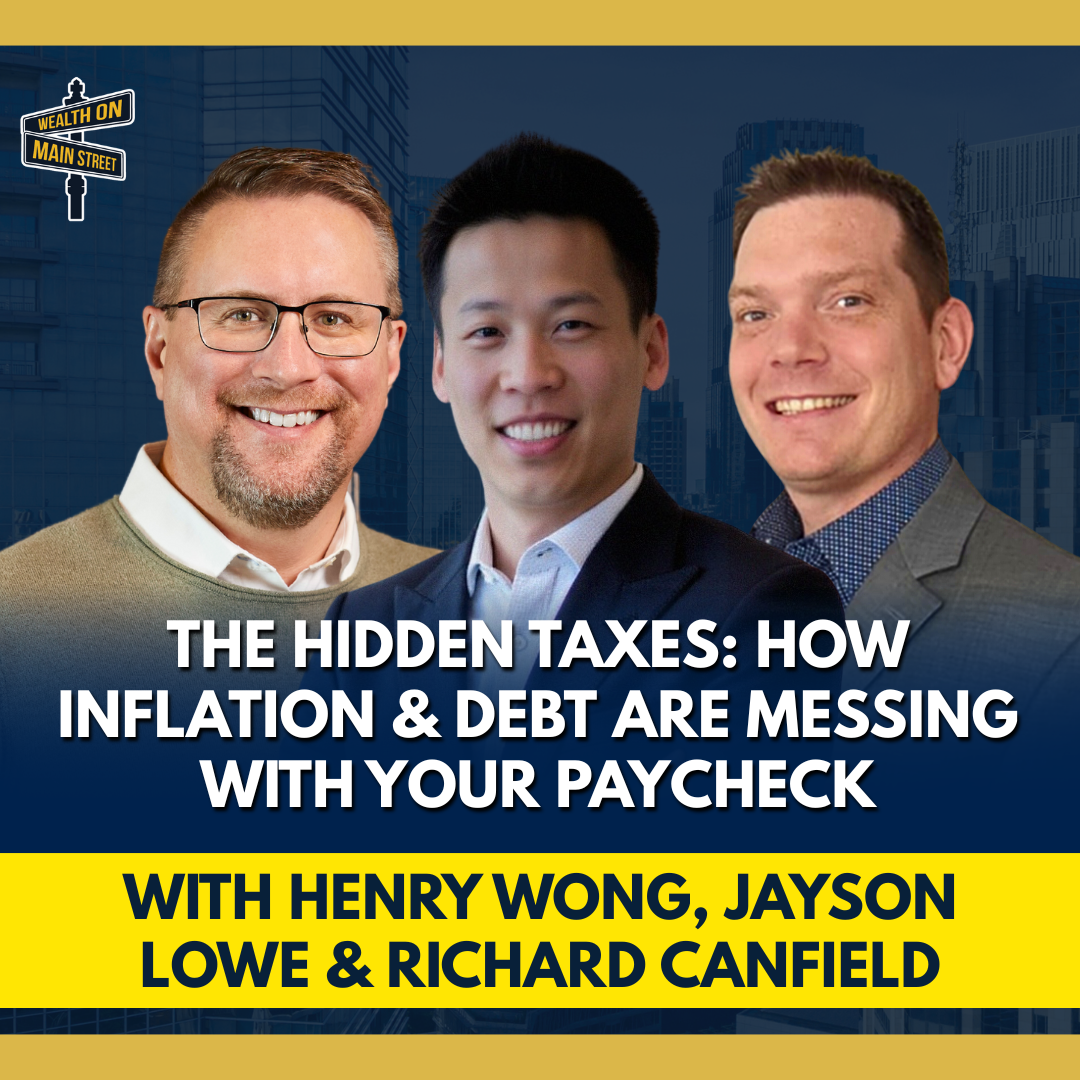
[00:00:00] Speaker A: I call it the triple threat episode with Richard, Henry and I. This is part two. We're talking about the money stuff that actually shows up in your life.
[00:00:07] Speaker B: You know, what you're doing is you're creating engagement and confidence in some area of your financial life.
[00:00:13] Speaker A: You're punished for trying to keep up with the damage that the system caused in the first place.
[00:00:17] Speaker C: Most people are actually watching the wrong scoreboard.
[00:00:20] Speaker B: No one gets really amped about opening up their bills.
[00:00:24] Speaker A: The only people who benefit from this system are the ones who create money and the ones who lend it.
[00:00:28] Speaker C: Financial markets don't give any warnings. They don't knock. They just drop.
[00:00:33] Speaker A: The fact of the matter is, most people would rather die than think.
[00:00:38] Speaker A: Okay, welcome back to the I don't call it the triple threat episode with Richard, Henry and I. This is part two, and as you know, I mean, it's. We're talking about the money stuff that actually shows up in your life. And.
[00:00:55] Speaker A: This part two is for the you and me crowd, the ones who are working and saving and wondering why it still feels like our money disappears faster than the last donut at a staff meeting.
We're talking about how inflation, debt, and the banking system are quietly messing with your paycheck. And Henry's gonna lead us through a lot of great value there and talk about what you can actually do about it. So there won't be any jargon. It's just going to be the truth.
Because nobody on Main street is getting rescued by a stimulus package.
We talked earlier in the first episode. I mean, if we want to win, we don't have to play their game. We get to play ours. And so that's what this episode is about, and how to stop, I guess, losing money the normal way and start keeping it the smart way.
So grab your Tim Hortons or grab your Dunkin Donuts coffee and buckle up, because this is about to get real, and you're going to learn how this can work for you. And so wealth on Main Street, I think, is where common sense is still legal and control is the new currency.
And thinking differently is definitely not optional. So let's dive in, guys.
[00:02:14] Speaker C: Awesome. Really, really happy to be back. And the last part we talked about was the impact of tariffs and on enter enterprise value for business owners overnight. That really draws a lot of headaches. And it starts blurring the lines between personal and corporate today. You know, when we talk about tax, most people just think about income tax. I think the first thing is to pay attention for the headlines for the right reasons, not for the TV programming, but more so for how it can translate to the impact to you. And so this is where we'll dive into how those headlines or policy decisions, how does that really relate to your, the UME level? Because what I like to refer it to is silent tax.
It could be labeled differently as inflation, it can be labeled differently as tariffs. But those policy decisions that are happening at Ottawa and Washington, they will make decisions in a system that you don't control, you don't own, such like printing money or raising tariffs or piling on more debt or spending more for new programs. All of that is going to show up somewhere. But they're not giving you an invoice with line by line items on the receipt that you actually paid for this. You know, it's something that no one's really telling you. So trying to help translate that because it sneaks into the prices of everything you touch, from your groceries to the fuel station that you go through and the mortgages, these are all silent taxes at work. It's not again, income taxes, but it's an erosion of what your dollars are starting to do for you. When Capitol Hill or Parliament Hill make those decisions, they ripple straight through manufacturing, shipping, energy, and then it ends up right here in your cash flow. So I want to share another diagram here. This one is specifically at the family finances level. And so similarly, something like a tariff increase, especially if, especially if you're importing goods from, you know, the US or such, if there's impacts to some way duties that, you know, Canada raises on you, these are still taxes, they're just called duty. But that's going to result in consumer prices that change for you. Things like interest rate, things like your mortgage payment and ultimately your cash flow. So if you're on $100,000 salary and you're getting the CPI, bank of Canada inflation rate, while you're still on a fixed income, it's risen above that. But the actual reality of what we talked about wasn't, doesn't actually translate the exact way. And today we'll really dive into it and help. See, we're going to look under the hood and see the mechanics of how it's actually impacting you because most people are actually watching the wrong scoreboard. The CPI and Ottawa's scoreboard or Washington scoreboard is theirs. But your family scoreboard is related to these cash flow, the margin, and in true fact, your time and your freedom because no one unpacks those costs for you. And the things that we're going to talk about will start Helping you see it from the vantage point and the lens that hopefully we want you to see.
And if you don't see the full chain, you don't see the relationship, then you can't design a structure, you can't design the right. You can't bring in the right tools, and therefore you then can't apply the right strategies specific to your situation.
Everyone's wealth portfolio is different. So they're going to apply different tools, they're going to apply different strategies. But if you're buying strategies or if you're buying, you know, different tools without clarity on the context and the environment and the relationship to them, to your goals and objectives, then you're chasing rates of return, which is what they want from you.
[00:06:04] Speaker B: What I love about the image that you have on the screen, Henry, is of course, everyone's seen literally on tv. My son was watching, I think it was an old Simpsons episode. And of course, because you don't see these where let the ball go and it hits on the other side with these marbles anymore. They used to be really popular. And he's like, oh man, I really want one of those. And so that just happened a couple of days ago. And here you are using this imagery for our example today to talk about the impact of a government decision, a tariff situation impacting the product that's being imported or exported or what have you. And then the chain of events that. How it swings towards, you know, eventually hitting your pocketbook.
So I really like the visual there. And I think that, you know, anyone who's watching on YouTube who's not driving in a car will really connect with it.
What. When we think about this, there's also a time like to some of these things and it shifts depending on the type of product.
And I think about a business client of mine who's, you know, they're kind of in the iron and metal fabrication business.
And so they watch a lot of the product for steel and they're looking at when prices are up and down from a general commodity perspective. Like they're looking, when should I be purchasing? And sometimes they'll recognize, you know, this is a pretty good price. We don't need all this material, but we're going to go hard in and get like double what we need.
Huge purchase order, just so they have that stockpile in place for a way to hedge against these types of events, whether it's a tariff or some other spike that takes place, that's an unknown market condition. And that way now when they're looking at pricing for larger products projects, if they're looking at bids, they can say, you know what, we might be able to shave our bid a little bit better than some of our competition because we've been able to secure pricing, known fixed pricing on what we have in inventory. And like that's another method of looking at the, the power of having liquidity and capitalization in place to make a strategic decision like that. So when we look at the pocketbook of the average consumer, they might not see that impact and they might, you know, that element could actually.
[00:08:17] Speaker B: To some degree almost push out the impact that we might see on our pocketbook because there's a little bit of that that's happening with the business. So they're not shoving all of that price point to the end consumer yet. They're almost like amortizing it over a period of time to when they see the real impact. Do you kind of see what I'm getting at 100%?
[00:08:35] Speaker C: It depends on the position of that business and how close they are to the raw materials that is affected right off the bat. So let's say back in March 2025 is on aluminum and the other kind of metals and that is, that's raw material that will immediately feel that impact as opposed. And then there's that lag as it moves down the value, the supply value chain for consumers. And when it gets to the consumers, at some point it's going to reach in there. As you're saying, if they're melting it gradually, amortizing it through, then.
[00:09:12] Speaker C: If they were in the right capital position at that time, they could bulk buy and hedge it from that vantage point. But at some way this will reach to the dinner table of families.
The prices can no longer be absorbed by the business and they have all come into the hands of the family.
[00:09:32] Speaker B: Okay, so you want to keep the wealth in the family. I get it. I hear you. Me too. That's why we wrote this book, don't spread the wealth. Everyone tells you that. You want to spread the money, spread the wealth around. No, no, no, you don't want to do that. You want to keep the money in the family with the people you love and care about, where it belongs for as many generations as possible. That's what we talk about in this book. In this book we have an incredible 15 page bonus you can download which instructs you on how to start the conversation with your family, on annual family banking meetings, how to host them, some sample exercises and a sample agenda. Tons of amazing great benefits. Go ahead, get a copy Right now head on over to don't spread wealth. That's don't spread wealth.
Don't spread wealth dot com. You're going to love it.
[00:10:14] Speaker C: So what I want to share too is if we were to take a step back just 10 years and since 2015, what I'm just going to share on screen and this has happened globally, it's not just in Canada and the U.S. but we look at in 2015 those impacts things like deficits, things like tariffs, things like taxes, at least for the Canadian contacts that I've put down. Purchasing power from that $100,000 has gone down to the, has gone down 28% or that purchasing power. So when the governing bodies are spending more than they earn, they're printing to cover shortfalls, layers on trade fiction, all of that's going to make its way through to you. And it's, this is the way that I would phrase it as. It's the slowest confiscation in history. It's just happening bit by bit by bit by bit.
So on an annual basis you can kind of see your purchasing power where that you maybe have worked a decade, but you're making less than what it is. The value of what you've been spending has been going down, down to the arrive compounded 28,000. So it starts with 2,000, then you know the 5,000 since compared to the year before and then three years later 7,000. And then we keep moving down towards this vantage point. So the, these cumulative little cuts add up very, very heavily. You don't feel it, but they add up. And this is just on the published numbers. Imagine what the actual numbers are.
And just for, for the reference when you look at someone's income. So the context for listeners to capture is you're part of a progressive income tax system. You never really got to choose it, let's say. But when the purchasing power, when your purchasing power goes down and if you need to work, let's say as an example, you're working overtime, so you're going to clock in more hours to cover for that shortfall. So the way that you can measure for that shortfall, no one's going to tell you, but you need to, if there's a 28,000, sorry, 28% decrease, well, it's 28,000. So if I put that same $120,000 compared to the $100,000 after flushing it through that income tax system, you will see that your after tax income is $91,000. So it's not really $100,000. So why is it not $100,000? Because there's the progressive tax system, the relationship to it. Because you're earning, you're not. Even though you earned $100,000, you'll lose the amount of money. So you're down 78. But to get to the same 100,000, you actually have to make more money. And then when you're moving up and making more money, you're tapping into higher marginal tax rates so that $10,000 to restore back to 100,000. So again, it should be 100,000 if you want to be the same. But you actually have to earn more than that just to break even. So just unpacking these pieces as it relates or dissecting these pieces here, you. You wanted $100,000. You want the same purchasing power of $100,000.
But because of the erosion of your purchasing power, you will work more to get restore that a hundred thousand dollars. But you actually have to work even harder because there's another tax system that comes in play, the tax system which is now taking an extra 10,000 from you.
[00:13:44] Speaker B: Just to recap, Henry, really, what we're getting at is here, look, just because you're working harder to replace the earning power, the buying power that you need, and you're putting in the extra time. So there's a three pronged hidden loss taking place, hidden impact. And this hidden impact, it's like a hidden pain. It's like, you know what? You have a major injury and the bone is about to break. You don't even know. And then all of a sudden, when it happens now you got to go into recovery. You got to go get a surgery done. Because this, this major element is building up over time. So we have the inflation that's eroding the buying power. You had a hundred thousand, now you're down by 28%.
Okay, well, I can work $28,000 of extra income, but because of the tax problem, I'm increasing the tax distribution to the government, not to my family.
That doesn't give me the equal purchasing power. So I actually probably have to work closer to 100 to, like, get to 136 or $138,000 in order to equalize the purchasing element of what I've lost. So there's an. So there's an increased amount of time, effort, and energy at work.
So that's less time for your family. That's time away from things that you would need. You're working harder. It puts stress on your body.
You're feeding the tax system more and the impact of inflation, which in itself is a hidden tax, causes the almost a requirement to pay more tax in other areas of your life, hence creating a double taxation event that you didn't even know was happening.
[00:15:16] Speaker A: I would add to what you shared Rich, which was excellent. And Henry, this is amazing.
[00:15:22] Speaker A: It, there's only two ways that you can respond to the reality that we're outlining here.
You can complain about the machine or you can learn how it works, which is what Henry's teaching, and you can position yourself differently inside of it. And that's what the, the infinite banking concept equips people to do. It lets you step out of the part of the machine that leaks value and moves you in to the part that compounds it. And instead of keeping cash in a system that is continually devaluing that cash, you're moving money into a private contract based environment, a dividend paying whole life insurance policy, or ideally a system of policies. And the capital that you have ready access to, the amount is increasing every single day by design.
It isn't tied to market cycles or, or government policy decisions.
And you're still using that capital for.
[00:16:38] Speaker A: Anything that you want to control in terms of how you finance, but you're doing it from a position of total and absolute control. So now you're playing your game, not theirs.
You're compounding capital while you deploy. You're, you're borrowing from strength, not dependency.
[00:16:59] Speaker B: Right.
[00:17:00] Speaker A: And you've essentially aligned yourself with the underlying principle of how wealth is actually created through control, leverage and time.
And so when I hear somebody ask me, what's the return, what's the roi? It's one word. It's control.
If you understand the machine, you can make it work for you. And the infinite banking concept, is that understanding in motion?
[00:17:26] Speaker C: Absolutely. And we're not comparing this process of controlling the banking function to investments because we can still, as Jason, you aptly shared, we're coming from a place of strength. And what's missed is the behavior of the policy owner. Everyone's just looking at the product and comparing one process to another process or one product to another product. And the element that is often missed is actually the policy owner's behavior or the behavior or the banker of the system.
And when we look at these, I'll call it effects from things like inflation. Inflation doesn't just raise prices, it lowers confidence. So if your confidence is down.
[00:18:09] Speaker C: You will find yourself back into a system of dependency versus coming from a system of control and strength.
[00:18:16] Speaker A: Anybody watching or listening?
You worked for a decade to make less, not because you failed.
It's because you were playing by the rules that were designed for someone else's advantage. And it just doesn't have to be that way.
[00:18:30] Speaker C: And just as these processes that we work with our clients can be engineered, it will move you from reaction to design. Because inflation, if inflation and loss in purchasing power is engineered, resilience can also be engineered too.
And this is the key takeaway to separate the difference instead of chasing returns is to shift the thinking towards building resilience and engineering it in your favor.
So the next part that I want to highlight and share with everyone is how that can't be quantified and what that $100,000 from 2015 actually buys for you today. Okay, so just to expand back on this 91,000, that $10,000 is the tax gap because that will be enriching the tax collectors as it relates from that policy decision.
But you're the one taking the cost in the erosion of the purchasing power. So the first part is they shrink your dollars with inflation, then they punish you for earning more of those shrinking dollars. And it's not unfair, it's economic sleight of hand. So you get a raise to keep up with those high, higher prices. But it's not really living large, that progressive system, it doesn't care why you got the raise. It's just, it just sees that the number is bigger. And because of the progressive tax system and how it's been designed, the higher the number, the more that it's going to be taking. So it's like you're rich now, so just, just pay more. And while you're trying to climb out of the purchasing power erosion, your tax rate is climbing and you're not getting ahead, you're actually getting harvested.
So these tax brackets are adjusted for real value, not inflated numbers. And most Canadians who are thinking in the position of just working harder is not going to happen in paying less. You've got to think and engineer the processes different tax policy and monetary policy and tariff policy and other drama effects that's happening on Capitol Hill or Parliament Hill. They don't talk to each other. There's no centralized system that it works together, at least for that I know. So.
[00:20:50] Speaker C: You'Re really just losing that value from a weaker currency.
[00:20:56] Speaker B: How would you like to see a 91 year case study that we put together to explain how this infinite banking thing can work for a family over two generations? Well, you know what? Real easy to do that. We have that right in our second Book Cash follows the leader. You can get a copy for free, delivered right to your inbox. Head on over to cash follows.com that's cash follows.com and pick up a copy right now.
[00:21:21] Speaker A: Anybody listening or watching? I want to ask you one question.
How do you feel about being taxed at a higher rate for earning more of what's now worth less?
[00:21:34] Speaker A: Just take a moment and, and internalize that.
You're punished for trying to keep up with the damage that the system caused in the first place. It's like, it's like running on a treadmill that speeds up every time you start catching your breath.
You're running faster, but you're not moving forward.
And so if you stop to think about that, the only people who benefit from this system are the ones who create money and the ones who lend it.
Everyone else is stuck in the shrinking version.
That's where the infinite banking concept changes everything.
[00:22:08] Speaker C: So we just kind of talked about the income and the discrepancy to thinking about what you are gaining to keep after these policies. But what about the impact as it relates to your wealth? So there's a bucket related to your wealth and how you've structured your wealth currently or whether it's structured or unstructured. But there's components and let's use a really common example as it relates to how do these impacts have to your wealth portfolio. So what I've shared with you here is just kind of a collection of the history and on a nominal sense when we look at all of this. So again, I'm just using 1971 or 1970 as the initial history. Look back from when the dollars were depeg or unpegged or removed from the attachment to gold. So with that reference point, every time the government needed to bring more money into circulation, they had to have the corresponding value of gold assigned to it. But when 1971 happened, they decided to deg it and detach it. So you doesn't matter how much gold you have, they can have that much dollars. Well this, this sets a really important precedence that now we have history to look back to all of that. Now when most people build their wealth personally, most of them will use traditional wealth, sorry, traditional tools as example. TFSAs, RSPs, unregistered accounts, real estate, doesn't matter the asset class. But what's important is what is most predominantly shared is just invest it with the S&P 500. So what I've shared with you is the S&P 500 from 1970. And I've just highlighted in particular points of time when those economic shock events or collapse events happen.
And this is something that I just want to highlight that when we talk about building wealth, I believe in the philosophy that it should be something that has that you want to engineer volatility out, you want to not have all of these type of. It doesn't sit well in my stomach, let's just say so we don't want you. You want a compass. You don't have a crystal ball of what's going to happen, when it's going to happen. And so that the prediction isn't a gamble. A compass provides the direction.
[00:24:30] Speaker B: A couple things about the image you have on the screen, Henry. So number one. Yeah. 1971 to 2025 present you've listed oil crisis, Black Monday, another oil crisis. We've got the dot com bubble, COVID 19 tariff market shop. What you don't have listed but it's clearly easy to see on is the global financial crisis in 2008 because it's a giant dip right there. And you can see the dip there and then the dip in basically like 20, 20, 2021 area is equally as drastic. And that's kind of like you basically are looking at Almost a lost 20 year period of time right there. If you just look at the S and P. Yeah. While they say that the Nelson Nash would call us the mountain wave graph of lies because it looks like little mountains and it looks like it's a wave. So he calls it the mountain wave graph of lies. And Nelson would reflect and Jason, you'll remember this when he was talking about when Nixon made the announcement about detaching US dollars from gold, Nelson was so angry, he said he almost threw something through his television. And of course television was really expensive back then. 1971, Nelson had one because it wasn't just that he. What he had done, it's the statement that was made. He says we're all Keynesians now.
In other words, everyone is now operating on the economic principles of John Maynard Keynes, which Nelson felt very strongly about. And he says, you're not talking about me. He yelled at the television. He wanted to throw something through. And he says but fat chance of good. It would have done me anything based on the situation.
But this is where a lot of his recognition and his understanding of what he had been learning from the foundation for Economic Education from the Mises Institute about Austrian economics, he was clear that this was not the right direction for the world to go. And it's my belief that that point in time in his life with what he had been learning, coupled with over the remaining decade, a decade later, the rapid rise of interest rates, how that impacted him financially. Those were the premier years of him being in business for himself and learning what was going on. To recognize the building blocks of the dividend paying whole life insurance policy was what he was looking for.
You know, the combination of what Nixon did, the Austrian mindset versus a Keynesian mindset, followed up by the, the rapid increase of interest rates that almost decimated him and his family.
All of those elements were a build up that led him and led us to be in a position where we can even be recording this podcast today. So I, I just find it really interesting what you're sharing with us on the screen. Yeah, yeah.
[00:27:01] Speaker A: I, I would say, Richard too, that the irony of all this is that.
[00:27:08] Speaker A: You know, the same, the same system that punishes your income, rewards your ownership.
[00:27:15] Speaker A: The banks, the banks do it right, they just never taught you how. And.
[00:27:22] Speaker A: This is where again, you know, we, we speak about our Nelson Nash and how blessed we were beyond the definition of good fortune to.
[00:27:30] Speaker A: Spend as much time with him as we did. It was an incredible joy to know that man. And he helped us to think about our thinking, not his, but to think about our own thinking. And that's what we're trying to convey here in, in what we're, what we're sharing. I mean, your dollars are shrinking. Your, your hard work is being taxed to earn more shrinking dollars.
And the infinite banking concept lets you own the process that keeps theirs growing. There being the bank and the government.
That's how you're going to step off the treadmill and do what I did. I share all the time. You guys, you may have never, I don't know if you ever heard me say this, but I share this. Even in our family banking meetings, we've made inflation irrelevant.
[00:28:24] Speaker A: It's just irrelevant.
[00:28:28] Speaker A: Isn't that good?
[00:28:29] Speaker C: Absolutely. And you know, one, the most conventional advice out there, again, right or wrong, it's everyone, you know, I, I believe in controlling the direction, how you want to place and use your money. But the main, the most popular message that is shared is to build your retirement in a structure of an RRSP or 401k that's tracking the S&P 500 and the Vantage point I just kind of want to highlight here again just for notice, this image was generated out of ChatGPT and it was not very precise in placing the arrow as incomplete. So just kind of putting that there. But when you're putting money into these structured tools.
The first thought to think about is who does not who started those tools and who can it be designed for. And the vantage point I would think about is now underlying what's being the contents of what's in those containers.
The thought just for you to think about is you're not really investing. When I look at this, I'm waiting and wondering when I'm going to get nuked. Financial markets don't give any warnings, they don't knock, they just drop. It's like a silent plane flying overhead. And by the time you look up, your wealth is like, whoa, what happened? This isn't a good strategy. This is exposure without protection.
It's diversification. And diversification isn't just about having a mix of different tech ETFs or manufacturing or basic essentials. It's about diffusing the risk before it detonates. And the important thing that as you're listening, if you can take away hope, is not a hedge structure is the survival. And we're talking about the positioning of where your capital and what you want to do with that capital.
[00:30:22] Speaker B: We want you to understand the five strategies that you can use to reduce taxes now and in the future that we wrote about them in our book Keep taxes away from your wealth. You can get a copy of keep taxes away from your wealth by going to keep taxesaway.com that's keep taxesaway.com. ease on over there. Get a copy today.
[00:30:42] Speaker C: The next thing now I just want to highlight as context for some context is I think you can remember the last.
[00:30:51] Speaker C: Graphic that I shared was comparing the price of homes to I'll say gold as what it was, 537 ounces to 121 ounces.
So this value, just to kind of recap is the home didn't really raise in value. It's the same value. The gold didn't change in value. The only thing that changed was the medium of exchange or the paper currency that was the legal 10. That is the legal tender or medium of exchange. And that has eroded in that value, which you can kind of see from the value of gold, the home value denominated in gold.
So when we look at this from this vantage point, if I were to now tie in that, you know, it's not about gold losses and stocks winning, it's that the dollar.
What I want to highlight is the dollar is the thing that's losing. So let's take a look at it this way. So on the left side here, you can see that.
[00:31:57] Speaker C: Everyone will Celebrate. Most people, most advisors or financial entertainers will celebrate. Like if you put your money in The S&P5 some, you know, they don't talk about the structure of where it's located but you know you'll average a 12% rate of return or 10, whatever that return is. So when you use hindsight to your evaluation to that you look at it and it's confirmation. My, my opinion is confirmation bias. Look. Oh yes, you see it go up. On average it's going to go up. Who cares about these detonation times. You will come out ahead.
Well let me take a, let me kind of share a little bit of vantage point again denominating the same thing in the value of gold.
And I'm using the most common reference that to say oh, index it against the S&P 500. Now in Canada maybe most people would say you should be putting it into the TSX 500 or so such right the top, you know, TSX 60 or whatever the index is from there. But I'm using the S&P 500. So there's also gain from foreign exchange, US dollar to Canadian dollar and all that stuff. But nonetheless the highlight in this denomination is using the same price of gold, the 537 ounces.
If you put that same amount of capital initially and you put it into the S and P in the RSP and then let's not forget there's after tax effects of it coming out, the net gain from outside of that registered structured tool is 605. So that works out to about 12% of a difference. So why does that matter? So what that matters is if we look at from this vantage point all those sleepless nights watching the market swing on headlines that you can't control today there's doom scrolling on X or while your portfolio is sinking or stressing over Fed meetings or war oil prices earning calls for what about a 12% difference?
And this is just not doing anything. But think about the other financial costs as it relates to your advisor who's taking the cut. As it relates to, you know, finding you the best hedge fund or investment manager that's putting it into these products that give some really good fees and commissions to the advisor. Now this is all happening when you're taking the risk of these potential market swings and market volatilities.
So if we remove all of that component of the investment management industry and we're just looking at it in a value representation of gold, that, that in my opinion, for me that exercise was very, very painful to go through during that time as opposed to if I just stored it under my mattress. I'm just using that as an example in the denomination of gold.
[00:34:57] Speaker A: You know, Henry, what comes up for me as we've gone through this in part one and now in part two where we've, you know, looked at the, the impact on entrepreneurs, business owners, and then the impact of people who don't live on Wall street, they just live on, you know, Maple Avenue.
Yeah, it.
[00:35:25] Speaker A: For me, it's, I, I see it as.
[00:35:31] Speaker A: People developing an understanding. Nelson used to say, when you understand what's going on, you'll, you'll know exactly what to do.
And you've got a scenario where people are.
[00:35:46] Speaker A: They'Re earning more shrinking dollars.
[00:35:50] Speaker A: That's a problem.
And you've got a solution to that problem.
[00:35:56] Speaker A: The infinite banking concept and the tool that's used to implement it.
[00:36:02] Speaker A: Dividend paying, whole life insurance policies.
[00:36:07] Speaker A: Something quite old fashioned and boring.
[00:36:11] Speaker A: The kind of thing that makes most financial influencers mock.
[00:36:17] Speaker A: But inside of that concept and tool is the most radical idea that people discover.
[00:36:27] Speaker A: Control.
[00:36:29] Speaker A: And they get to a point where they're not asking, can we afford this? They're asking how should we finance it?
[00:36:37] Speaker A: And when you are in a position, you know, I've been doing this since July of 08. Rich began his journey in 09. Henry, what year did you begin your journey?
[00:36:48] Speaker C: Started in 2018, but practiced 2021.
[00:36:52] Speaker A: The time has flown by, hasn't it?
[00:36:54] Speaker C: Just a blink of an eye.
[00:36:56] Speaker A: Can you believe that Nelson would always say, the time's going to go by anyhow.
And so people who are listening and watching, when you catch this, because it's more caught than it is taught, then.
[00:37:12] Speaker A: The game is no longer about earning more shrinking dollars. It's about creating a place where your dollars can't shrink.
Think about it.
[00:37:22] Speaker C: And most advisors manage portfolios. We help people manage systems. Now portfolios move money, systems move power.
Most advisors will rebalance funds. We work on helping clients rebalance the architecture that funds their lives.
And Jason, I know you shared last time.
Advisors focus on returning the returns inside the box that they don't control.
[00:37:48] Speaker A: Right.
[00:37:48] Speaker C: We're designing the box because it's not your stocks that make you vulnerable. It's how your cash flow, your debt, your taxes interact. When those policy announcements come and those shifts that happen to you, the real.
[00:38:02] Speaker A: ROI here is control.
[00:38:04] Speaker C: And the goal is not to react faster, it's to depend less. When you control your system, you don't wait for permission from markets or Ottawa or Washington to act that's real independence. And Jason, you know, you are definitely an inspiration as it relates to striving so that inflation doesn't impact our wealth portfolio.
[00:38:24] Speaker A: I appreciate that. Thank you. And Nelson, when we first got going in our journey, Richard will remember this. When we first met Nelson and he would share with people that.
[00:38:39] Speaker A: This is going to take.
[00:38:42] Speaker A: Years, not hours to, to accomplish and.
[00:38:49] Speaker A: We are living proof of that.
Our family.
[00:38:53] Speaker A: Is now in that position where we don't rely upon a conventional bank for anything other than the convenience of debit.
And that when Nelson said when you get the bankers out of your life, what a peaceful, stress free way of life it is.
[00:39:13] Speaker A: I did not catch that.
[00:39:16] Speaker A: When I began my journey, but believe me, I've, I've caught it. And.
[00:39:24] Speaker A: So anybody who's listening to Henry, Richard and I, if we can do it, you can do it too.
And it all begins with reading the book that changed everything for us, becoming your own banker.
It'll take you a couple of hours to get through and if you read it with an open mind, I promise you it's going to open your eyes to a whole new financial world.
[00:39:51] Speaker A: And then you get connected with the right person on our team because across America, across Canada.
[00:39:59] Speaker A: I'm speaking from a place of.
[00:40:03] Speaker A: Relying solely upon the thousands of reviews that you'll find on Uncle Google.
If you look up Ascendant financial.
[00:40:13] Speaker A: And just read a sample size of a hundred, you'll find thousands. But read a sample size of a hundred of those reviews and internalize the pattern that you see in the feedback that people are sharing.
We pride ourselves in being the most highly regarded.
[00:40:36] Speaker A: Coaches in the infinite banking concept and.
[00:40:44] Speaker A: We just love it.
I think that comes across pretty evident in the content that, that we share to help people think about their thinking. Not Richard's, not Henry's, not mine. Your thinking.
And Nelson would say the fact of the matter is most people would rather die than think.
[00:41:06] Speaker A: Don't be most people.
[00:41:08] Speaker B: Look, we all think that we should be paying only your fair share in taxes. Just so happens I think your fair share is lower than probably what you're paying now. Well, we talk a little bit about that in our book keep taxes away from your wealth. You can get a copy and access to the bonuses by going to keeptaxesaway.com that's keeptaway taxesaway.com. head on over there and pick up a copy today.
[00:41:30] Speaker C: You know, last thing that I kind of want to help the listeners connect with is, is bringing clarity over chaos. I mean you can go on social media you can go on mainstream media and you'll see all ads and things. That brings a lot of confusion. And you know the step to take back on is every headline, it demands a reaction. Then the news will say inflation is down, tariffs up, rates are steady. But none of it actually, when you even go into the body of the content, shows how those connect to your specific life.
So this is a really good example of it's just noise and it keeps you anxious but not informed.
So the issue isn't that you need more information, you need better interpretation.
So when you get the education that's not coming from a source of.
[00:42:27] Speaker C: Interests, conflicting interests, you can probably, you'll be able to see things a little bit more clearly as you've shared. It's more caught than taught. So, and the challenge, and I, and I'm guilty of this, I'm an analytical person. You know, most people will drown in.
[00:42:42] Speaker B: Data because nobody watching would ever pick that up, by the way.
[00:42:44] Speaker A: Yeah, no, it's, you would have never have known.
[00:42:48] Speaker C: I get the data, I got to engineer it, I got to analyze it.
When people always say to me, I got to see the numbers, the thing that I'll share is the numbers without the context or the understanding of the relationship adds no value to you.
When you're drowning in that data, once you have the structure to filter it, that's where it helps. Structure is that translation to help turn that chaos into the comprehension and understanding.
Structure isolates the signal from the noise. And when you can see what actually moves the needle, how it impacts you and your business or your family's wealth, then you know how to respond as it relates to the levers for your cash flow, liquidity, taxes. And that's psychological peace of mind. You're starting to live with much more confidence instead of confusion.
[00:43:39] Speaker B: Makes me think of a business owner who's looking to have a nice colorful dashboard set up for some metrics on their business. You know, what are the KPIs and the reason those are created is it's to simplify and distill a whole bunch of overly complex data elements down to something that can be actioned in a decision making process.
So you, you the same way that a business owner would have that you should think about how are you creating that for your own life and your own household?
What are the basic dashboards or simple things that you want to be able to see? I know, geez, it happened like three or four times in the last seven days in some meetings I've had with folks and they're just like, doesn't matter what I do. I log in. I love it. I log in and I look at my system of policies and they just keep going up. Doesn't matter what I do. And I'm like, yeah, I know, it's kind of boring. It was like, no, it's not boring.
For some people, it's boring because they just know it's always working in the background. Like, I don't even put any thought into it because I just know that that's what's happening. But for other people, there's some people that are tracking it every day. They're plugging it into a spreadsheet. I'm like, wow, that seems like a lot of work. It's like, I know, but I love it. And like, they're just lit up like a Christmas tree over this idea of constant. Like, there's nothing else that does this. I'm like, well, I mean, maybe there is, and we just don't know about it. Like, it's possible. But, you know, what you're doing is you're creating engagement and confidence in some area of your financial life.
And if you can get that excited about watching daily accumulation of cash value, what. How does that. How does that energy translate into other areas of your life? Like, you could go from like, having the.
[00:45:18] Speaker B: Okay, you remember, Jason, we used to talk about the financial junk drawer, and we would do. We would do live events, and we would ask people the question, who's ever seen. Who's ever been scared to open a statement from an investment statement? When it came in the mail, people's hands go up. You know, the letter just gets tossed in the junk drawer of some of your bills. And you don't want to open it because you have a pretty good idea what it's going to. What it's going to say. And you don't want the bad news, right? Like, no one gets really amped about opening up their bills yet. You see that handwritten letter that came in from, like, your grandma or something, you're like, oh, you're going to open that first. And everything else gets put on the table. It's kind of the same way, only it's people instead of them logging into their regular bank or logging in to pay bills, they're logging, logging in to see constant accumulation of cash value. So just take that same feeling that when someone sends you a nice note or a thank you card or a handwritten letter compared to the bills.
And that is what's happening for people who are implementing this concept. And if you could have more of that good feeling in your life, how is that going to filter through other areas of your life that have nothing to do with your finances?
[00:46:27] Speaker A: Yeah, really good point.
Can I share something with you guys? So I'm literally just looking at this on my screen here right now. So.
[00:46:38] Speaker A: There'S one of 77 life insurance policies in our family banking system that just came up for its anniversary here on October 23rd.
And I pay $20,000 in premium on an annual basis into this policy.
[00:47:02] Speaker A: The cash value growth from October 23, 2024 to October 23, 2025, was $32,965.
[00:47:16] Speaker A: How's that for beating the pants off of inflation?
[00:47:20] Speaker B: You said 32, right?
[00:47:22] Speaker A: $32,965.
[00:47:28] Speaker B: So for every dollar of premium you contributed over the previous year, because you're already into the next year, and we know that this year is going to be better than the previous one already.
[00:47:36] Speaker C: Yeah.
[00:47:37] Speaker B: But for every dollar that you contributed last year in premium, you generated A$65 in asset in asset value.
[00:47:47] Speaker A: And the starting death benefit on this policy, which was created In October of 2012, the starting death benefit was $721,177.
[00:48:01] Speaker A: On the anniversary date, it was $1,289,055.
And if you know that the cash value is contractually guaranteed to match the total death benefit of the policy by age 100 in Canada and age 100 in the United States, age of the life insured, which in this case is yours truly, then you can automatically see, you'll catch very quickly that these contracts beat the pants off of inflation. And I'm not even describing the dividend, Rich. The dividend was $10,992.
[00:48:41] Speaker C: And you didn't even put. I'm not sure, but it doesn't sound like you even put the capital to work it. That's just your ATM that you put in $20,000, and it has a value increase for you of 32,000 that.
No, no, no traditional commercial bank can.
[00:48:58] Speaker B: Beat that ATM that doesn't. That doesn't include businesses that you funded, pieces of equipment, because you have an Amazon store business. You've got vehicles purchased by. By yourself or family members that you've ran through that particular policy.
I think that's the one that you probably use to purchase all the appliances for your new house when your house was built.
[00:49:18] Speaker A: That's exactly right.
[00:49:19] Speaker B: Yeah. Yeah.
[00:49:20] Speaker A: You remember that? Yeah, that's very true. Because I wanted to show.
I wanted to show how we financed everything that Nelson describes in the book when he says, you know, you can, you can do automobiles, you can do appliances, you can do investment like anything that you would otherwise pay cash for lease or finance. And you mentioned being able to deploy capital for things like business.
[00:49:50] Speaker A: Any business that I have been invited to have any degree of growth influence over and by proxy have a co ownership interest in the capital came from the life insurance company.
[00:50:07] Speaker A: That's where it came from.
And that one business, that Amazon business that you're referencing, that Amazon FBA business in July of 2019 was doing 50,000 in gross revenue a month.
[00:50:21] Speaker A: With no margin.
That business will do 20 million this year.
[00:50:28] Speaker A: That will not show up on any policy illustration from any life insurance company.
But the capital that made that outcome an achievable reality came.
[00:50:44] Speaker A: From the life insurance company and came from my own understanding and my implementation of the infinite banking concept.
[00:50:55] Speaker A: If that doesn't.
[00:50:58] Speaker A: Spark an inspiration to learn more about this concept.
[00:51:05] Speaker A: There'S no helping you.
[00:51:07] Speaker C: Absolutely.
[00:51:08] Speaker B: Seeing as how you gave a fund style. I just looked up a policy anniversary that I had in August. This policy isn't as old and I put $33,245 in premium into the policy and it accumulated or the growth of the policy in the same year was 43,183, so about $9,900 more or whatever. And it was 30% more than the premiums I put in.
The dividend the previous year was 6,186. The dividend on this year was 7,173. So I got $1,000 more dividend for the policy than I so than I did the previous year. So I got the same plus a thousand dollars more dividend than the previous year.
And I mean that policy was started in 2018.
[00:51:59] Speaker B: So you know, it's proof is in the pudding.
[00:52:04] Speaker A: I love it. And this would speak to the fact that you were able to allocate your premium differently than I was back in 2012. Right. Like the the majority of my 20,000 in premium, 15,000 of that is the base premium, the minimum amount required. The remaining 5,000 is paid up additions today.
It's the inverse.
You can set up the contract so that you're putting 5,000 in as the minimum premium and 15,000 in as the paid up addition. I'm not saying that's the right way to go about it. I'm just saying that that's what is possible.
And the acceleration of cash value growth is much faster now than it was when I was Putting policies together starting in July of 08.
And it wasn't quite July. It took me almost six months to get approved personally.
But that's when I was first introduced to the concept was in July of 08.
[00:53:03] Speaker C: All of you gentlemen are talking about yours made me look up mine because my, here we go, my apology anniversary is coming up on November 3rd. So I'm just like. So I've already transferred my funds in and you know, looking to see, I mean I, I kind of have an idea of what it's going to be but I'm not there yet. But you know, I'm moving my mind into it. So just kind of wanted to share this fun stuff and I think the, the last thing to kind of talk about is everyone you know, listening to this has the pieces. They have accounts, they have corporations, they have their insurance, their savings. The, the challenge is you're if, if you're the one kind of orchestrating that, that might be something that you want to take advantage of. The process that we have, we provide a clarity process and that clarity process helps give you clarity on making sure things are put together in the right order so each pieces supports the next. It's not just a whole bunch of stuff in different financial junk drawers. We're trying to unify a really good structure because it's not just about the product. You know, the dividend paying whole life insurance policy is a great product but how you orchestrate it and then when you get good coaching from people who have experience. Jason, you know, again, great role model for all of us to learn from, especially from your stage and you being an investor, a very successful entrepreneur. I come from a financial engineering type background. Richard, you've got you know, experience up to always learning from all the wonderful stuff from you. So we, I, I'm learning from all of you all the time too. And you know, I just have a different kind of lens and experience that I can, that I love to be able to add value with.
So you know, every, everyone will have different ways. But when we are looking at your specific circumstance, we're going to tailor it and you know, even if you're not ready yet, definitely as you're listening, sit down and map out the flows of your wealth, how money enters into it, how it moves, how it exits your specific world. Because the challenge is most people have all these products and then they have all these products and they're managing, balancing all those plates. I'm sure you, you know, and it's like stable. These strategies are just stapled together and what you need is a real nice cohesive structure that is unifying everything for you.
[00:55:19] Speaker A: Couldn't have said it better myself.
Nicely done, Henry.
[00:55:23] Speaker B: This has been a ton of fun, guys. Hopefully everyone's enjoyed our kind of two parter here on the combination of tariffs and and the impact of inflation amongst both your business and your household. If you didn't see R1 in relation to businesses, make sure you click to check out that video next.
And here's to having more value for your dollar by controlling the flow of the them. We will see you on next week's episode.
[01:00:03] Speaker B: Foreign.
[01:00:19] Speaker B: Welcome to wealth on Main street where conversations about growing your wealth are fun and entertaining. Wealth isn't just about money. It's the skills and the knowledge. Knowledge that we develop to pass on to future generations. Tune in each week to grow your mindset and your net worth at the same time.
[01:00:44] Speaker A: Okay, welcome back to the I don't call it the triple Threat episode with Richard, Henry and I. This is part two and as you know, I mean it's, we're talking about the money stuff that actually shows up in your life. And this part two is for the you and me crowd, the ones who are working and saving and wondering why it still feels like our money disappears faster than the last donut at a staff meeting.
We're, we're talking about how inflation, debt and the banking system.
[01:01:21] Speaker A: Are quietly messing with your paycheck. And Henry's gonna lead us through a lot of great value there and talk about what you can actually do about it. So there won't be any jargon. It's just going to be the truth because nobody on Main street is getting rescued by a stimulus package.
We talked earlier in the first episode. I mean, if we want to win, we don't have to play their game. We get to play hours. And so that's what this episode is about and how to stop, I guess, losing money the normal way and start keeping it the smart way.
So grab your Tim Hortons or grab your Dunkin Donuts coffee and buckle up because this is about to get real and you're going to learn how this can work for you. And so wealth on Main Street I think is where common sense is still legal and control is the new currency.
And thinking differently is definitely not optional. So let's dive in, guys.
[01:02:19] Speaker C: Awesome. Really, really happy to be back. And the last part we talked about was the impact of tariffs and on enterprise value for business owners overnight. That really draws a lot of headaches and it starts blurring the lines between Personal and corporate today, you know, when we talk about tax, most people just think about income tax. I think the first thing is to pay attention for the headlines for the right reasons, not for the TV programming, but more so for how it can translate to the impact to you. And so this is where we'll dive into how those headlines or policy decisions, how does that really relate to your, the UME level? Because what I like to refer to is silent tax. It's, it could be labeled differently as inflation, it can be labeled differently as tariffs. But those policy decisions that are happening at Ottawa, Washington, they will impact, they will make decisions. In a system that you don't control, you don't own, such like printing money or raising tariffs or piling on more debt or spending more for new programs, all of that is going to show up somewhere. But they're not giving you an invoice with line by line items on the receipt that you actually paid for this. You know, it's something that no one's really telling you. So trying to help translate that because it sneaks into the prices of everything you touch from your groceries to the fuel station that you go through and the mortgages. These are all silent taxes at work. It's not again income taxes, but it's an erosion of what your dollars are starting to do for you. When Capitol Hill or Parliament Hill make those decisions, they ripple straight through manufacturing, shipping, energy, and then it ends up right here in your cash flow. So I want to share another diagram here. This one is specifically at the family finances level.
And so similarly, something like a tariff increase, especially if, especially if you're importing goods from the US or such, if there's impacts to some way duties that Canada raises on you, these are still taxes, they're just called duty. But that's going to result in consumer prices that change for you. Things like interest rate, things like your mortgage payment and ultimately your cash flow. So if you're on a hundred thousand dollar salary and you're getting the CPI bank of Canada inflation rate while you're still on a fixed income, it's risen above that. But the actual reality of what we talked about wasn't, doesn't actually translate the exact way. And today we'll really dive into it and help see if we're going to look under the hood and see the mechanics of how it's actually impacting you. Because most people are actually watching the wrong scoreboard. The CPI and Ottawa scoreboard or Washington scoreboard is theirs, but your family scoreboard is related to these cash Flow the margin and in true fact, your time and your freedom, because no one unpacks those costs for you. And the things that we're going to talk about will start helping you see it from the vantage point and the lens that hopefully we want you to see.
And if you don't see the full chain, you don't see the relationship, then you can't design a structure, you can't design the right, you can't bring in the right tools, and therefore you then can apply the right strategies specific to your situation.
Everyone's wealth portfolio is different. So they're going to apply different tools, they're going to apply different strategies. But if you're buying strategies or if you're buying, you know, different tools without clarity on the context and the environment and the relationship to them, to your goals and objectives, then you're chasing rates of return, which is what they want from you.
[01:06:10] Speaker B: What I love about the image that you have on the screen, Henry, is of course, everyone's seen, you know, literally on tv. My son was watching, I think it was an old Simpsons episode. And of course, because you don't see these where you let the ball go and it hits on the other side with these marbles anymore, they used to be really popular. And he's like, oh man, I really want one of those. And so that just happened like a couple of days ago. And here you are using this imagery for our example today to talk about the impact of a government decision, a tariff situation impacting the product that's being imported or exported or what have you, and then the chain of events, how it swings towards, you know, eventually hitting your pocketbook.
So I really like the visual there. And I think that, you know, anyone who's watching on YouTube who's not driving in their car will really connect with it.
What, when we think about this, there's also a time, like to some of these things and it shifts depending on the type of product.
And I think about a business client of mine who's, you know, they're kind of in the iron and metal fabrication business and so they'll, they, they watch a lot of the, the product for steel and they're looking at when prices are up and down from a general commodity perspective. Like they're looking when should I be purchasing? And sometimes they'll recognize, you know, this is a pretty good price. We don't need all this material, but we're going to go hard in and get like double what we need, huge purchase order just so they have that stockpile in place.
For a way to hedge against these types of events, whether it's a tariff or some other spike that takes place, that's an unknown market condition. And that way now when they're looking at pricing for larger products projects, if they're looking at bids, they can say, you know what, we might be able to shave our bid a little bit better than some of our competition because we've been able to secure pricing, known fixed pricing on what we have in inventory. And like that's another method of looking at the, the power of having liquidity and capitalization in place to make a strategic decision like that. So when we look at the pocketbook of the average consumer, they might not see that impact and they might, you know, that element could actually.
[01:08:23] Speaker B: To some degree almost push out the impact that we might see on our pocketbook because there's a little bit of that that's happening with the business. So they're not shoving all of that price point to the end consumer yet. They're almost like amortizing it over a period of time to when they see the real impact. Do you kind of see what I'm getting at 100%?
[01:08:41] Speaker C: It depends on the position of that business and how close they are to the raw materials that is affected right off the bat. So let's say back in March 2025 is on aluminum and the other kind of metals and that's raw material that will immediately feel that impact as opposed. And then there's that lag as it moves down the value, the supply value chain for consumers. And when it gets to the consumers, at some point it's going to reach in there. As you're saying, if they're melting it gradually, amortizing it through, then.
[01:09:18] Speaker C: If they were in the right capital position at that time, they could bulk buy and hedge it from that vantage point. But at some way this will reach to the dinner table of families.
The prices can no longer be absorbed by the business and they have all come into the hands of the family.
So what I want to share too is if we were to take a step back just 10 years and since 2015, what I'm just going to share on screen, and this has happened globally, it's not just in Canada and the U.S. but we look at in 2015 those impacts, things like deficits, things like tariffs, things like taxes, at least for the Canadian context that I've put down, purchasing power from that $100,000 has gone down to the, has gone down 28% or that purchasing power. So when the governing bodies are Spending more than they earn. They're printing to cover shortfalls, layers on trade fiction. All of that's going to make its way through to you. And it's, this is the way that I would phrase it as. It's the slowest confiscation in history.
It's just happening bit by bit by bit by bit.
So on an annual basis you can kind of see your purchasing power where that you maybe have worked a decade, but you're making less than what it is. The value of what you've been spending has been going down, down to the arrived compounded 28,000. So it starts with 2,000, then the 5,000 since compared to the year before, and then three years later 7,000. And then we keep moving down towards this vantage point. So these cumulative little cuts add up very, very heavily. You don't feel it, but they add up. And this is just on the published numbers. Imagine what the actual numbers are, are, and just for, for the reference when you look at someone's income. So the context for listeners to capture is you're part of a progressive income tax system. You never really got to choose it, let's say, but when the purchasing power, when your purchasing power goes down, and if you need to work, let's say as an example, you're working overtime, so you're going to clock in more hours to cover for that shortfall. So the way that you can measure for that shortfall, no one's going to tell you, but you need to. If there's a 28,000, sorry, 28% decrease, well, it's 28,000. So if I put that same $120,000 compared to the $100,000 after flushing it through that income tax system, you will see that your after tax income is $91,000. So it's not really a hundred thousand dollars. So why is it not a hundred thousand dollars? Because there's the progressive tax system, the relationship to it, because you're earning, you're not. Even though you earned a hundred thousand dollars, you'll lose the amount of money, so you're down 78. But to get to the same 100,000, you actually have to make more money. And then when you're moving up and making more money, you're tapping into higher marginal tax rates so that $10,000 to restore back to 100,000. So again, it should be 100,000 if you want to be the same. But you actually have to earn more than that just to break even. So just unpacking these pieces as it relates or Dissecting these pieces here, you wanted $100,000. You want the same purchasing power of $100,000. But because of the erosion of your purchasing power, you will work more to get restore that $100,000. But you actually have to work even harder because there's another tax system that comes in play, the tax system which is now taking an extra 10,000 from you.
[01:13:07] Speaker B: Just to recap, Henry, really what we're getting at is here, look, just because you're working harder to replace the earning power, the buying power that you need, and you're putting in the extra time. So there's a three pronged hidden loss taking place, hidden impact.
And this hidden impact, it's like a hidden pain. It's like, you know what, you have a major injury and the bone is about to break. You don't even know. And then all of a sudden when it happens now you got to go into recovery, you got to go get a surgery done, because this major element is building up over time. So we have the inflation that's eroding the buying power. You had a hundred thousand, now you're down by 28%. Okay, well, I can work $28,000 of extra income, but because of the tax problem, I'm increasing the tax distribution to the government, not to my family.
That doesn't give me the equal purchasing power, so I actually probably have to work closer to 100 and to like get to 136 or $138,000 in order to equalize the purchasing element of what I've lost. So there's an, so there's an increased amount of time, effort and energy at work. So that's less time for your family. That's time away from things that you would need. You're working harder, it puts stress on your body.
You're feeding the tax system more. And the impact of inflation, which in itself is a hidden tax, causes the almost an requirement to pay more tax in other areas of your life, hence creating a double taxation event that you didn't even know was happening.
[01:14:39] Speaker A: I would add to what you shared, Rich, which was excellent. And Henry, this is amazing.
[01:14:45] Speaker A: It. There's only two ways that you can respond to, to the reality that we're outlining here.
You can complain about the machine or you can learn how it works, which is what Henry's teaching. And you can position yourself differently inside of it. And that's what the, the infinite banking concept equips people to do. It lets you step out of the part of the machine that leaks value and Moves you in to the part that compounds it. And instead of keeping cash in a system that is continually devaluing that cash, you're moving money into a private contract based environment, a dividend paying whole life insurance policy, or ideally a system of policies. And the capital that you have ready access to, the amount is increasing every single day. By design.
It isn't tied to market cycles or, or government policy decisions.
And you're still using that capital for.
[01:16:01] Speaker A: Anything that you want to control in terms of how you finance, but you're doing it from a position of total and absolute control. So now you're playing your game, not theirs.
You're compounding capital while you deploy. You're, you're borrowing from strength, not dependency.
[01:16:22] Speaker B: Right?
[01:16:23] Speaker A: And you've essentially aligned yourself with the underlying principle of how wealth is actually created through control, leverage and time.
And so when I hear somebody ask me, what's the return, what's the roi? It's one word, it's control.
If you understand the machine, you can make it work for you. And the infinite banking concept, is that understanding in motion?
[01:16:49] Speaker C: Absolutely. And we're not comparing this process of controlling the banking function to investments, because we can still, as Jason, you aptly shared, we're coming from a place of strength. And what's missed is the behavior of the policy owner. Everyone's just looking at the product and comparing one process to another process or one product to another product. And the element that is often missed is actually the policy owner's behavior or the behavior or the banker of the system.
And when we look at these, I'll call it effects from things like inflation. Inflation doesn't just raise prices, it lowers confidence.
So if your confidence is down.
[01:17:32] Speaker C: You will find yourself back into a system of dependency versus coming from a system of control and strength.
[01:17:39] Speaker A: Anybody watching or listening?
You worked for a decade to make less, not because you failed.
It's because you were playing by the rules that were designed for someone else's advantage. And it just doesn't have to be that way.
[01:17:53] Speaker C: And just as these processes that we work with our clients can be engineered, it will move you from reaction to design. Because inflation, if inflation and loss in purchasing power is engineered, resilience can also be engineered too.
And this is the key takeaway to separate the difference instead of chasing returns is to shift the thinking towards building resilience and engineering it in your favor. So the next part that I want to highlight and share with everyone is how that can't be quantified and what that $100,000 from 2015 actually buys for you today. Okay, so just to expand back on this 91,000, that $10,000 is the tax gap because that will be enriching the tax collectors as it relates from that policy decision.
But you're the one taking the cost in the erosion of the purchasing power. So the first part is they shrink your dollars with inflation, then they punish you for earning more of those shrinking dollars. And it's not unfair, it's economic sleight of hand. So they, you get a raise to keep up with those high, higher prices. But it's not really living large. That progressive system doesn't care why you got the raise. It's just, it just sees that the number is bigger. And because of the progressive tax system and how it's been designed, the higher the number, the more that it's going to be taking. So it's like you're rich now, so just, just pay more. And while you're trying to climb out of the purchasing power erosion, your tax rate is climbing and you're not getting ahead. You're actually getting harvested.
So these tax brackets are adjusted for real value, not inflated numbers. And most Canadians who are thinking in the position of just working harder is not going to happen in paying less. You've got to think and engineer the processes different tax policy and monetary policy and tariff policy and other drama effects that's happening on Capitol Hill or Parliament Hill. They don't talk to each other. There's no centralized system that it works together, at least for that I know. So.
[01:20:14] Speaker C: You'Re really just losing that value from a weaker currency.
[01:20:19] Speaker A: Anybody listening or watching? I want to ask you one question.
How do you feel about being taxed at a higher rate for earning more of what's now worth less?
[01:20:32] Speaker A: Just take a moment and internalize that.
You're punished for trying to keep up with the damage that the system caused in the first place.
It's like running on a treadmill that speeds up every time you start catching your breath.
You're running faster, but you're not moving forward.
And so if you stop to think about that, the only people who benefit from this system are the ones who create money and the ones who lend it.
Everyone else is stuck in the shrinking version.
That's where the infinite banking concept changes everything.
[01:21:06] Speaker C: So we just kind of talked about the income and the discrepancy to thinking about what you are gaining to keep after these policies. But what about the impact as it relates to your wealth? So there's a bucket related to your wealth and how you've structured your wealth currently or whether it's structured or unstructured but there's components and let's use a really common example as it relates to how do these impacts have to your wealth portfolio. So what I've shared with you here is just kind of a collection of the history and on a nominal sense when we look at all of this. So again I'm just using 1971 or 1970 as the initial history look back from when the dollars were unpegged or removed from the attachment to gold. So with that reference point, every time the government needed to bring more money into circulation, they had to have the corresponding value of gold assigned to it. But when 1971 happened they decided to de peg it and detach it. So it doesn't matter how much gold you have, they can have that much dollars.
Well this, this sets a really important precedence that now we have history to look back to all of that. Now when most people build their wealth personally, most of them will use traditional wealth, sorry traditional tools as example TFSAs, RSPs, unregistered accounts, real estate, doesn't matter the asset class. But what's important is what is most predominantly shared is just invest it with the S&P 500. So what I've shared with you is the S and P from 1970 and I've just highlighted in particular points of time when those economic shock events or collapse events happened.
And this is something that I just want to highlight that when we talk about building wealth I, I believe in the philosophy that it should be something that has that you want to engineer volatility out. You want to not have all of these type of. It doesn't sit well in my stomach. Let's just say so we don't want.
You want a compass. You don't have a crystal ball of what's going to happen, when it's going to happen. And so that the prediction isn't a gamble. A compass provides the direction.
[01:23:28] Speaker B: A couple things about the image you have on the screen Henry. So number one. Yeah. 1971 to 2025 present you've listed oil crisis, Black Monday, another oil crisis. We've got the dotcom bubble covid19 tariff market shop. What you don't have listed but it's clearly easy to see on is the global financial crisis in 2008 because it's a giant dip right there and you can see the dip there and then the dip in basically like 2020, 2021 area is equally as drastic and that's kind of like you Basically are looking at Almost a lost 20 year period of time right there. If you just look at the S and P. Yeah. While they say that the. Nelson Nash would call us the mountain wave graph of lies because it looks like little mountains and it looks like it's a wave. So he calls it the mountain wave graph of lies. And Nelson would reflect. And Jason, you'll remember this when he was talking about when Nixon made the announcement about detaching US dollars from gold, Nelson was so angry, he said he almost threw something through his television. And of course, television was really expensive back then. 1971, Nelson had one. Because it wasn't just that he, what he had done, it's the statement that was made. He says, we're all Keynesians now.
In other words, everyone is now operating on the economic principles of John Maynard Keynes, which Nelson felt very strongly about. And he says, you're not talking about me. He yelled at the television. He wanted to throw something through and he says, but fat chance of good. It would have done me anything based on the situation.
But this is where a lot of his recognition and his understanding of what he had been learning from the foundation for Economic and Education, from the Mises Institute about Austrian economics, he was clear that this was not the right direction for the world to go. And it's my belief that that point in time in his life with what he had been learning, coupled with over the remaining decade, a decade later, the rapid rise of interest rates, how that impacted him financially, those were the, the premier years of him being in business for himself and, and learning what was going on, to recognize the building blocks of the dividend paying whole life insurance policy was what he was looking for.
You know, the combination of what Nixon did, the Austrian mindset versus a Keynesian mindset, followed up by the rapid increase of interest rates that almost decimated him and his family.
All of those elements were a buildup that led him, and led us to be in a position where we can even be recording this podcast today. So I just find it really interesting what you're sharing with us on the screen. Yeah, yeah.
[01:25:59] Speaker A: I would say, Richard, too, that the irony of all this is that.
[01:26:06] Speaker A: You know, the same, the same system that punishes your income, rewards your ownership.
[01:26:13] Speaker A: The banks, the banks do it right. They just never taught you how.
And.
[01:26:20] Speaker A: This is where again, you know, we, we speak about our Nelson Nash and how blessed we were beyond the definition of good fortune to spend as much time with him as we did. It was an incredible joy to know that man. And he helped us to think about our thinking, not his, but to think about our own thinking. And that's what we're trying to convey here in what.
[01:26:45] Speaker A: We'Re sharing. I mean, your dollars are shrinking, your hard work is being taxed to earn more shrinking dollars.
And the infinite banking concept lets you own the process that keeps theirs growing. They're being the bank and, and the government.
That's how you're going to step off the treadmill and, and do what I did. I, I share all the time, you guys. You may have never, I don't know if you ever heard me say this, but I share this. Even in our family banking meetings, we've made inflation irrelevant.
[01:27:22] Speaker A: It's just irrelevant.
[01:27:26] Speaker A: Isn't that good?
[01:27:27] Speaker C: Absolutely. And, you know, one, the most conventional advice out there, again, right or wrong, it's everyone, you know, I, I believe in controlling the direction, how you want to place and use your money. But the main, the most popular message that is shared is to build your retirement in a structure of an RRSP or 401k that's tracking the S&P 500. And the Vantage point I just kind of want to highlight here again, just for notice, this image was generated out of ChatGPT and it was not very precise in placing the arrow as incomplete. So just kind of putting that there. But when you're putting money into these structured tools, the first thought to think about is who does that? Who started those tools and who can it be designed for? And the vantage point I would think about is now underlying what's being the contents of what's in those containers.
The thought just for you to think about is you're not really investing. When I look at this, I'm waiting and wondering when I'm going to get nuked. Financial markets don't give any warnings, they don't knock, they just drop. It's like a silent plane flying overhead. And by the time you look up, your wealth is like, whoa, what happened? This isn't a good strategy. This is exposure without protection. It's diversific. And diversification isn't just about having a mix of different, you know, tech ETFs or, you know, manufacturing or basic essentials. It's about diffusing the risk before it detonates. And the important thing that, as you're listening, if you can take away hope, is not a hedge structure, is the survival. And we're talking about the positioning of where your capital and what you want to do with that capital. The next thing now I just want to highlight as a context for some Context is, I think you can remember the last.
[01:29:29] Speaker C: Graphic that I shared was comparing the price of homes to I'll say gold as what it was 537 ounces to 121 ounces.
So this value just to kind of recap is the home didn't really raise in value. It's the same value. The gold didn't change in value. The only thing that changed was the medium of exchange or the paper currency that was the legal 10, that is the legal tender or medium of exchange. And that has eroded in that value, which you can kind of see from the value of gold, the home value denominated in gold.
So when we look at this from this vantage point, if I were to now tie in that, you know, it's not about gold losses and stocks winning, it's that the dollar, what I want to highlight is the dollar is the thing that's losing. So let's take a look at it this way. So on the left side here you can see that.
[01:30:35] Speaker C: Everyone will celebrate. Most people, most advisors or financial entertainers will celebrate like if you put your money in The S&P 500 and some, you know, they don't talk about the structure where it's located, but you know, you'll average a 12% rate of return or 10% whatever that return is.
So when you use hindsight to your evaluation to that, you look at it and it's confirmation. My opinion is confirmation bias. Look. Oh yes, you see it go up. On average it's going to go up. Who cares about these detonation times. You will come out ahead.
Well, let me take a, let me kind of share a little bit of vantage point again denominating the same thing in the value of gold.
And I'm using the most common reference that to say, oh, index it against the S&P 500. Now in Canada maybe most people would say you should be putting it into the TSX 500 or so such, right the top, you know, TSX 60 or whatever the index is from there. But I'm using the S P500. So there's also a gain from foreign exchange, US dollar to Canadian dollar and all that stuff. But nonetheless the highlight in this denomination is using the same price of gold, the 537 ounces.
If you put that same amount of capital initially and you put it into the S and P in the RSP and then let's not forget there's after tax effects of it coming out, the net gain from outside of that registered structured tool is 605. So that works out to about 12% of a difference.
Why does that matter? What that matters is if we look at from this vantage point, all those sleepless nights watching the market swing on headlines that you can't control.
Today there's doom scrolling on X or while your portfolio is sinking or stressing over Fed meetings or war oil prices earning calls for what about a 12% difference?
And this is just not doing anything. But think about the other financial costs as it relates to your advisor who's taking the cut. As it relates to, you know, finding you the best hedge fund or investment manager that's putting it into these products that give some really good fees and commissions to the advisor. Now this is all happening when you're taking the risk of these potential market swings and market volatilities.
So if we remove all of that component of the investment management industry and we're just looking at it in a value representation of gold.
[01:33:22] Speaker C: In my opinion, for me that exercise was very, very painful to go through during that time as opposed to if I just stored it under my mattress. I'm just using that as an example in the denomination of gold.
[01:33:35] Speaker A: You know Henry, what comes up for me as we've gone through this in part one and now in part two where we've you know, looked at the, the impact on entrepreneurs, business owners and then the impact of people who don't live on Wall street, they just live on, you know, Maple Avenue.
It.
[01:34:03] Speaker A: For me it's, I, I see it as.
[01:34:09] Speaker A: People developing an understanding. Nelson used to say when you understand what's going on, you'll, you'll know exactly what to do and you've got a scenario where people are.
[01:34:24] Speaker A: They'Re earning more shrinking dollars.
[01:34:28] Speaker A: That's a problem.
And you've got a solution to that problem.
[01:34:34] Speaker A: The infinite banking concept and the tool that's used to implement it, dividend paying, whole life insurance policies.
[01:34:44] Speaker A: Something quite old fashioned and boring.
[01:34:49] Speaker A: The kind of thing that makes most financial influencers mock.
[01:34:54] Speaker A: But inside of that concept and tool is the most radical idea that people discover.
[01:35:04] Speaker A: Control.
[01:35:07] Speaker A: And they get to a point where they're not asking can we afford this? They're asking how should we finance it?
[01:35:15] Speaker A: And when you are in a position, you know, I've been doing this since July of 08. Rich began his journey in 09. Henry, what year did you begin your journey?
[01:35:26] Speaker C: Started in 2018 but practiced 2021.
[01:35:29] Speaker A: The time has flown by, hasn't it?
[01:35:32] Speaker C: Just a blink of an eye.
[01:35:34] Speaker A: Can you believe that Nelson would always say the time's going to go by anyhow. And so people who are listening and watching, when you catch this because it's more caught than it is taught, then.
[01:35:50] Speaker A: The game is no longer about earning more shrinking dollars. It's about creating a place where your dollars can't shrink.
Think about it.
[01:36:00] Speaker C: And most, most advisors manage portfolios. We help people manage system now. Portfolios move money, systems move power.
Most advisors will rebalance funds. We work on helping clients rebalance the architecture that funds their lives.
And Jason, I know you shared last time.
Advisors focus on returning the returns inside the box that they don't control.
[01:36:25] Speaker A: Right.
[01:36:26] Speaker C: We're designing the box because it's not your stocks that make you vulnerable. It's how your cash flow, your debt, your taxes interact. When those policy announcements come and those shifts that happen to you, the real.
[01:36:40] Speaker A: ROI here is control.
[01:36:42] Speaker C: And the goal is not to react faster, it's to depend less. When you control your system, you don't wait for permission for markets or Ottawa or Washington to act. That's real independence. And Jason, you know you are definitely an inspiration as it relates to striving so that inflation doesn't impact our wealth portfolio.
[01:37:02] Speaker A: I appreciate that. Thank you. And Nelson, when we first got going in our journey, Richard will remember this. When we first met Nelson and he would share with people that.
[01:37:16] Speaker A: This is going to take.
[01:37:20] Speaker A: Years, not hours to, to accomplish and.
[01:37:26] Speaker A: We are living proof of that.
Our family.
[01:37:31] Speaker A: Is now in that position where.
[01:37:35] Speaker A: We don't rely upon a conventional bank for anything other than the convenience of debit.
And that when Nelson said when you get the bankers out of your life, what a peaceful, stress free way of life it is.
[01:37:51] Speaker A: I did not catch that.
[01:37:54] Speaker A: When I began my journey.
[01:37:57] Speaker A: But believe me, I've, I've caught it. And.
[01:38:02] Speaker A: So anybody who's listening to Henry, Richard and I, if we can do it, you can do it too.
And it all begins with reading the book that changed everything for us, becoming your own banker.
It'll take you a couple of hours to get through and if you read it with an open mind, I promise you it's going to open your eyes to a whole new financial world.
[01:38:29] Speaker A: And then you get connected with the right person on our team because across America, across Canada.
[01:38:36] Speaker A: I'm speaking from a place of.
[01:38:41] Speaker A: Relying solely upon the thousands of reviews that you'll find on Uncle Google.
If you look up Ascendant Financial.
[01:38:51] Speaker A: And just read a sample size of a hundred, you'll find thousands. But read a sample size of a hundred of those reviews and internalize the pattern that you See, in the feedback that people are sharing, we pride ourselves in being the most highly regarded.
[01:39:14] Speaker A: Coaches in the infinite banking concept, and.
[01:39:21] Speaker A: We just love it.
I think that comes across pretty evident in the content that, that we share to help people think about their thinking. Not Richard's, not Henry's, not mine. Your thinking.
And Nelson would say, the fact of the matter is most people would rather die than think.
[01:39:44] Speaker A: Don't be most people.
[01:39:46] Speaker C: You know, last thing that I kind of want to help the listeners connect with is, is bringing clarity over chaos. I mean, you can go on social media, you can go on mainstream media, and you'll see all ads and things. That brings a lot of confusion. And, you know, the step to take back on is every headline, it demands a reaction. Then the news will say, inflation is down, tariffs up, rates are steady, but none of it actually, when you even go into the body of the content, shows how those connect to your specific life.
So this is a really good example of it's just noise, and it keeps you anxious, but not informed.
So the issue isn't that you need more information, you need better interpretation.
So when you get the education that's not coming from a source of.
[01:40:43] Speaker C: Interests, conflicting interest, you can probably. You'll be able to see things a little bit more clearly as you've shared. It's more caught than taught. So. And the challenge, and I, and I'm guilty of this, I'm an analytical person. You know, most people will drown in.
[01:40:58] Speaker B: Data because nobody watching would ever pick that up, by the way. Yeah, no, it's.
[01:41:01] Speaker A: You would have never known.
[01:41:04] Speaker C: You know, I get the data, I got to engineer it, I got to analyze it. You know, when people always say to me, I got to see the numbers, the thing that I'll share is the numbers without the context or the understanding of the relationship adds no value to you.
[01:41:17] Speaker B: Right.
[01:41:18] Speaker C: And when you're drowning in that data, once you have the structure to filter it, that's where it helps. Structure is that translation to help turn that chaos into the comprehension and understanding. So structure isolates the signal from the noise. And when you can see what actually moves the needle, how it impacts you and your business or your family's wealth, then you know how to respond as it relates to the levers for your cash flow, liquidity, taxes, and that psychological piece of mind, you're starting to live with much more confidence.
[01:41:53] Speaker B: Instead of confusion, makes me think of a, you know, business owner who's looking to have a nice colorful dashboard set up for some metrics on their business. You know, what are the KPIs. And the reason those are created is it's to simplify and distill a whole bunch of overly complex data elements down to something that can be actioned in a decision making process.
So you, the same way that a business owner would have that you should think about how are you creating that for your own life and your own household? What are the basic dashboards or simple things that you want to be able to see? I know, geez. It happened like three or four times in the last seven days in some meetings I've had with folks and they're just like, doesn't matter what I do. I log in, I love it. I log in and I look at my, my, my system of policies and they just, they just keep going up. Doesn't matter what I do. And I'm like, yeah, I know, it's kind of boring. It was like, no, it's not boring. Like for some people it's boring because they just know it's always working in the background. Like, I don't even put any thought into it because I just know that that's what's happening. But for other people, there's some people that are tracking it every day. They're plugging it into a spreadsheet. I'm like, wow, that seems like a lot of work. It's like, I know, but I love it. And like they're just lit up like a Christmas tree over this idea of constitutional. Like there's nothing else that does this. I'm like, well, I mean, maybe there is and we just don't know about it. Like it's possible. But you know, what you're doing is you're creating engagement and confidence in some area of your financial life.
And if you can get that excited about watching daily accumulation of cash value, what, how does that, how does that energy translate into other areas of your life? Like, you could go from like having the.
[01:43:35] Speaker B: You remember, Jason, we used to talk about the financial junk drawer and we would do, we would do live events and we would ask people the question, who's ever seen, who's ever been scared to open a statement from an investment statement? When it came in the mail, people's hands go up. You know, the letter just gets tossed in the junk drawer of some of your bills and you don't want to open it because you have a pretty good idea what it's going to, what it's going to say and you don't want the bad news. Right? Like, no one gets really amped about opening up their bills.
Yet you see that handwritten letter that came in from, like, your grandma or something, you're like, oh, you're going to open that first, and everything else gets put on the table. It's kind of the same way, only it's people, instead of them logging into their regular bank or logging in to pay bills, they're logging in to see constant accumulation of cash value. So just take that same feeling that when someone sends you a nice note or a thank you card or a handwritten letter compared to the bills.
And that is what's happening for people who are implementing this concept.
And if you could have more of that good feeling in your life, how is that going to filter through other areas of your life that have nothing to do with your finances?
[01:44:43] Speaker A: Yeah, really good point.
Can I share something with you guys? So I'm literally just looking at this on my screen here right now. So.
[01:44:54] Speaker A: There'S one of 77 life insurance policies in our family banking system that just came up for its anniversary here on October 23rd.
And I pay $20,000 in premium on an annual basis into this policy.
[01:45:18] Speaker A: The cash value growth from October 23, 2024 to October 23, 2025, was $32,965.
[01:45:32] Speaker A: How's that for beating the pants off of inflation?
[01:45:36] Speaker B: You said 32, right?
[01:45:38] Speaker A: $32,965.
[01:45:44] Speaker B: So for every dollar of premium you contributed over the previous year, because you're already into the next year, and we know that this year is going to be better than the previous one already.
[01:45:53] Speaker C: Yeah.
[01:45:53] Speaker B: But for every dollar that you contributed last year in Premium, you generated $1.65 in asset. In asset value.
[01:46:03] Speaker A: And the starting death benefit on this policy, which was created In October of 2012, the starting death benefit was $721,177.
[01:46:17] Speaker A: On the anniversary date, it was $1,289,055.
And if you know that the cash value is contractually guaranteed to match the total death benefit of the policy by age 100 in Canada and age 100 in the United States, age of the life insured, which in this case is yours truly, then you can automatically see, you'll catch very quickly that these contracts beat the pants off of inflation.
And I'm not even describing the dividend, Rich. The dividend was $10,992.
[01:46:57] Speaker C: And you didn't even put. I'm not sure, but it doesn't sound like you even put the capital to work it. That's just your ATM that you put in $20,000 and it has a value increase for you of 32,000.
That no, no, no traditional commercial bank can beat that atmosphere.
[01:47:16] Speaker B: That doesn't, that doesn't include businesses that you funded, pieces of equipment, because you have an Amazon store business. You've got vehicles purchased by yourself or family members that you've ran through that particular policy.
I think that's the one that you probably use to purchase all the appliances for your new house when your house was built.
[01:47:35] Speaker A: That's exactly right.
[01:47:36] Speaker B: Yeah, yeah.
[01:47:36] Speaker A: You remember that? Yeah, that's very true. Because I wanted to show, I wanted to show how we financed everything that Nelson describes in the book when he says, you know, you can, you can do automobiles, you can do appliances, you can do investment, you like anything that you would otherwise pay cash for lease or finance. And you mentioned being able to deploy capital for things like business.
[01:48:06] Speaker A: Any business that I have been invited to have any degree of growth, influence over and by proxy have a co ownership interest in the capital came from the life insurance company.
[01:48:24] Speaker A: That's where it came from.
And that one business, that Amazon business that you're referencing, that Amazon FBA business in July of 2019 was doing 50,000 in gross revenue a month.
[01:48:37] Speaker A: With no margin.
That business will do 20 million this year.
[01:48:44] Speaker A: That will not show up on any policy illustration from any life insurance company.
But the capital that made that outcome an achievable reality came.
[01:49:00] Speaker A: From the life insurance company and came from my own understanding and my implementation of the infinite banking concept.
If that doesn't.
[01:49:14] Speaker A: Spark an inspiration to learn more about this concept.
[01:49:21] Speaker A: There'S no helping you.
[01:49:23] Speaker C: Absolutely.
[01:49:24] Speaker B: Seeing as how you gave a fun study. I just looked up a policy anniversary that I had in August.
This policy isn't as old and I put $33,245 in premium into the policy and it accumulated or the growth of the policy the same year was $43,183. So about $9,900 more or whatever. And it was 30% more than the premiums I put in the dividend the previous year was 6,186. The dividend on this year was 7,173. So I got $1,000 more dividend for the policy than I so than I did the previous year. So I got the same plus $1,000 more dividend than the previous year.
And I mean that policy was started in 2018.
[01:50:16] Speaker B: So you know, it's proof is in the pudding.
[01:50:21] Speaker A: I love it. And this would speak to the fact that you were able to Allocate your premium differently than I was back in 2012. Right. Like the, the majority of my 20,000 in premium, 15,000 of that is the base premium, the minimum amount required. The remaining 5,000 is paid up additions. Today it's the inverse.
You can set up the contract so that you're putting 5,000 in as the minimum premium and 50 15,000 as the paid up addition. I'm not saying that's the right way to go about it. I'm just saying that that's what is possible.
And the acceleration of cash value growth is much faster now than it was when I was putting policies together starting in July of 08.
And it wasn't quite July. It took me almost six months to get approved personally.
But that's when I was first introduced to the concept was in July of 08.
[01:51:20] Speaker C: All of you gentlemen are talking about yours made me look up mine because my here we go, my apology anniversary is coming up on November 3rd. So I'm just like. So I've already transferred my funds in and you know, looking to see, I mean I, I kind of have an idea of what it's going to be but I'm not there yet. But you know, I'm moving my mind into it so just kind of wanted to share this fun stuff and I think the, the last thing to kind of talk about is everyone, you know, listening to this has the pieces. They have accounts, they have corporations, they have their insurance, their savings. The, the challenge is you're if, if you're the one kind of orchestrating that, that might be something that you want to take advantage of. The process that we have, we provide a clarity process and that clarity process helps give you clarity on making sure things are put together in the right order so each pieces supports the next. It's not just a whole bunch of stuff in different financial junctures. We're trying to unify a really good structure because it's not just about the product. You know the dividend paying whole life insurance policy is a great product but how you orchestrate it and then when you get good coaching from people who have experience. Jason, you know, again, great role model for, for all of us to learn from especially from your stage and you being an investor, a very successful entrepreneur. I come from a financial engineering type background. Richard, you've got experience up to always learning from all the wonderful stuff from you. So I'm learning from all of you all the time too. And I just have a different kind of lens and experience that I love to be able to add value with.
So everyone will have different ways. But when we are looking at your specific circumstance, we're going to tailor it. And you know, even if you're not ready yet, definitely as you're listening, sit down and map out the flows of your wealth, how money enters into it, how it moves, how it exits your specific world. Because the challenge is most people have all these products and then they have all these products and they're managing, balancing all those plates. I'm sure you, you know, and it's like staple. These strategies are just stapled together and what you need is a real nice cohesive structure that is unifying everything for you.
[01:53:36] Speaker A: Couldn't have said it better myself. Nicely done, Henry.
[01:53:39] Speaker B: This has been a ton of fun, guys. Hopefully everyone's enjoyed our kind of two parter here on the combination of tariffs and and the impact of inflation amongst both your business and your household. If you didn't see R1 in relation to businesses, make sure you click to check out that video next.
And here's to having more value for your dollar by controlling the flow of them. We will see you on next week's episode. Subscribe now so that you never miss a show on your favorite podcast player. We're on all the major ones. You can find them
[email protected] that's wealthon main street.com.